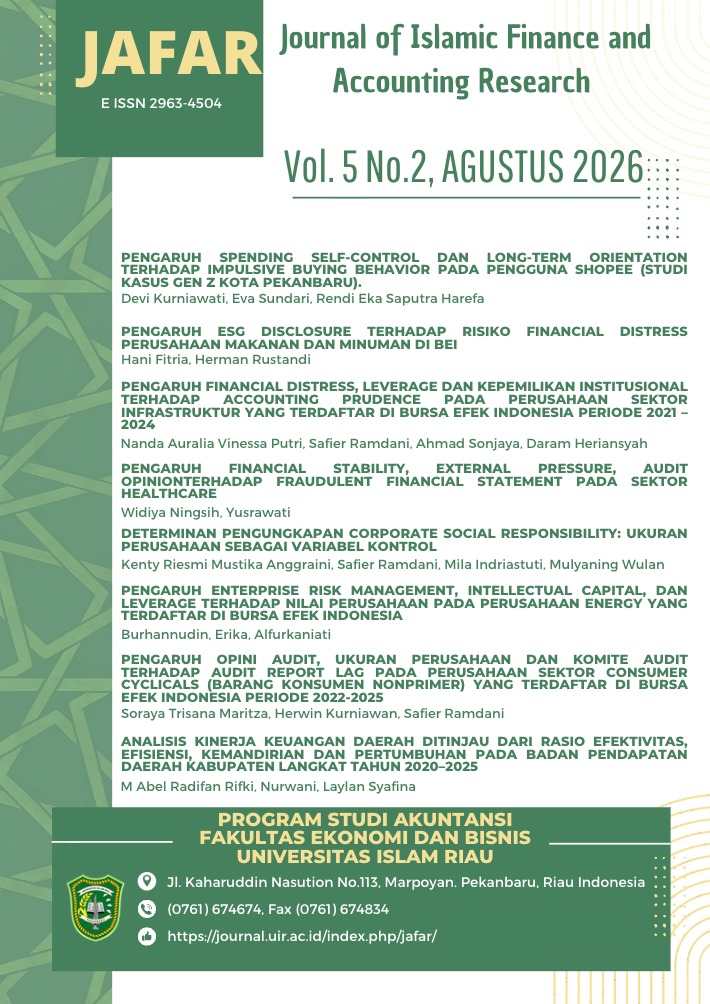
PENGARUH SPENDING SELF-CONTROL DAN LONG-TERM ORIENTATION TERHADAP IMPULSIVE BUYING BEHAVIOR PADA PENGGUNA SHOPEE (STUDI KASUS GEN Z KOTA PEKANBARU)
DOI:
https://doi.org/10.25299/jafar.2026.28033Keywords:
Spending self control, Long-term orientation, Impulsive buying behaviorAbstract
Penelitian ini bertujuan untuk mengetahui dan menganalisis pengaruh "Pengaruh Spending self-control dan Long-term orientation terhadap Impulsive buying behavior pada pengguna Shopee (Studi Kasus Gen Z Kota Pekanbaru). Jenis penelitian yang digunakan dalam penelitian ini adalah deskriptif kuantitatif. Populasi dalam penelitian ini adalah Gen Z Kota Pekanbaru yang pernah berbelanja di e-commerse Shopee. Sampel dalam penelitian sebanyak 138 orang Gen Z Kota Pekanbaru yang pernah berbelanja di e-commerse Shopee dimana penentuan sampel menggunakan rumus Hair dengan metode Purposive sampling. Data penelitian diolah menggunakan aplikasi SPSS Statistic 25. Meskipun Spending Self-Control dan Long-term Orientation secara konseptual merupakan mekanisme pengendalian terhadap perilaku konsumsi, dalam konteks pengguna Shopee kalangan Gen Z, pengaruh keduanya belum cukup kuat untuk menahan dorongan pembelian impulsif yang dipengaruhi oleh stimulus lingkungan digital.
Downloads
References
Bearden, W. O., Money, R. B., & Nevins, J. L. (2016). A measure of long-term orientation: Development and validation. Journal of Marketing Research. https://doi.org/10.1509/jmr.15.0451
Benartzi, S., & Thaler, R. H. (2017). Behavioral economics and the retirement savings crisis. Science, 339(6124), 1152–1153. https://doi.org/10.1126/science.1231320
Chen, T., Su, X., & Widjaja, A. E. (2019). Facebook C2C social commerce. Electronic Commerce Research and Applications. https://doi.org/10.1016/j.elerap.2019.100832
Dholakia, U. M. (2000). Temptation and resistance: An integrated model of consumption impulse formation and enactment. Psychology & Marketing, 17(11), 955–982.
Dholakia, U. M., & Morwitz, V. G. (2020). The influence of long-term orientation on consumer behavior. Journal of Retailing, 96(1), 19–32. https://doi.org/10.1016/j.jretai.2019.09.002
Gong, Y., Wang, M., Huang, J. C., & Cheung, S. Y. (2020). Toward a goal orientation-based feedback-seeking typology: Implications for employee performance outcomes. Journal of Applied Psychology. https://doi.org/10.1037/apl0000460
Haws, K. L., Bearden, W. O., & Nenkov, G. Y. (2021). Consumer spending self-control effectiveness and outcome elaboration prompts. Journal of the Academy of Marketing Science, 49(4), 835–862. https://doi.org/10.1007/s11747-020-00683-8
Hofmann, W., Reinecke, L., & Meier, A. (2017). Of sweet temptations and bitter aftertaste: Self-control as a moderator of the effects of media use on well-being. In L. Reinecke & M. B. Oliver (Eds.), The Routledge handbook of media use and well-being (pp. 211–222). Routledge.
Iyer, G. R., Blut, M., Xiao, S. H., & Grewal, D. (2020). Impulse buying: A meta-analytic review. Journal of the Academy of Marketing Science. https://doi.org/10.1007/s11747-019-00670-w
Lim, X. J., Cheah, J. H., Waller, D. S., & Ting, H. (2022). What influences impulse buying behavior in social commerce? The role of consumer emotions, social influence, and trust. Journal of Retailing and Consumer Services, 65, 102860.
Rook, D. W., & Fisher, R. J. (2021). Normative influences on impulsive buying behavior. Journal of Consumer Research, 48(4), 883–899. https://doi.org/10.1093/jcr/ucab031
Sharma, P., Sivakumaran, B., & Marshall, R. (2020). Exploring impulse buying. Journal of Business Research. https://doi.org/10.1016/j.jbusres.2019.02.021
Soman, D. (2001). Effects of payment mechanism on spending behavior. Journal of Consumer Research, 27(4), 460–474.
Stromback, C., Lind, T., Skagerlund, K., Vastfjall, D., & Tinghog, G. (2017). Does self-control predict financial behavior and financial well-being? Journal of Behavioral and Experimental Finance. https://doi.org/10.1016/j.jbef.2017.04.002
Sussman, A. B., & Alter, A. L. (2019). The exception is the rule: Underestimating and overspending on exceptional expenses. Journal of Consumer Research, 39. https://doi.org/10.1086/665833
Verplanken, B., & Herabadi, A. (2001). Individual differences in impulse buying tendency: Feeling and no thinking. European Journal of Personality, 15(S1), S71–S83.
Vohs, K. D., & Faber, R. J. (2007). Spent resources: Self-regulatory resource availability affects impulse buying. Journal of Consumer Research, 33(4), 537–547.
Wang, T., & Bansal, P. (2018). Social responsibility in new ventures: Profiting from a long-term orientation. Strategic Management Journal. https://doi.org/10.1002/smj.2718
Youn, S., & Faber, R. J. (2020). Impulse buying: The role of self-control and emotions. Journal of Consumer Marketing, 37(2), 1–12. https://doi.org/10.1108/JCM-05-2019-3170
Zhang, Y., Kong, F., & Wang, L. (2019). The role of future time perspective in financial behavior. Personality and Individual Differences. https://doi.org/10.1016/j.paid.2019.109503
Downloads
Published
How to Cite
Issue
Section
License
Copyright (c) 2026 Devi Kurniawati, Eva Sundari, Rendi Eka Saputra Harefa

This work is licensed under a Creative Commons Attribution 4.0 International License.