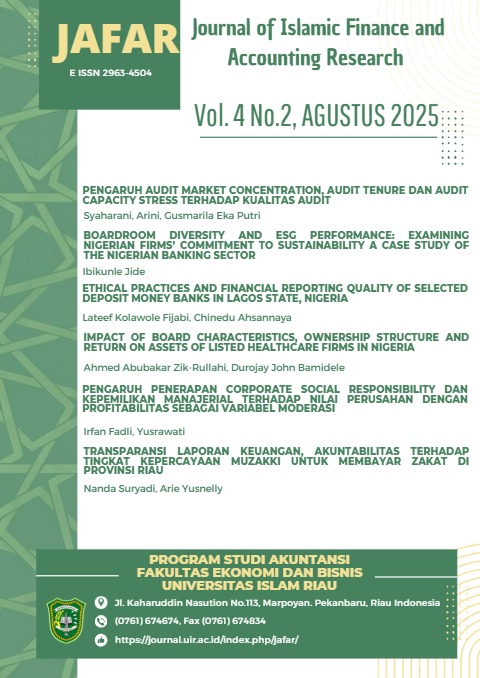
BOARDROOM DIVERSITY AND ESG PERFORMANCE: EXAMINING NIGERIAN FIRMS’ COMMITMENT TO SUSTAINABILITY A CASE STUDY OF THE NIGERIAN BANKING SECTOR
DOI:
https://doi.org/10.25299/jafar.2025.23727Keywords:
Corporate Governance, Boardroom Diversity, ESG Performance, Sustainability Reporting, Nigerian Banking SectorAbstract
Environmental, Social, and Governance (ESG) considerations have become central to corporate governance, financial sustainability, and long-term business success. As global investors and regulators emphasize sustainable business practices, companies are increasingly required to integrate ESG principles into their corporate strategies and financial disclosures. This study examined the impact of boardroom diversity on ESG performance in Nigerian banks, focusing on gender diversity, board size, independent directors, board tenure, and educational background. Using secondary data from annual reports and sustainability disclosures of five top-tier commercial banks between 2017 and 2023, this study evaluated the relationship between board composition and ESG outcomes. The findings indicated that while boardroom diversity is an essential governance mechanism, its direct effect on ESG performance is statistically weak. Gender diversity showed a positive but insignificant impact on ESG scores, while board size and the proportion of independent directors exhibited negative relationships. Board tenure, although positively associated with ESG performance, lacked statistical significance. These results suggested that beyond demographic diversity, board effectiveness in driving ESG integration depends on regulatory enforcement, corporate policies, and sustainability expertise.
Downloads
References
Adams, R. B., & Ferreira, D. (2009). Women in the boardroom and their impact on governance and performance. Journal of Financial Economics, 94(2), 291-309. https://doi.org/10.1016/j.jfineco.2008.10.007
Arayssi, M., Dah, M., & Jizi, M. (2016). Women on boards, sustainability reporting, and firm performance. Sustainability Accounting, Management and Policy Journal, 7(3), 376-401. https://doi.org/10.1108/SAMPJ-07-2015-0055
Bear, S., Rahman, N., & Post, C. (2010). The impact of board diversity and gender composition on corporate social responsibility and firm reputation. Journal of Business Ethics. https://doi.org/10.1007/s10551-010-0505-2
Byron, K., & Post, C. (2019). Women on boards and firm performance: A meta-analysis. Academy of Management Journal, 58(5), 1546-1571. https://doi.org/10.5465/amj.2013.0319
Central Bank of Nigeria (CBN). (2020). Code of Corporate Governance for Banks and Discount Houses in Nigeria. Abuja, Nigeria.
Central Bank of Nigeria (CBN). (2021). Guidelines on sustainable banking principles in Nigeria. Abuja, Nigeria.
Cheng, S. (2008). Board size and the variability of corporate performance. Journal of Financial Economics, 87(1), 157-176. https://doi.org/10.1016/j.jfineco.2006.10.006
Donaldson, T., & Preston, L. E. (1995). The stakeholder theory of the corporation: Concepts, evidence, and implications. Academy of Management Review, 20(1), 65-91. https://doi.org/10.5465/amr.1995.9503271992
Friede, G., Busch, T., & Bassen, A. (2019). ESG and financial performance: Aggregated evidence from more than 2,000 empirical studies. Journal of Sustainable Finance & Investment, 5(4), 210-233. https://doi.org/10.1080/20430795.2015.1118917
García‐Sánchez, I. M., Martínez‐Ferrero, J., & García‐Benau, M. A. (2019). Board of directors and CSR: The effect of diversity and independence on firms’ social performance. Corporate Social Responsibility and Environmental Management, 26(4), 717-727. https://doi.org/10.1002/csr.1655.
Giese, G., Lee, L. E., Melas, D., Nagy, Z., & Nishikawa, L. (2021). Foundations of ESG investing: How ESG affects equity valuation, risk, and performance. The Journal of Portfolio Management, 45(5), 69-83.
Grewal, J., Hauptmann, C., & Serafeim, G. (2020). Material sustainability information and stock price informativeness. Journal of Business Ethics, 161(2), 409-432.
Hillman, A. J., Cannella, A. A., & Paetzold, R. L. (2000). The resource dependence role of corporate directors: Strategic adaptation of board composition in response to environmental change. Journal of Management Studies, 37(2), 235-255. https://doi.org/10.1111/1467-6486.00179
Jizi, M. I., Salama, A., Dixon, R., & Stratling, R. (2014). Corporate governance and corporate social responsibility disclosure: Evidence from the US banking sector. Journal of Business Ethics, 125(4), 601-615.
Reyes, R. (2024). Three steps to tackling the green skills gap in the boardroom. Reuters. Retrieved from https://www.reuters.com/sustainability/boards-policy-regulation/comment-three-steps-tackling-green-skills-gap-boardroom-2024-10-23/
Downloads
Published
How to Cite
Issue
Section
License
Copyright (c) 2025 Ibikunle Jide

This work is licensed under a Creative Commons Attribution 4.0 International License.