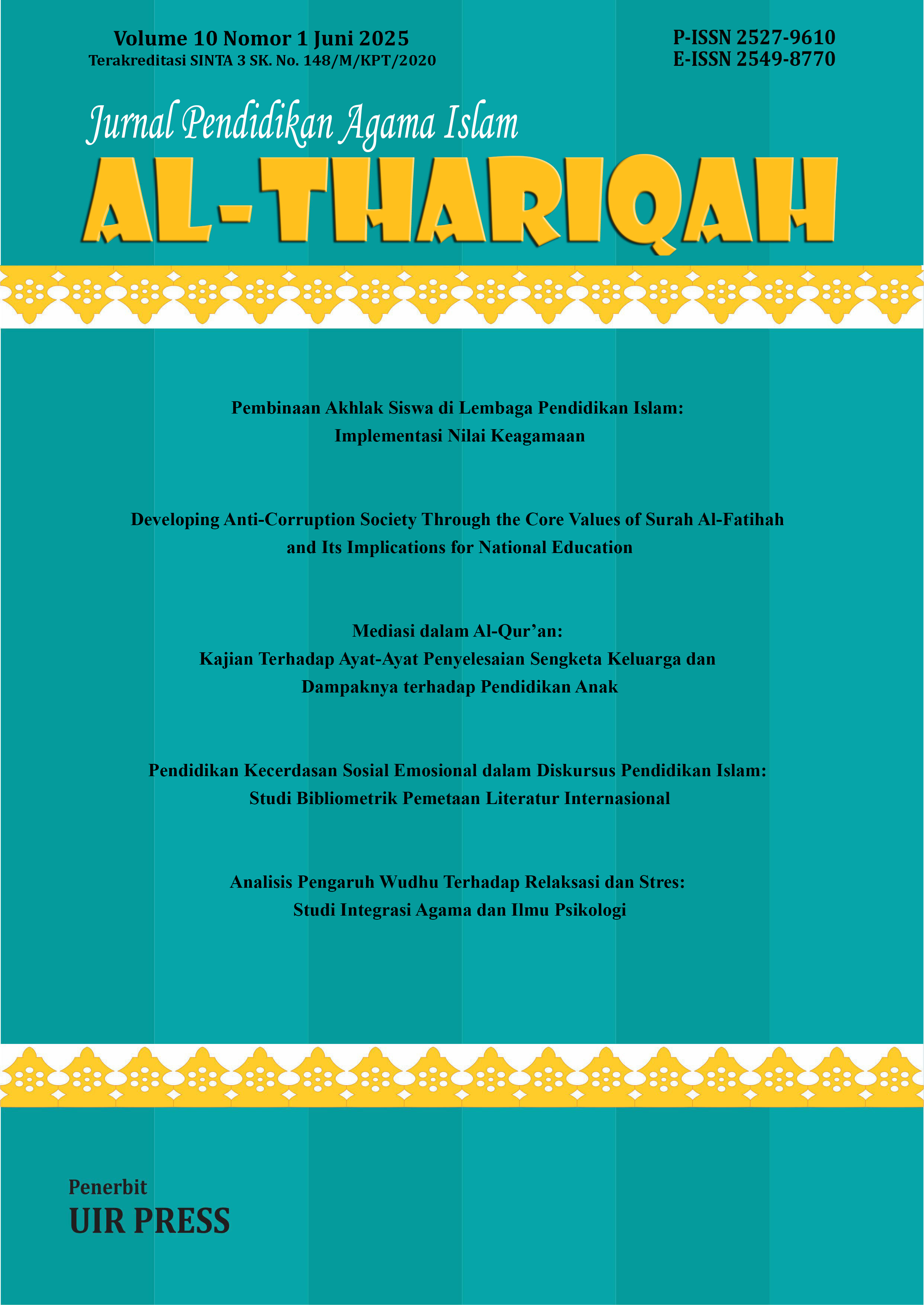
Pendidikan Kecerdasan Sosial Emosional dalam Diskursus Pendidikan Islam: Studi Bibliometrik Pemetaan Literatur Internasional
DOI:
https://doi.org/10.25299/althariqah.2025.vol10(1).22854Keywords:
Social and Emotional Intelligence, Literature Mapping, Emotional Education, Scopus, Bibliometric Studies, Research TrendsAbstract
This study examines the lack of attention to social and emotional learning (SEL) education. The aim of this research is to analyze trends, sources, and themes of scientific publications regarding SEL in the period from 2015 to 2025, as well as to provide recommendations for future research. The method applied is quantitative bibliometrics, which involves an analysis of 200 publications from the Scopus database using tools such as Publish or Perish, VOSviewer, and Microsoft Word. The analysis results show that the topics of social and emotional learning (SEL) experienced an increase peaking in 2019-2020, but significantly declined until 2025. Emotional Intelligence (EI) emerged as a main theme, particularly in terms of its impact on individuals and social relationships. However, the integration of EI with social intelligence, digital literacy, and practical interventions is still very limited. The conclusion of this study shows that EI has not been fully explored, thus further development of more comprehensive, practical, and contextual studies is needed
Downloads
References
Ali Anhar Syi’bul Huda, Hamdi, Muhammad Noor Ridani, Abid Nurhuda. “Reorientasi Dikotomis Ilmu Agama Dan Umum Melalui Pendekatan Analisis Bibliometrik.” Kamaya: Jurnal Ilmu Agama, vol. 7, 2024, pp. 155–68, https://jayapanguspress.penerbit.org/index.php/kamaya 155.
Anhar, Ali, et al. “Diskursus Deep Learning Curriculum Dan Pengembangan Isunya Di Masa Depan Melalui Tinjauan Analisis Bibliometrik.” Al Washliyah: Jurnal Penelitian Sosial Dan Humaniora, vol. 3, no. 1, 2025, pp. 1–17.
Barlas, Natasha Sohail, et al. “Can Social-Emotional Learning Programs Be Adapted to Schools in Pakistan? A Literature Review.” International Journal of School and Educational Psychology, vol. 10, no. 1, 2022, pp. 155–69, https://doi.org/10.1080/21683603.2020.1850374.
Bellido-García, Roberto, et al. “Educational Revolution: Bibliometric Analysis of the Advancement of Artificial Intelligence in Education.” International Journal of Engineering Trends and Technology, vol. 72, no. 6, 2024, pp. 409–20, https://doi.org/10.14445/22315381/IJETT-V72I6P136.
Bisquerra Alzina, Rafael, andÈliaLópez-Cassà. “The Intelligent Cultivation of Moral Emotions in Adolescence.” Revista Espanola de Pedagogia, vol. 79, no. 278, 2021, pp. 103–13, https://doi.org/10.22550/REP79-1-2021-09.
Blewitt, Claire, et al. “Social and Emotional Learning Associated With Universal Curriculum-Based Interventions in Early Childhood Education and Care Centers: A Systematic Review and Meta-Analysis.” JAMA Network Open, vol. 1, no. 8, 2018, p. e185727, https://doi.org/10.1001/jamanetworkopen.2018.5727.
Butvilas, Tomas, and Kristina Kovaitė. “The Expression of Socio-Emotional Competence among Younger Lithuanian Adolescents as the Precondition for Their Creativity.” Creativity Studies, vol. 15, no. 2, 2022, pp. 497–510, https://doi.org/10.3846/cs.2022.16630.
Cavioni, Valeria, et al. “Bridging the SEL CASEL Framework with European Educational Policies and Assessment Approaches.” International Journal of Emotional Education, vol. 16, no. 1, 2024, pp. 6–25, https://doi.org/10.56300/ULTX1565.
Dombrovskis, Valerijs, et al. “Intervention in Teaching as a Means for Developing Emotional Intelligence and Positive Thinking in 1st-Year Students in Teacher Education Programmes.” Environment and Social Psychology, vol. 9, no. 9, 2024, p. 59429, https://doi.org/10.59429/esp.v9i9.2790.
Dursun, Asiye. “Bibliometric Analysis of Postgraduate Theses on Religious Coping in Turkiye and Its Relationship With Psychological Variables.” Current Perspectives in Social Sciences, vol. 28, no. 2, 2024, pp. 258–70, https://doi.org/10.53487/atasobed.1416458.
Firdaus, Firdaus, et al. “The Accuracy of Developing Professional Madrasah Teachers: Seen from Gender and Teacher Certification in the Future Profession”. Journal of Instruction and Islamic Religious Education, vol. 1, no. 1, Mar. 2025, pp. 15-28, https://doi.org/10.63826/jiire.v1i1.3.
Hamdi, Santiani, Jasiah, Ali Anhar Syi’bul Huda, Mualimin. “Research Trends and Gaps in Learning Environment Characteristics in Communities : A Bibliometric Analysis.” J-PAI : Jurnal Pendidikan Agama Islam, vol. 11, no. 1, 2024, pp. 58–72.
Hamdi , Setria Utama Rizal, Nurul Hikmah, Muhammad Syabrina, Sulistyowati, andMualimin. “Development of Digital-Based Islamic Education Teaching Modules on Duha Prayer Material in Elementary Schools.” Jurnal Pendidikan Agama Islam, vol. 21, no. 1, 2024, pp. 132–46, https://doi.org/Doi: https://doi.org/10.14421/jpai.v21i1.7520.
Hamdi, Hamdi, et al. “The Existence of the Development of Islamic Education Management in Madrasas : Actualization of Principles and Values of Hadith Perspectives in the Contemporary Era.” Al-Thariqah, vol. 9, no. 2, 2024, https://doi.org/10.25299/al-thariqah.2024.vol9(2).19623.
Harianto, Eko. “Publication Trends of Journal Articles About Religious Moderation in Recent Years: Bibliometric Analysis.” Islamic Review Jurnal Riset Dan Kajian Keislaman, vol. 11, no. 2, 2022, pp. 125–38, https://doi.org/10.35878/islamicreview.v11i2.375.
Herdianto, Roni, et al. “Filsafat Pendidikan Dan Perkembangannya: Kajian Bibliometrik Berdasarkan Database Scopus.” Belantika Pendidikan, vol. 4, no. 1, 2021, pp. 44–56, https://doi.org/10.47213/bp.v4i2.101.
Ida, Merlin J., andS.Prabakar. “Emotional Intelligence and Social Interaction – A Bibliometric Analysis.” International Research Journal of Multidisciplinary Scope, vol. 5, no. 2, 2024, pp. 224–31, https://doi.org/10.47857/irjms.2024.v05i02.0412.
Iriyani, S. A., Patty, E. N. S., Rahim, A., Awaliyah, M., Refitaningsih, R., & Ria, P. “Tren Manajemen Pendidikan: Analisis Bibliometrik Menggunakan Aplikasi Vosviewer. Edu Cendikia: Jurnal Ilmiah Kependidikan.” Edu Cendikia: Jurnal Ilmiah Kependidikan, vol. 3, no. 01, 2023, pp. 93–100, https://doi.org/https://doi.org/10.47709.
Jaelani, Abdul Qadir, and Lailul Ilham. “Strategi Meningkatkan Kecerdasan Emosional Dan Spiritual Siswa.” Komunika Jurnal Dakwah Dan Komunikasi, vol. 13, no. 1, 2019, pp. 97–106, https://doi.org/10.24090/komunika.v13i1.2056.
Li, Zan, et al. “Emotional Intelligence of Educators: A Bibliometric Review, 1998–2024.” Social Psychology of Education, vol. 28, no. 1, 2025, p. 11218, https://doi.org/10.1007/s11218-025-10048-2.
Maxwell, Bruce, and Joanna Peplak. “Developing Emotional Intelligence in Social and Emotional Learning.” The Oxford Handbook of Emotional Development, no. May, 2022, pp. 463–74, https://doi.org/10.1093/oxfordhb/9780198855903.013.39.
---. “Developing Emotional Intelligence in Social and Emotional Learning.” The Oxford Handbook of Emotional Development, 2022, pp. 463–74, https://doi.org/10.1093/oxfordhb/9780198855903.013.39.
Mones, Anselmus Yata, and Cresensius Paulus Boli Toba. “Pengaruh Pendidikan Karakter Terhadap Kecerdasan Emosional Remaja Kelas XI Di SMA Negeri 1 Malaka Barat Besikama.” Jurnal Penelitian Pendidikan Agama Katolik, vol. 1, no. 1, 2021, pp. 110–24, https://doi.org/10.52110/jppak.v1i1.5.
Muhajir, Muhajir, et al. "Islamic ethics, identity processes, and project-based learning method for madrasah teachers: A phenomenological approach." Journal of Instruction and Islamic Religious Education 1.1 (2025): 1-13. https://doi.org/10.63826/jiire.v1i1.2
Namora, Dian, et al. “Islamic Education Narratives from the Turkistan Plain: Discovering the Heritage of Al-Zarnuji’s Thoughts on Islamic Professional Teachers”. Journal of Instruction and Islamic Religious Education, vol. 1, no. 1, Mar. 2025, pp. 57-69, https://doi.org/10.63826/jiire.v1i1.6.
Nurhafizah, and Hasan Syahrizal. “Dampak Peran Orangtua Dan Pembelajaran Daring Pada Kecerdasan Sosial Emosional Anak Usia 5-6 Tahun.” Jurnal Dzurriyat Jurnal Pendidikan Islam Anak Usia Dini, vol. 1, no. 1, 2023, pp. 55–66, https://doi.org/10.61104/jd.v1i1.24.
Pauji, I., Kusharyadi, R., & Khotimi, A. Z. “Analisis Bibliometrik: Tren Riset Epistemological Obstacle Dari Tahun 2000-2022.” JPMI (Jurnal Pembelajaran Matematika Inovatif), vol. 6, no. 3, 2023, pp. 1099–1112, https://doi.org/https://doi.org/10.22460/JPMI.V6I3.
Rahman, Syahrir, and Nomahaza Mahadi. “Visualising Emotional Intelligence Global Research Trends Using Bibliometric Analysis.” Journal of Sustainability Science and Management, vol. 19, no. 6, 2024, pp. 200–19, https://doi.org/10.46754/jssm.2024.06.014.
Riza, Fahru, and Yoto Yoto. “Membangun Kecerdasan Emosional Siswa SMK Untuk Menjawab Tantangan Industri Modern.” Briliant Jurnal Riset Dan Konseptual, vol. 8, no. 4, 2023, p. 940, https://doi.org/10.28926/briliant.v8i4.1643.
Rasyidi, Rasyidi, et al. “Inquiry-Based Learning Method: Is It Effective in Improving Madrasah Teacher Social Competence in Student-Centered Learning”. Journal of Instruction and Islamic Religious Education, vol. 1, no. 1, Mar. 2025, pp. 29-44, https://doi.org/10.63826/jiire.v1i1.4.
Sari, Nur Indah, Santiani. “Analisis Bibliometrik Penerapan Media Flash Card Pada Materi Pendidikan Agama Islam Dengan Menggunakan Aplikasi VOS Viewer Dan Publish Or Perish.” Jurnal Intelek Dan Cendikiawan Nusantara, 2024, pp. 3036–44, https://jicnusantara.com/index.php/jicn/article/view/332%0Ahttps://jicnusantara.com/index.php/jicn/article/download/332/391.
Seda Koç, E. “Analysis of Some of the Primary Education Curricula in Terms of International Social and Emotional Skills.” Turkish Online Journal of Qualitative Inquiry, vol. 11, no. 4, 2020, pp. 481–510, https://doi.org/10.17569/tojqi.723172.
Situngkir, Ledyana Dwi Mei, et al. “Analisis Kecerdasan Emosi Di Kalangan Kepala Sekolah: Efek Jenis Kelamin Dan Pengalaman Kepemimpinan.” Jurnal Pendidikan Dan Pembelajaran Indonesia (Jppi), vol. 4, no. 3, 2024, pp. 943–50, https://doi.org/10.53299/jppi.v4i3.673.
Soland, James, et al. “Examining the State-Trait Composition of Social-Emotional Learning Constructs: Implications for Practice, Policy, and Evaluation.” Journal of Research on Educational Effectiveness, vol. 12, no. 3, 2019, pp. 550–77, https://doi.org/10.1080/19345747.2019.1615158.
Solih, Mohamed, et al. “Research Trends and Patterns on Emotional Intelligence in Education: A Bibliometric and Knowledge Mapping During 2012-2021.” Open Education Studies, vol. 6, no. 1, 2024, p. 2025, https://doi.org/10.1515/edu-2024-0025.
Sukenti, Desi, and Syahraini Tambak. "Islamic Teacher's Ethical Behavior, Identity Formation, and Writing Assessment: A Phenomenological Inquiry." AL-ISHLAH: Jurnal Pendidikan15.4 (2023): 4943-4952. https://doi.org/10.35445/alishlah.v15i4.4570
Suryati, Nanik, and Mohammad Salehudin. “Program Bimbingan Dan Konseling Untuk Mengembangkan Kecerdasan Spiritual Dan Emosional Siswa.” Edukatif Jurnal Ilmu Pendidikan, vol. 3, no. 2, 2021, pp. 578–88, https://doi.org/10.31004/edukatif.v3i2.349.
Tambak, Syahraini, and Desi Sukenti. "Case-Based Learning Method in Learning: Is it Effective to Improve Teaching Skills of Madrasa Teachers in Indonesia?." Journal of Learning for Development 11.1 (2024): 151-164. https://doi.org/10.56059/jl4d.v11i1.763
Tambak, Syahraini, et al. "Development of Madrasah Teacher Leadership Competency: Involving Project-Based Learning Methods in Students-Centered Learning." Pegem Journal of Education and Instruction 14.3 (2024): 243-255. https://doi.org/10.47750/pegegog.14.03.23
Tambak, Syahraini, and Desi Sukenti. "Student Involvement Within Islamic Teacher Education: For a Future Profession." QIJIS (Qudus International Journal of Islamic Studies) 11.2 (2024): 317-352. http://dx.doi.org/10.21043/qijis.v11i2.8141
Tambak, Syahraini, and Desi Sukenti. "Strengthening Islamic behavior and Islamic psychosocial in developing professional madrasah teachers." Cakrawala Pendidikan: Jurnal Ilmiah Pendidikan 39.1 (2020): 65-78. doi:10.21831/cp.v39i1.26001
Tambak, Syahraini, Hamzah Hamzah, Desi Sukenti, and Mashitha Sabdin, "Internalization of Islamic Values in Developing Students' Actual Morals." JPI (Jurnal Pendidikan Indonesia) 10.4 (2021): 697-709. http://dx.doi.org/10.23887/jpi-undiksha.v10i4.30328
Tambak, S., et al. “Discussion method accuracy in Islamic higher education: The influence of gender and teaching duration." Cakrawala Pendidikan: Jurnal Ilmiah Pendidikan 41.2 (2022): 507-520. https://doi.org/10.21831/cp.v41i2.40644
Vera, Elizabeth M. “Social Emotional Learning and Cultural Relevancy: Real World Challenges.” Preventing School Failure, vol. 67, no. 4, 2023, pp. 233–45, https://doi.org/10.1080/1045988X.2022.2109565.
Wang, Dong, and JingQin. “Research Development of Teachers’ Emotional Intelligence in the 21st Century: A Bibliometric Analysis.” Acta Psychologica, vol. 257, 2025, p. 105067, https://doi.org/10.1016/j.actpsy.2025.105067.
Wu, Yi-Chia, and Michael S.Minor. “The Brand Relationship of Cult-Like Following: Developing Scales of Measurement in Apple and Catholic Devotees.” Emaj Emerging Markets Journal, vol. 9, no. 2, 2020, pp. 27–36, https://doi.org/10.5195/emaj.2019.185.
Yasin, Muhammad Muthi’ul Haqq bin Fatah, et al. “Wahdah Method for Madrasah Teacher Professionalism: Is It Effective for Improving Al-Qur’an Reading Skill?”. Journal of Instruction and Islamic Religious Education, vol. 1, no. 1, Mar. 2025, pp. 45-55, https://doi.org/10.63826/jiire.v1i1.5.
Additional Files
Published
How to Cite
Issue
Section
License
Copyright (c) 2025 Hamdi Hamdi, Taufik Warman Mahfuzh, Akhmad Supriadi, Ali Anhar Syi’bul Huda

This work is licensed under a Creative Commons Attribution-ShareAlike 4.0 International License.