The Characteristics of Andesite and Sandstone as Aggregate Substitution in Concrete Mixtures
Keywords:
Characteristic, Andesite, Sandstone, Aggregate, ConcreteAbstract
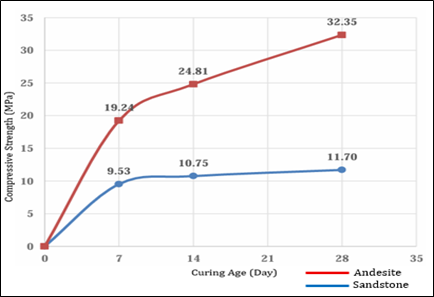
Aggregates make up the biggest part of concrete. The use of locally available aggregate in concrete production can reduce transportation distance and potentially minimize the carbon footprint. The objective of this study is to analyze local aggregates is andesite and sandstone that from a region in Riau. The method of research is an experiment in laboratory for identitication of the chemical composition, abrasion resistance testing, and concrete compressive strength testing with these local aggregates. Concrete samples were made with a target strength of 30 MPa and tested after 7, 14, and 28 days of curing. The results showed that the higher chemical content of SiO2 for andesite aggregate is a 44,66 % and for sandstone aggregate is 64.63%. The abrasion resistance for andesite aggregate is a 12,40% and sandstone aggregate is 66.00%, indicating that the andesite aggregate meets spesification is a level below 40%. Meanwhile, the concrete compressive strengths of 32.35 MPa after 28 days of curing for andesite aggregate and 11.70 MPa for sandstone aggregate indicate that the andesite aggregate achieved the expected compressive strength of 30 MPa. Research indicates that while sandstone has a higher SiO2 than andesite, it yields lower abrasion resistance and concrete compressive strength than andesite aggregate. This reinforce the fact that high SiO2 content does not directly guarantee increased concrete compressive strength. Rather, abrasion values and mechanical characteristics of the aggregate must be considered collectively. Local andesite aggregate is suitable for structural concrete mixes, whereas sandstone aggregate is appropriate for non-structural applications.
Downloads
References
Abdurrokhim, Adhiperdana, B., & Hendarmawan. (2022). Temporal variation in sandstone composition of Miocene Jatiluhur Formation in the Bogor Trough, West Java, Indonesia. Journal of Geoscience, Engineering, Environment, and Technology, 7(3), 132–139.
Abidin, I. S., Siswandi, & Gibran, A. K. (2024). Mineralogical and Geochemical Clay Analysis for Portland Cement Quality Distribution: A Study Case From Ajibarang District, Central Java, Indonesia. Journal of Geoscience, Engineering, Environment, and Technology, 9(04), 461–469.
Amin, M., Supriyatna, Y. I., & Sumardi, S. (2018). The material from Lampung as coarse aggregate to substitute andesite for concrete-making. IOP Conference Series: Materials Science and Engineering, 285(1).
Ariawan, I. M. A., Wedagama, D. M. P., Elizar, Genta Putra, K. A., & I Putu Chandra Wibawa. (2024). Mechanistic Characteristics of HRS-WC Mixture Using Tabas Stone Waste Coated With Plastic Waste As Aggregate. Journal of Geoscience, Engineering, Environment, and Technology, 9(3), 363–371.
Asadi, M., TaghaviGhalesari, A., & Kumar, S. (2022). Machine learning techniques for estimation of Los Angeles abrasion value of rock aggregates. European Journal of Environmental and Civil Engineering, 26(3), 964–977.
Bahrami, K., Fatemi Aghda, S. M., Noorzad, A., & Talkhablou, M. (2019). Investigation of Abrasion and Impact Resistance of Aggregates in Different Environments in Direh, Kermanshah, Iran. Geotechnical and Geological Engineering, 37(3), 2015–2028.
Basu, P., Thomas, B. S., Gupta, R. C., & Agrawal, V. (2021). Properties of sustainable self-compacting concrete incorporating discarded sandstone slurry. Journal of Cleaner Production, 281, 125313.
Cheshomi, A., Moradizadeh, M., & Fizollahi, S. (2020). Impact of Petrography and Hardness of Sandstone Minerals on the Wear of Mini Disk Cutters through Rolling Indentation Abrasion Test (RIAT). Rock Mechanics and Rock Engineering, 53(12), 5593–5616.
Czinder, B., & Török, Á. (1983). Strength and abrasive properties of andesite: relationships between strength parameters measured on cylindrical test specimens and micro-Deval values-a tool for durability assessment.
Czinder, B., & Török, Á. (2021). Strength and abrasive properties of andesite: relationships between strength parameters measured on cylindrical test specimens and micro-Deval values—a tool for durability assessment. Bulletin of Engineering Geology and the Environment, 80(12), 8871–8889.
Davidovits, J., Huaman, L., & Davidovits, R. (2019). Ancient organo-mineral geopolymer in South-American Monuments: Organic matter in andesite stone. SEM and petrographic evidence. Ceramics International, 45(6), 7385–7389.
Elsheikh, M. Y., Elshami, A. A., & Mohsen, I. A. (2020). Green Concrete Utilizing Andesite and Rhyolite Aggregate. International Journal of Civil Engineering and Technology (Ijciet), 11(7).
Fauzi, Hakim, L., & Van Castro Siregar, D. D. (2020). Making and characterization of polymer concrete with aggregate from sand, pumice and bagasse fiber waste with bending processes resin epoxy. AIP Conference Proceedings, 2221.
Handayani, A. F., Rosyidah, D. H., Sulaksitaningrum, R., Susanto, P. B., & Umniati, S. (2023). Andesite waste powder as mineral admixture in concrete: A Review. E3S Web of Conferences, 445.
Harmiyati, Al Ihsyan, N., & Syahputri, D. (2024). Analysis of the Effect of Bagasse Addition on Compressive Strength, Porosity, and Permeability of Pervious Concrete as Material for Green Building Program. Journal of Geoscience, Engineering, Environment, and Technology, 9(04), 420–425.
Jahed Armaghani, D., Mohd Amin, M. F., Yagiz, S., Faradonbeh, R. S., & Abdullah, R. A. (2016). Prediction of the uniaxial compressive strength of sandstone using various modeling techniques. International Journal of Rock Mechanics and Mining Sciences, 85, 174–186.
Janardan, A., Verma, S., Choudhari, P., & Scholar, R. (2024). EFFECT OF NANO SILICA ON THE COMPRESSIVE STRENGTH OF CONCRETE. In International Journal of Creative Research Thoughts (Vol. 12, Number 1).
Java, W., Shah, I. B., Muslim, D., & Sophian, R. I. (2026). Influence of Weathering On The Mechanical Strength and Factor of Safety of Andesitic Rocks In the Gunung Geulis Area. Journal of Geoscience, Engineering, Environment, and Technology, 11(2).
Kakasor Ismael Jaf, D., Abdulrahman, A. S., Abdulrahman, P. I., Salih Mohammed, A., Kurda, R., Ahmed, H. U., & Faraj, R. H. (2023). Effitioned soft computing models to evaluate the impact of silicon dioxide (SiO2) to calcium oxide (CaO) ratio in fly ash on the compressive strength of concrete. Journal of Building Engineering, 74.
Kurniasih, A., Wicitra, A. P., Qadaryati, N., Khorniawan, W. B., Dalimunthe, H. L., Setyawan, R., Galih, A., & Jayanti, R. (2026). Relative Age and Depositional Environment of The Limestone Unit of Karangsambung Formation in Jatibungkus Hill, Kebumen Geopark, Indonesia. Journal of Geoscience, Engineering, Environment, and Technology, 11(2).
Kurniawandy, A., Ismeddiyanto, Haekal, M., & Zikri, R. (2025). Study of the Mechanical Properties of Underwater Concrete in Seawater Environments. Journal of Geoscience, Engineering, Environment, and Technology, 10(1), 51–58.
López, A., Mayacela, M., Chérrez, D., Aldas, E., & Contreras, L. F. (2023). Comparison of Physical and Mechanical Properties of Stone Aggregates and Their Use in the Structure of a Flexible Pavement, from Mines in Ecuador. Buildings, 13(7).
Melati, S. (2019). Studi Karakteristik Relasi Parameter Sifat Fisik Dan Kuat Tekan Uniaksial Pada Contoh Batulempung, Andesit, Dan Beton. Jurnal GEOSAPTA, 5(2), 133.
Mundra, S., Agrawal, V., & Nagar, R. (2020). Sandstone cutting waste as partial replacement of fine aggregates in concrete: A mechanical strength perspective. Journal of Building Engineering, 32.
Naderi, M., & Kaboudan, A. (2021). Experimental study of the effect of aggregate type on concrete strength and permeability. Journal of Building Engineering, 37, 101928.
Palassi, M., & Danesh, A. (2016). Relationships Between Abrasion/Degradation of Aggregate Evaluated from Various Tests and the Effect of Saturation. Rock Mechanics and Rock Engineering, 49(7), 2937–2943.
Ren, J., & Yin, C. (2022a). Investigating mechanical characteristics of aggregate structure for road materials. International Journal of Pavement Engineering, 23(2), 372–386.
Ren, J., & Yin, C. (2022b). Investigating mechanical characteristics of aggregate structure for road materials. International Journal of Pavement Engineering, 23(2), 372–386.
Renaldi, R., & Botjing, M. U. (2023). Daerah Buluri Kota Palu Geological Study and Physical Properties Tests of Andesite Rocks in the Buluri Area , Palu City. Bomba - Jurnal Pembangunan Daerah, (1), 35–42.
Umar, T., Egbu, C., & Saidani, M. (2020). A Modified Method for Los Angeles Abrasion Test. Iranian Journal of Science and Technology - Transactions of Civil Engineering, 44(3), 941–947.
Usman, D. N., Sukarsih, I., Permanasari, Y., Mildani, D., Widayati, S., Nuryahya, H., Pulungan, L., & Ramadhani, R. N. (2023). Analysis of Disaster Vulnerability Areas in West Bandung Regency, West Java, Indonesia. Journal of Geoscience, Engineering, Environment, and Technology, 8(4), 305–311.
Winarno, T., Marin, J., & Jati, W. W. (2020). Effect of Porphyritic Andesite Intrusion on The Formation of Contact Metamorphism Aureole in Selo Gajah Hill Clastic Limestone, Bojonegoro Regency, East Java, Indonesia. Journal of Geoscience, Engineering, Environment, and Technology, 5(2).
Yang, F., Li, H., Zhao, G., Guo, P., Li, W., & Yang, X. (2020). Mechanical Performance and Durability Evaluation of Sandstone Concrete. Advances in Materials Science and Engineering, 2020.
Downloads
Published
Issue
Section
License
Copyright (c) 2026 Journal of Geoscience, Engineering, Environment, and Technology

This work is licensed under a Creative Commons Attribution-ShareAlike 4.0 International License.
Copyright @2019. This is an open-access article distributed under the terms of the Creative Commons Attribution-ShareAlike 4.0 International License which permits unrestricted use, distribution, and reproduction in any medium. Copyrights of all materials published in JGEET are freely available without charge to users or / institution. Users are allowed to read, download, copy, distribute, search, or link to full-text articles in this journal without asking by giving appropriate credit, provide a link to the license, and indicate if changes were made. All of the remix, transform, or build upon the material must distribute the contributions under the same license as the original.