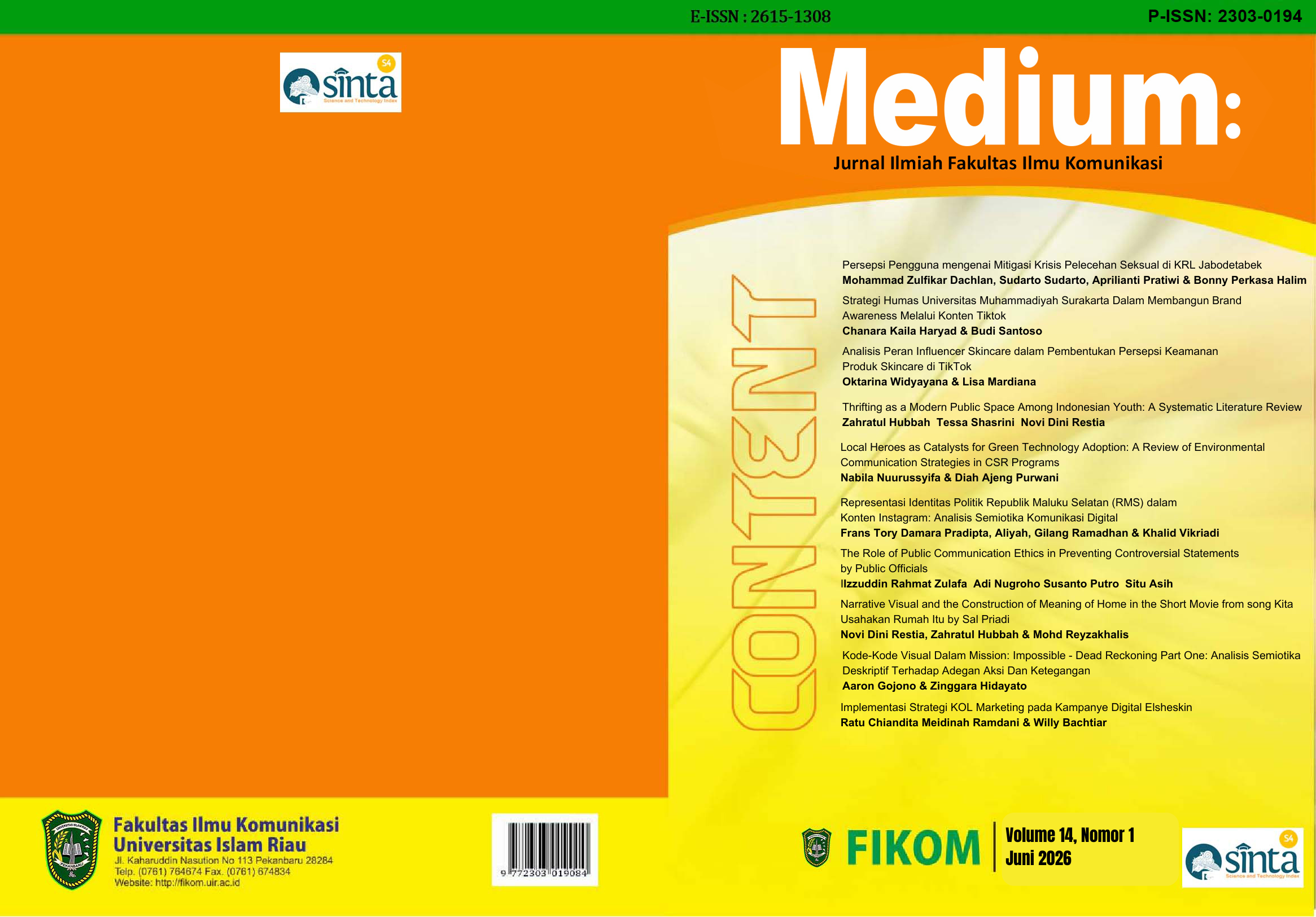
Kode-Kode Visual Dalam Mission: Impossible - Dead Reckoning Part One: Analisis Semiotika Deskriptif Terhadap Adegan Aksi Dan Ketegangan
DOI:
https://doi.org/10.25299/medium.v14i1.27332Keywords:
John Fiske’s semiotics, visual codes, action film, Mission: Impossible, ideologyAbstract
This study examines the visual codes in the film Mission: Impossible - Dead Reckoning Part One (2023) through John Fiske’s semiotic approach. As a spy-action film filled with high-intensity sequences, the movie presents a variety of visual signs that construct the audience’s cinematic experience. The analysis focuses on Fiske’s three levels of codes: reality, representation, and ideology complemented by verbal codes as supporting elements. Using a qualitative method with descriptive semiotic analysis, this research investigates film texts, including action scenes, dialogues, cinematography, lighting, and visual symbolism. The findings are expected to reveal how visual elements function not merely as aesthetic entertainment but also as tools for constructing ideological meanings related to heroism, technological domination, and global surveillance. The novelty of this research lies in its emphasis on visual codes within action films, an area often overlooked, thereby contributing to film and visual communication studies and providing valuable insights for filmmakers in designing meaningful action sequences.
Downloads
References
Barker, C. (2012). Cultural studies: Theory and practice. SAGE Publications.
Barthes, R. (2007). Mythologies. Hill and Wang.
Bordwell, D., & Thompson, K. (2010). Film art: An introduction (9th ed.). McGraw-Hill.
Booker, M. (2019). Historical dictionary of American cinema. Rowman & Littlefield.
Bourdieu, P. (1991). Language and symbolic power. Harvard University Press.
Caivano, J. L. (1998). Color and semiotics: A two-way street. Color Research & Application, 23(6), 390–401.
Chandler, D. (2017). Semiotics: The basics (3rd ed.). Routledge.
Cicchirillo, V. (2013). Effects from violent media, short- and long-term. In M. S. Eastin (Ed.), Encyclopedia of media violence (pp. 108–112). SAGE Publications. https://doi.org/10.4135/9781452218557.n41
Denzin, N. K., Lincoln, Y. S., Giardina, M. D., & Cannella, G. S. (Eds.). (2024). The SAGE handbook of qualitative research (6th ed.). SAGE Publications.
Deutsch, D. (1978). Psychology of music. In E. C. Carterette & M. P. Friedman (Eds.), Handbook of perception: Vol. 10 (pp. 191–218). Academic Press.
Fiske, J. (2010). Introduction to communication studies. Routledge.
Flick, U. (2008). Triangulation. In N. K. Denzin & Y. S. Lincoln (Eds.), The SAGE handbook of qualitative research (5th ed.). SAGE Publications.
Habibie, A. R., & Rahmawati, D. H. (2025). Representasi kekerasan dalam film The Equalizer 3 (Analisis semiotika John Fiske). Jurnal Multidisiplin Ilmu Akademik, 2(4), 575–589. https://doi.org/10.61722/jmia.v2i4.5692
Haller, K. (2019). The little book of colour: How to use the psychology of colour to transform your life. Penguin Life.
Haqqu, R., & Pramonojati, T. A. (2022). Representasi terorisme dalam dua adegan film Dilan 1990 dengan analisis semiotika John Fiske. Rekam, 18(1), 67–80.
Haryati, H., & Mustafa, M. (2020). Analisis semiotika kekerasan dalam film Dilan 1990. Jurnal Riset Mahasiswa Dakwah dan Komunikasi, 2(2), 88–98.
Khalizah, S., Sikumbang, A. T., & Harahap, S. (2022). John Fiske semiotics analysis in the theme of gender equality in the film Mulan. International Journal of Cultural and Social Science, 3(2), 478–484. https://doi.org/10.53806/ijcss.v3i2.578
King, G. (2018). Action movies: The cinema of striking back. Routledge.
Littlejohn, S. W., & Foss, K. A. (2009). Encyclopedia of communication theory. SAGE Publications.
Madhona, R. H. (2022). Representasi emosional Joker sebagai korban kekerasan dalam film Joker 2019 (Analisis semiotika Ferdinand de Saussure). Soetomo Communication and Humanities, 3(1), 1–13.
Mulvey, L. (1989). Visual and other pleasures. Indiana University Press.
Neale, S. (2021). Genre and Hollywood. Routledge.
Neuendorf, K. A. (2017). The content analysis guidebook (2nd ed.). SAGE Publications.
Peirce, C. S. (1998). The essential Peirce: Selected philosophical writings (Vol. 2). Indiana University Press.
Pratama, A. P. (2022). Semiotika Fiske terhadap ideologi patriotisme film Gundala. JADECS (Journal of Art, Design, Art Education & Cultural Studies), 7(1), 38–45.
Putri, T. N. N., & Kritstianto, B. R. D. (2025). Representation of Javanese cultural in the modern era in the film Losmen Bu Broto. Jurnal Spektrum Komunikasi, 13(1), 15–28.
Rachman, N. A. (2023). John Fiske’s semiotic analysis of moral education in Budi Pekerti film. Journal of Language, Communication, and Tourism, 2(1), 18–28. https://doi.org/10.25047/jlct.v2i1.4481
Saussure, F. de. (2011). Course in general linguistics (C. Bally & A. Sechehaye, Eds.; R. Harris, Trans.). Columbia University Press. (Original work published 1916)
Sarah, R. (2022). Representation of feminism on the character of Enola Holmes in the film Enola Holmes: John Fiske’s semiotics analysis [Undergraduate thesis, Universitas Sunan Gunung Jati].
Shafinas, C. A., Santoso, H., Saleh, A., & Pranata, R. T. H. (2024). Representasi budaya Sulang-Sulang Pahompu dalam film Ngeri-Ngeri Sedap (Analisis semiotika John Fiske). Citizen: Jurnal Ilmiah Multidisiplin Indonesia, 4(3).
Sobur, A. (2004). Semiotika komunikasi. Remaja Rosdakarya.
Downloads
Published
Issue
Section
License
Copyright (c) 2026 Medium

This work is licensed under a Creative Commons Attribution 4.0 International License.