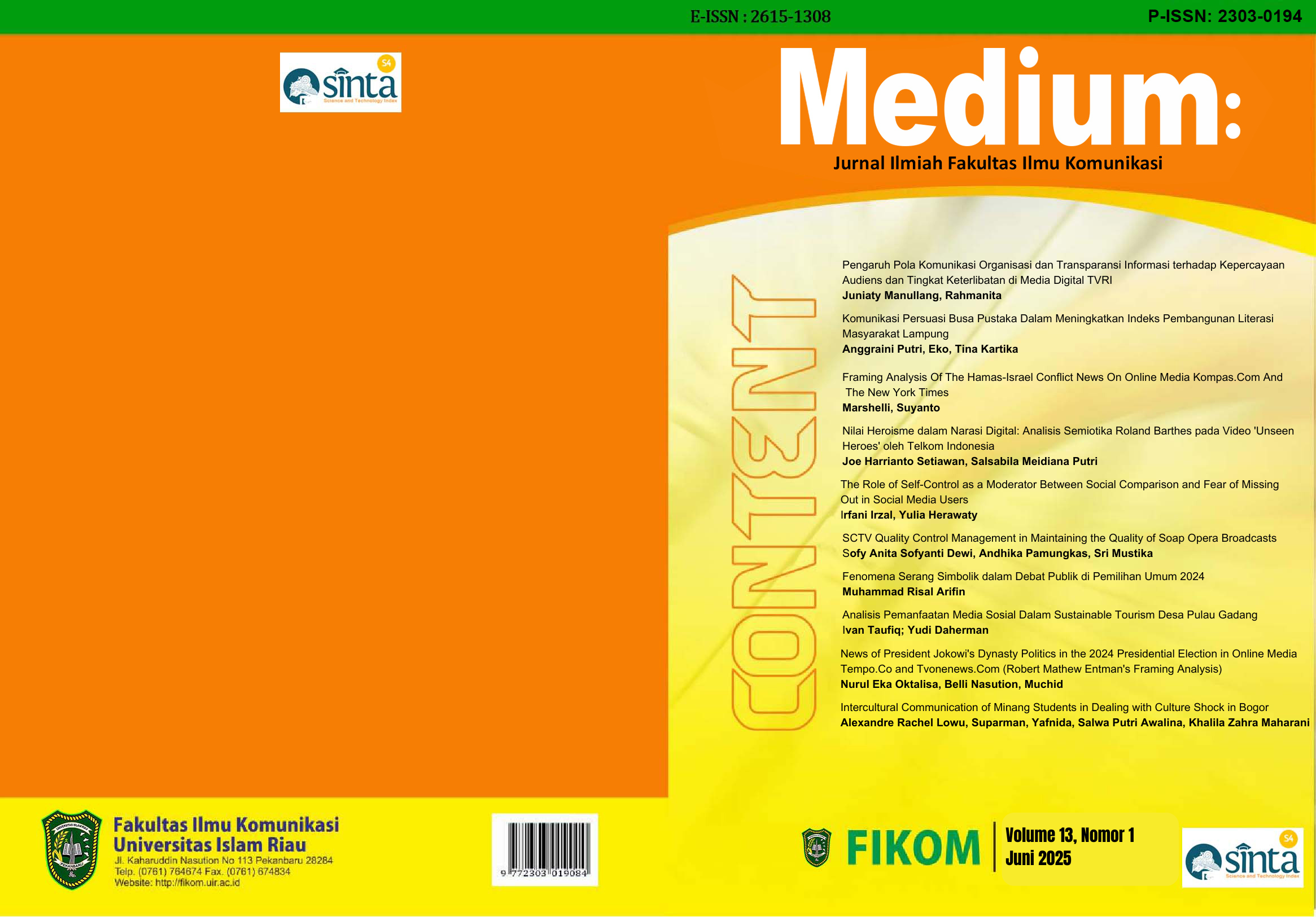
Analisis Pemanfaatan Media Sosial Dalam Sustainable Tourism Desa Pulau Gadang
DOI:
https://doi.org/10.25299/medium.v13i1.21915Keywords:
Pariwisata Berkelanjutan, Media Sosial, Desa WisataAbstract
Sustainable Tourism can be defined as a tourism concept that is expected to ensure the preservation and authenticity of natural resources. It is a development concept of sustainable development that includes economic, sociocultural, and environmental aspects in order to meet the needs of the present without reducing the fulfillment of the needs of future generations and can form a society that is adaptive to the environment and interacts with each other. Online media is important in its implementation, so this research looks at how social media can be a step in sustainable tourism. This research uses a descriptive qualitative method in which the object of research is the management of social media as sustainable tourism. The results of the study found that the village of Pulau Gadang in managing social media as sustainable tourism is as a validity tool and village promotion, education as a principle of sustainability, community and collaboration, responsible tourism management, interaction, evaluation and reciprocity.
Downloads
References
Bieger, T., & Laesser, C. (2015). The role of communication in sustainable tourism development: A case study of the Swiss Alps. Journal of Sustainable Tourism, 23(5), 767 785. https://doi.org/10.1080/09669582.2015.1013654
Jones, A., & Jenkins, J. (2017). Enhancing communication for sustainable tourism: The role of local residents in rural communities. Journal of Hospitality and Tourism Management, 31, 63–71. https://doi.org/10.1016/j.jhtm.2017.06.003 DOI: https://doi.org/10.1016/j.jhtm.2017.06.003
Manaf, Z. A., & Ab Karim, S. (2016). Community involvement in sustainable tourism development: The case of a rural village in Malaysia. Tourism Management Perspectives, 19, 73-82. https://doi.org/10.1016/j.tmp.2016.06.002 DOI: https://doi.org/10.1016/j.tmp.2016.06.002
Marzaman,A. Rasyid,AU. (2020). Eduwisata Bahari Berbasis Pemberdayaan Masyarakat dalam Pengembangan Taman LAUT Olele, Kabupaten Bone Bolango, Provinsi Gorontalo. Jurnal Master Pariwisata (JUMPA), 06 (02). 267 289. DOI: https://doi.org/10.24843/JUMPA.2020.v06.i02.p02
Murphy, P. E. 2017. Sustainable tourism: A global perspective (2nd ed.). Routledge.
Prabha, C., & Dhanya, S. (2018). Communication strategies for sustainable tourism development: A case study of eco-tourism in Kerala, India. International Journal of Tourism Research, 20(6), 813–825. https://doi.org/10.1002/jtr.2249 DOI: https://doi.org/10.1002/jtr.2249
Rona Rafidah Salsabila, Rhisa Aidilla Suprapto Nurhidayati, Sri Endah. 2009. “Sistem Pariwisata di Agropolitan Batu” . Media Masyarakat, Kebudayaan dan Politik. Vol (22) hal: 76-78.
Shrestha, R. K., & Aryal, A. (2019). Sustainable tourism in rural communities: A study of communication practices in Nepal’s village tourism. Tourism and Hospitality Research, 19(1), 42–51. https://doi.org/10.1177/1467358417750305
Taufiq, I., & Pithaloka, D (2023). Studi Fenomenologi Media Sosial Sebagai Media Komunikasi Pembangunan Daerah. Jurnal Medium 11 (2), 191-206. https://doi.org/10.25299/medium.2023.vol11(02).15154 DOI: https://doi.org/10.25299/medium.2023.vol11(02).15154
Taufiq, I., & Daherman, Y. (2024). Simulation Political Branding #Ganjarpresiden2024 Base on Media Sosial Analysis. Calathu: Jurnal Ilmu Komunikasi, 6(1), 35–43. https://doi.org/10.37715/calathu.v6i1.4454 DOI: https://doi.org/10.37715/calathu.v6i1.4454
Weaver, D. (2017). Sustainable tourism: Theory and practice (3rd ed.). Routledge.
Downloads
Published
Issue
Section
License
Copyright (c) 2025 Medium

This work is licensed under a Creative Commons Attribution 4.0 International License.