AUTHOR GUIDELINES
AUTHOR GUIDELINES
JURNAL DINAMIKA PERTANIAN
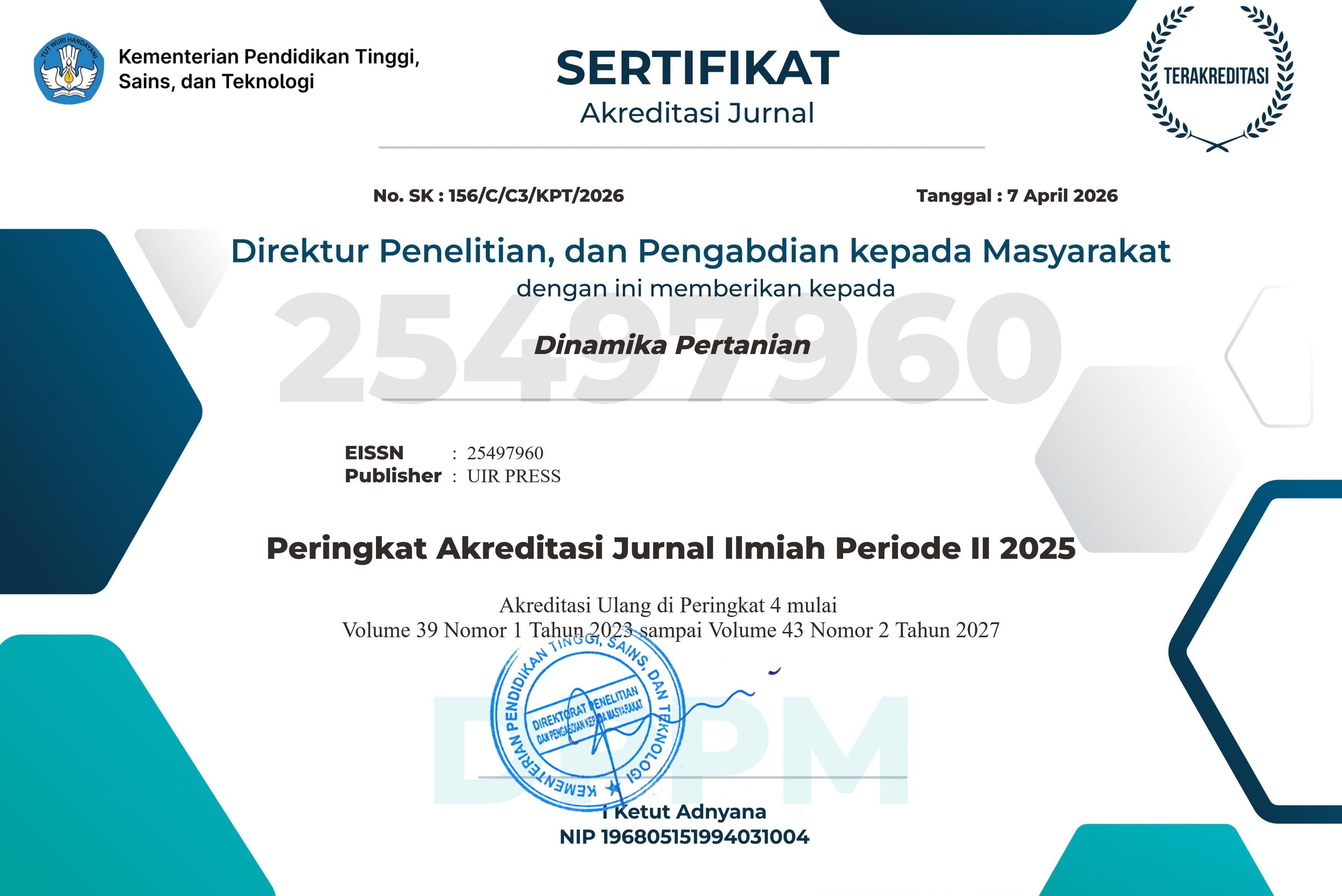
e-ISSN: 2549-7960 | p-ISSN: 0215-2525
Publisher: Faculty of Agriculture, Universitas Islam Riau
A. GENERAL PROVISIONS
- Jurnal Dinamika Pertanian accepts two types of manuscripts:
- Original research article – reports of original research that have not been published previously.
- Review article (literature review) – systematic or narrative reviews summarizing and analyzing recent developments in an agricultural topic, with depth of analysis and novel insights.
- Manuscripts must be written in Indonesian (following EYD) or English using effective, concise, and unambiguous academic style.
- Each manuscript must demonstrate novelty – for research articles: new findings; for review articles: new synthesis or fresh perspective on a topic. Novelty must be explicitly stated in the abstract and introduction.
- Manuscripts are checked for similarity using plagiarism detection software. The maximum allowed similarity is 20% (after excluding citations and bibliography).
- Manuscripts that meet the requirements will undergo anonymous peer-review (blind review) by at least one reviewer with relevant expertise.
B. FOCUS & SCOPE
JURNAL DINAMIKA PERTANIAN
(Starting from the April 2026 Issue)
Beginning with the April 2026 issue, Jurnal Dinamika Pertanian has refined its focus and scope to strengthen its scientific identity and enhance publication quality. The journal is now fully dedicated to Agrotechnology, with a strong emphasis on:
- Sustainable tropical agriculture
- Biological control and environmentally friendly approaches
- Climate-smart and resilient farming systems
- Digital and data-driven agricultural technologies
This refinement aims to strengthen the journal's scientific contribution and to serve as a platform for high-quality research addressing key challenges in sustainable tropical agriculture.
Detailed Scope
- Crop Science, Agronomy & Sustainable Agriculture
- Crop production systems in tropical environments
- Plant growth, development, and yield optimization
- Sustainable cropping systems and intensification
- Climate-smart agriculture and resilience
- Agroecology and regenerative agriculture
- Plant Protection, Biological Control & Plant-Microbe Interaction
- Integrated Pest Management (IPM)
- Biological control and entomopathogenic fungi
- Plant-microbe interactions and endophytes
- Eco-friendly pest and disease management
- Chemical ecology
- Plant Biotechnology & Physiology
- Functional metabolites and plant defense systems
- Molecular and physiological responses to stress
- Plant breeding and genetic improvement
- Soil Science & Plant Nutrition
- Soil health and nutrient dynamics
- Soil microbiology and rhizosphere ecology
- Biofertilizers and organic amendments
- Sustainable soil management
- Agricultural Innovation & Technology
- Precision agriculture and smart farming
- Remote sensing, GIS, and digital agriculture
- Artificial intelligence in agriculture
- Agricultural engineering and mechanization
C. MANUSCRIPT STRUCTURE (COMPLETE)
For Original Research Articles
- Title – maximum 15 words, capitalize each word (except short conjunctions). Must contain the highlight of key findings, not the method/process/location. Research location should not be mentioned in the title unless it is a unique case study.
- Author Names – full names without academic titles. Mark * for the corresponding author. Do not include positions or status (Lecturer, Student, etc.).
- Affiliation and Email – write in full: Department, Faculty, University, City, Postal Code, Country (separated by commas). Institution names must not be abbreviated. If all authors are from the same institution, no superscript numbers are needed. If affiliations differ, use superscripts (¹,²) to distinguish institutions. Corresponding author email is preceded by "*Email:".
- Abstract – 200–250 words, single paragraph, line spacing 1. Must contain: (1) brief background (importance of the research), (2) objectives, (3) brief methods, (4) summary of results/findings, (5) conclusions.
- Keywords – 3–5 words/phrases that reflect the article content, separated by semicolons.
- Introduction – No sub-section "Literature Review" containing general definitions. Required order: (a) general background (max 1 paragraph), (b) State of the Art (review of previous research, citing journals from the last 10 years), (c) Research Gap Analysis / Novelty Statement (explicitly required: gap and novelty), (d) research objectives. Avoid phrases such as: "the researcher is interested", "attempts", "hopes", "aims to see".
- Materials and Methods – descriptive sentences (not imperative). Must include: place, time, materials, equipment, design, procedures, sample, data analysis.
- Results and Discussion (can be combined or separated) – (1) present processed data, write key findings; (2) link with theory; (3) compare with other studies (not just as general references). Each table/figure must be cited by number in the text (e.g., "See Table 1.") – do not use "below".
- Conclusion – only answers the objectives, written in paragraph form (not bullet/numbered list). Do not separate into "Conclusion" and "Suggestion" sub-sections. Suggestions may be added in the same paragraph.
- References – minimum 15 citations, 80% from primary journals (maximum 20% books). Currency: last 10 years for novelty justification. Must use APA Style 7th edition consistently. Zotero/Mendeley are strongly recommended.
For Review Articles (Literature Review)
- Title – reflects the review topic and the novelty perspective.
- Author Names, Affiliation, Email – same as research articles.
- Abstract – 200–250 words, containing: background (why this review is important), review objectives, literature search method (databases, keywords, year range, inclusion/exclusion criteria), summary of main review findings, conclusions and implications.
- Keywords – 3–5 phrases.
- Introduction – topic background, state of the art showing the need for the review, and review objectives.
- Review Method – transparent description: sources (e.g., Scopus, Google Scholar, PubMed), keywords, search period, number of articles found and selected, and synthesis approach (narrative or thematic).
- Main Discussion/Literature Review – systematically organized by theme or chronology. Each sub-section must integrate findings from various authors, not just summarize one by one. Must include critical synthesis and identification of research gaps that still need to be filled.
- Conclusions and Recommendations – summarizes recent developments, identified gaps, and recommendations for future research.
- References – minimum 30 citations for review articles. Most (≥70%) from indexed journals within the last 10 years. APA 7th edition format.
D. TECHNICAL FORMATTING
1. Page Size and Margins
- Paper size: A4 (210x297 mm)
- Margins: left, right, top, bottom = 2.5 cm
2. Font Type and Size
- Body text: Times New Roman or Arial, size 11 pt, line spacing 1.5, justified alignment.
- Abstract: size 10 pt, line spacing 1.
- References: size 10 pt, line spacing 1, hanging indent 0.5 cm.
- Article title: 14 pt bold, centered.
- Author names: 12 pt bold, centered.
- Main sub-headings: 12 pt bold, left-aligned.
3. Tables
- Table caption placed above the table, numbered with Arabic numerals (1,2,3), not Roman numerals.
- Table must not be presented as images. No vertical lines. Horizontal lines only at the heading and the very bottom.
4. Figures
- Figure caption placed below the figure, numbered with Arabic numerals.
- Figures must not be blurry, text must be readable, no outer border.
5. Mathematical Equations
- Use Equation Editor. Number equations at the right margin, e.g., (1).
- Symbol descriptions must be in descriptive paragraph form, not as a list.
E. SPECIFIC RULES FOR TABLES, FIGURES, AND REFERENCES
- Each table/figure must be cited in the text before it appears. Cite by number only, e.g., "See Table 1." Do not use words like "below" or "following".
- Every reference cited in the text must appear in the reference list, and vice versa.
- Research articles: minimum 15 references. Review articles: minimum 30 references.
- In-text citation style: (Author, Year) or Author (Year). For three or more authors: (First Author et al., Year).
F. EDITORIAL POLICIES
- Plagiarism: Maximum similarity 20%. Manuscripts found to be plagiarized will be rejected.
- Review Process: Blind review, at least one reviewer. Final decision by the editorial board.
- Publication Fee: No charge (APC free).
- Issue Schedule: Published three times a year (April, August, December). Submission deadlines: January 31 (April), May 31 (August), September 30 (December).
- Language: Indonesian or English. English manuscripts are advised to undergo proofreading.
G. PUBLICATION ETHICS
The journal follows COPE (Committee on Publication Ethics) guidelines. Authors must guarantee the originality of the manuscript, disclose any conflicts of interest, and acknowledge all funding sources. Published manuscripts cannot be withdrawn except for serious scientific errors.
© 2026 - Jurnal Dinamika Pertanian, Faculty of Agriculture, Universitas Islam Riau