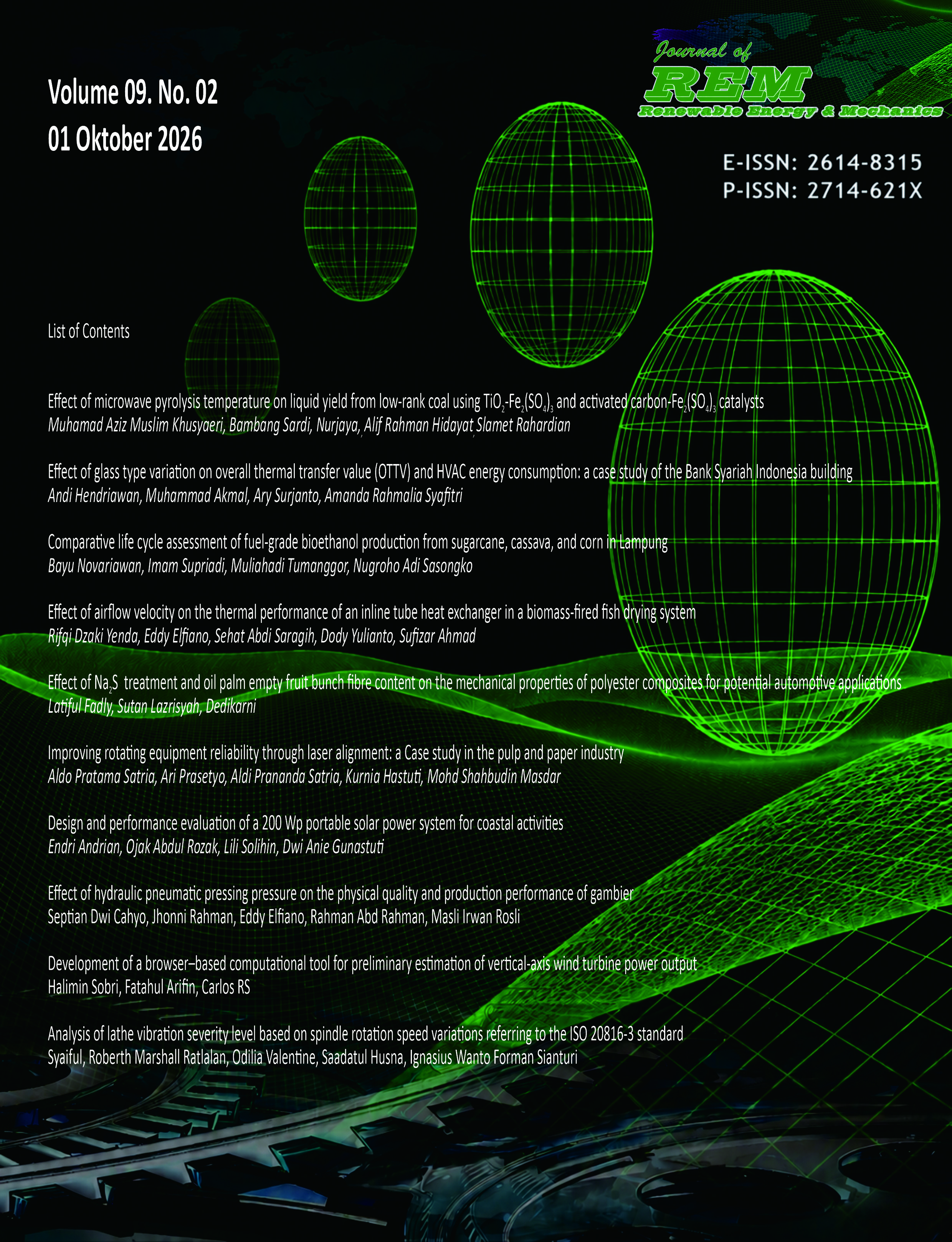
Effect of airflow velocity on the thermal performance of an inline tube heat exchanger in a biomass-fired fish drying system
DOI:
https://doi.org/10.25299/rem.2026.29239Keywords:
Airflow velocity, biomass, fish dryer, heat exchanger, inline tubeAbstract
This study evaluates the effect of airflow velocity on the thermal performance of an
inline tube heat exchanger integrated into an indirect biomass-fired fish drying
system. Experiments used wood biomass as the heat source and three airflow
velocities of 0.8, 1.1, and 1.3 m/s. Temperatures were recorded at 5, 10, and 15
min, and the convective heat transfer coefficient, air mass flow rate, logarithmic
mean temperature difference (LMTD), heat transfer rate, and calculated thermal
efficiency were evaluated using established heat-transfer relations. Increasing
airflow velocity from 0.8 to 1.3 m/s increased the average convective heat transfer
coefficient from 23.936 to 33.041 W/m²·K, a 38% increase. The highest reported
heat transfer rate, 9.86 W, occurred at 1.3 m/s, whereas the highest calculated
thermal efficiency, 54.18%, occurred at 0.8 m/s. Under the tested conditions, higher
airflow enhanced convective heat transfer and mass flow rate, while lower airflow
produced a higher calculated efficiency. The results indicate a trade-off between
heat-transfer capacity and calculated thermal efficiency. Verify the reported heat
transfer-rate unit and efficiency basis against the complete energy balance before
final publication.
Downloads
Downloads
Published
How to Cite
Issue
Section
Accepted 2026-09-29
Published 2026-10-01