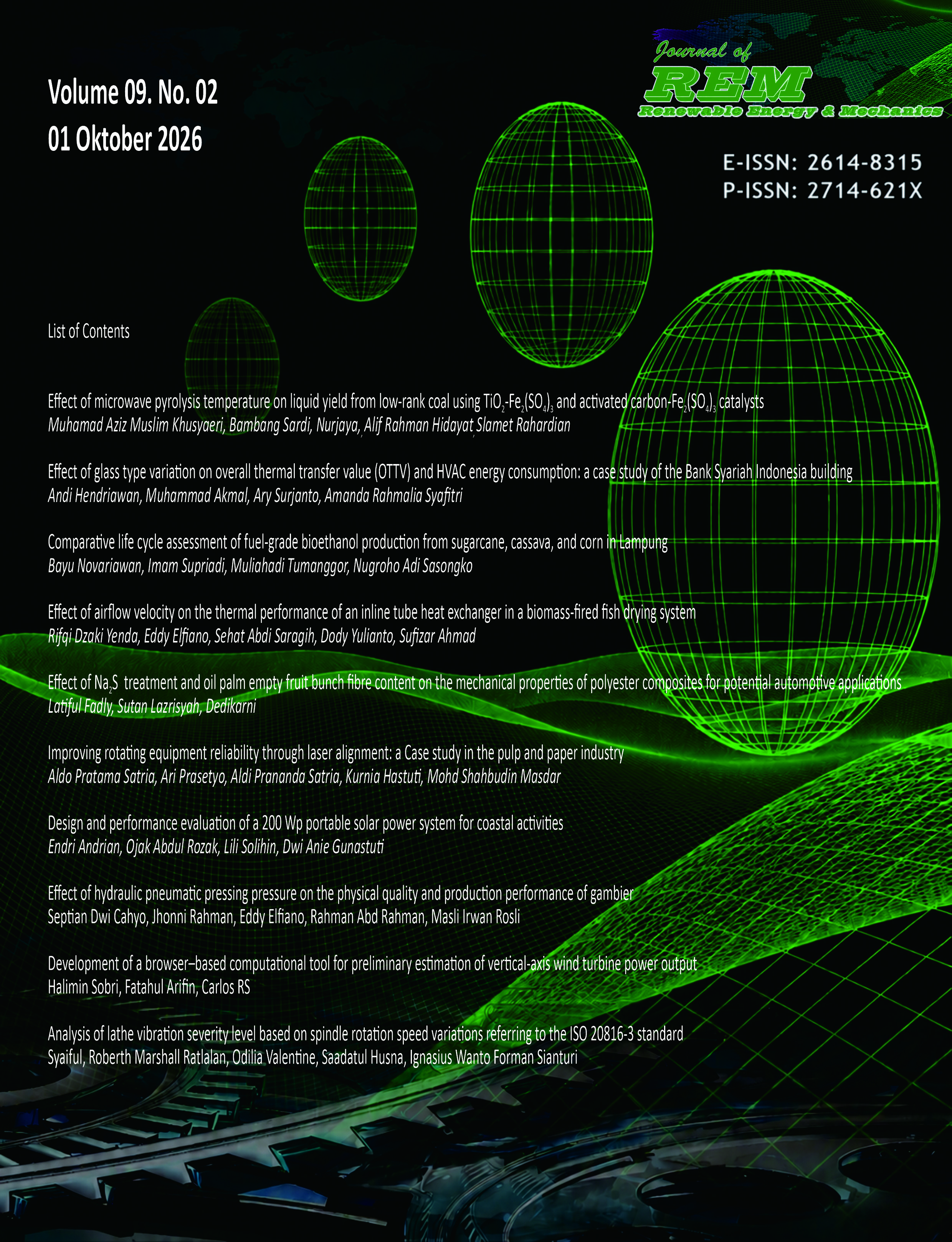
Effect of hydraulic pneumatic pressing pressure on the physical quality and production performance of gambier
DOI:
https://doi.org/10.25299/rem.2026.29189Keywords:
Gambier, hydraulic–pneumatic press, pressing pressure, density, production capacityAbstract
Gambier (Uncaria gambir Roxb.) is an important Indonesian plantation commodity whose physical quality and processing productivity are strongly influenced by the pressing stage. This study evaluated the effect of hydraulic–pneumatic operating pressure on gambier pressing performance and physical characteristics. We conducted experiments at five pressure levels (1, 3, 5, 7, and 8 bar), using an initial material mass of 5 kg for each test. We calculated the following parameters: pressing force, product density, estimated production capacity, wet-basis moisture content after pressing, and water removal during pressing. Pressures of 1 and 3 bar were insufficient to form a compact product. Within the effective range of 5–8 bar, increasing pressure increased product density from 1162.67 to 1270.40 kg/m³ and estimated production capacity from 14.88 to 23.42 kg/h. The calculated pressing force increased from 491.07 N at 5 bar to 785.71 N at 8 bar. Water removal based on the initial mass increased from approximately 0.60% at 5 bar to 5.00% at 8 bar. Among the tested conditions, 8 bar provided the best overall performance. However, because we did not evaluate pressures above 8 bar or energy consumption, this condition should be regarded as the best tested pressure rather than a globally optimised operating point.
Downloads
Downloads
Published
How to Cite
Issue
Section
Accepted 2026-09-29
Published 2025-10-01