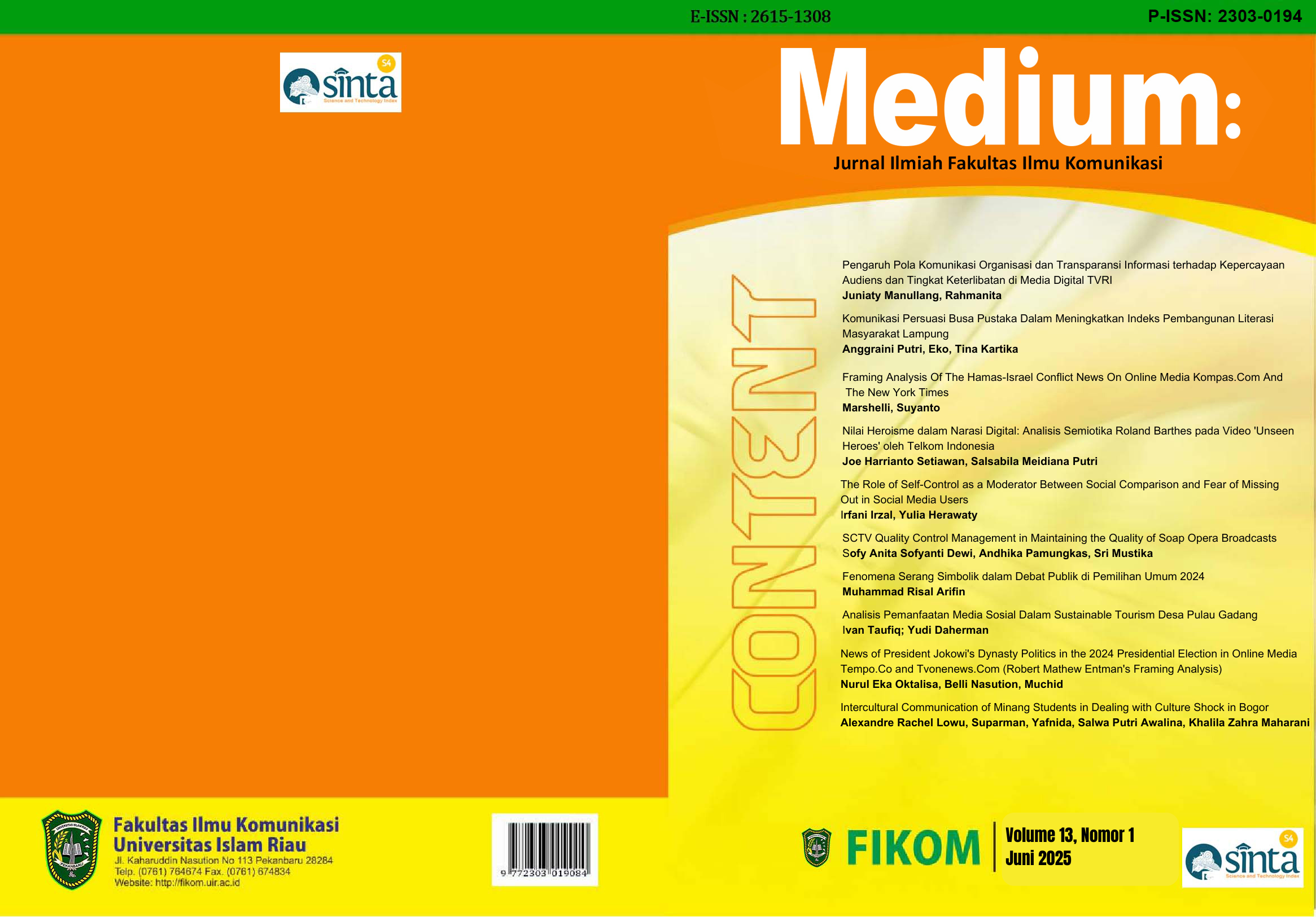
The Role of Self-Control as a Moderator Between Social Comparison and Fear of Missing Out in Social Media Users
DOI:
https://doi.org/10.25299/medium.v13i1.21405Keywords:
Fear of missing out, social comparison, kontrol diriAbstract
The use of social media is currently increasing, the habit of using one of the social media has an impact on the fear of being left behind or called the fear of missing out on social media users. This study fills the research gap in the psychological literature by validating the influence between social comparison and Fomo in the presence of self-control as a moderator. The purpose of this study is to look at the role of self-control as a moderator variable between the influence of social comparison on Fomo among 281 social media users. The population in this study were students who used social media aged 19-24 years. The measuring instruments used are the Fomo scale, social comparison and self-control. The data processor used is the Structural Equation Model (SEM) path analysis method with the Partial Least Square (PLS) method. The results of the analysis show that social comparison has an influence on fomo, self-control affects fomo and self-control is able to moderate the influence of social comparison on fear of missing out.
Downloads
References
Abel, J. P., Buff, C. L., & Burr, S. A. (2016). Social Media and the Fear of Missing Out: Scale Development and Assessment. Journal of Business & Economics Research (JBER), 14(1), 33–44. doi:10.19030/jber.v14i1.9554. DOI: https://doi.org/10.19030/jber.v14i1.9554
AMELIA, G. A. (2019). Pengaruh social comparison terhadap life satisfaction pada remaja akhir yang menggunakan Instagram (Doctoral dissertation, UNIVERSITAS NEGERI JAKARTA)
APJII. (2022). Profil Internet Indonesia 2022. Apji.or.Od, June, 10. apji.or.id
Arifin, H. H., & Milla, M. N. (2020). Adaptasi dan properti psikometrik skala kontrol diri ringkas versi Indonesia. Jurnal Psikologi Sosial, 18(2), 179–195. https://doi.org/10.7454/jps.2020.18 DOI: https://doi.org/10.7454/jps.2020.18
Averill, J. R. (1973). Personal control over aversive stimuli and its relationship to stress. Psychological Bulletin, 80(4), 286–303. https://doi.org/10.1037/h0034845 DOI: https://doi.org/10.1037/h0034845
Azizah, M. A. (2022). PENGARUH SOCIAL COMPARISON DAN SELF ESTEEM TERHADAP BODY IMAGE REMAJA AKHIR DI DUKUH MANGUNAN KLATEN (Doctoral dissertation, Universitas Widya Dharma).
Caplin, J.P. (2011). Kamus Lengkap Psikologi (Terjemahan Kartono, K). Jakarta: PT.Raja Grafindo Persada
Chou, H. T. G., & Edge, N. (2012). “They are happier and having better lives than I am”: The impact of using facebook on perceptions of others’ lives. Cyberpsychology, Behavior, and Social Networking, 15(2), 117–121. https://doi.org/10.1089/cyber.2011.0324 DOI: https://doi.org/10.1089/cyber.2011.0324
Ghufron, M. N., & Risnawati. R. (2010). Teori-teori Psikologi. Yogyakarta : Ar Ruzz Media.
Gugushvili, N., Täht, K., Schruff-Lim, E. M., Ruiter, R. A. C., & Verduyn, P. (2022). The Association Between Neuroticism and Problematic Social Networking Sites Use: The Role of Fear of Missing out and Self-Control. Psychological Reports, 0(0), 1–24. https://doi.org/10.1177/00332941221142003 DOI: https://doi.org/10.1177/00332941221142003
Hair, J. F., Hult, G. T. M., Ringle, C. M., & Sarstedt, M. (2017). A primer on partial least squares structural equation modeling (PLSSEM). Thousand Oaks, CA: Sage. DOI: https://doi.org/10.15358/9783800653614
Hair, J. F., Sarstedt, M., Hopkins, L., & Kuppelwieser, V. G. (2014). Partial least squares structural equation modeling (PLS-SEM): An emerging tool in business research. European Business Review, 26(2), 106–121. https://doi.org/10.1108/EBR-10-2013-0128 DOI: https://doi.org/10.1108/EBR-10-2013-0128
Herawati, I., Rizal, I., & Amita, N. (2022). The Impact of Social Media on Fear of Missing Out Among Z Generation: A Systematic Literature Review. Journal of Islamic and Contemporary Psychology (JICOP), 2(2), 92–98. https://doi.org/10.25299/jicop.v2i2.11179 DOI: https://doi.org/10.25299/jicop.v2i2.11179
Hofmann, W., & Kotabe, H. (2012). A General Model of Preventive and Interventive Self-Control. Social and Personality Psychology Compass, 6(10), 707–722. https://doi.org/10.1111/j.1751-9004.2012.00461.x DOI: https://doi.org/10.1111/j.1751-9004.2012.00461.x
Kadri, A. F. (2022). HUBUNGAN ANTARA KONTROL DIRI DENGAN FEAR OF MISSING OUT PADA MAHASISWA PENGGUNA MEDIA SOSIAL DI UNIVERSITAS ISLAM RIAU.
Latan, H., & Selva, T. (2013). Analisis Multivariate Teknik dan Aplikasi Menggunakan Program IBM SPSS 20,0. Penerbit Alfabeta.
Maza, S., & Aprianty, R. A. (2022). Hubungan Kontrol Diri Dengan Fear of Missing Out (Fomo)Pada Remaja Pengguna Media Sosial. Jurnal Mahasiswa BK An-Nur : Berbeda, Bermakna, Mulia, 8(3), 148. https://doi.org/10.31602/jmbkan.v8i3.9139 DOI: https://doi.org/10.31602/jmbkan.v8i3.9139
Martinek, Taylor, (2019). Can We Reduce Social Comparison and Fear of Missing Out with Labels on Instagram? Departmental Honors Projects. 86. https://digitalcommons.hamline.edu/dhp/86
Myers, T. A., & Crowther, J. H. (2009). Social comparison as a predictor of body dissatisfaction: A meta-analytic review. Journal of abnormal psychology, 118(4), 683 DOI: https://doi.org/10.1037/a0016763
Przybylski, A. K., Murayama, K., Dehaan, C. R., & Gladwell, V. (2013). Motivational, emotional, and behavioral correlates of fear of missing out. Computers in Human Behavior, 29(4), 1841–1848. https://doi.org/10.1016/j.chb.2013.02.014 DOI: https://doi.org/10.1016/j.chb.2013.02.014
Quarshie, H. O., Mis, M. B. A., & Cyber, P. G. (2012). The Impact of Computer Technology on the Development of Children In Ghana. 3(5), 717–722.
Reer, F., Tang, W. Y., & Quandt, T. (2019). Psychosocial well-being and social media engagement: The mediating roles of social comparison orientation and fear of missing out. New Media and Society, 21(7), 1486–1505. https://doi.org/10.1177/1461444818823719 DOI: https://doi.org/10.1177/1461444818823719
Rizal, I., & Widiantoro, D. (2022). No Mobile Phone Phobia (Nomophobia) Dengan Fear of Missing Out Pada Pengguna Media Sosial. Psikobuletin:Buletin Ilmiah Psikologi, 3(1), 35. https://doi.org/10.24014/pib.v3i1.14882 DOI: https://doi.org/10.24014/pib.v3i1.14882
Roberts, J. A., & David, M. E. (2020). The Social Media Party: Fear of Missing Out (FoMO), Social Media Intensity, Connection, and Well-Being. International Journal of Human-Computer Interaction, 36(4), 386–392. https://doi.org/10.1080/10447318.2019.1646517 DOI: https://doi.org/10.1080/10447318.2019.1646517
Schlosser, A. E. (2020). Self-disclosure versus self-presentation on social media. Current Opinion in Psychology, 31, 1–6. https://doi.org/10.1016/j.copsyc.2019.06.025 DOI: https://doi.org/10.1016/j.copsyc.2019.06.025
Servidio, R. (2021). Self-control and problematic smartphone use among Italian University students: The mediating role of the fear of missing out and of smartphone use patterns. Current Psychology, 40(8), 4101–4111. https://doi.org/10.1007/s12144-019-00373-z DOI: https://doi.org/10.1007/s12144-019-00373-z
Silvia, S., & Appulembang, Y. A. (2022). Social Comparison Dengan Fear of Missing Out Pada Remaja Pengguna Aktif Media Sosial. Jurnal Bimbingan Dan Konseling Ar-Rahman, 8(2), 171. https://doi.org/10.31602/jbkr.v8i2.8984 DOI: https://doi.org/10.31602/jbkr.v8i2.8984
Sklar, A. (2017). How could students’ use of social media be affecting their mental health? EdCannetwork, 1–2. https://www.edcan.ca/articles/students-use-social-media-affecting-mental-health/
Sujarwo, S., & Rosada, M. (2023). Hubungan Kontrol Diri dengan Fear of Missing Out pada Pengguna Media Sosial. Jurnal Ilmiah Fakultas Psikologi Universitas Yudharta Pasuruan, 10(1), 178–189. DOI: https://doi.org/10.35891/jip.v10i1.3722
Sultan, A. J. (2021). User engagement and self-disclosure on Snapchat and Instagram: the mediating effects of social media addiction and fear of missing out. Journal of Economic and Administrative Sciences. https://doi.org/10.1108/jeas-11-2020-0197 DOI: https://doi.org/10.1108/JEAS-11-2020-0197
Tandon, A., Dhir, A., Talwar, S., Kaur, P., & Mäntymäki, M. (2021). Dark consequences of social media-induced fear of missing out (FoMO): Social media stalking, comparisons, and fatigue. Technological Forecasting and Social Change, 171(June). https://doi.org/10.1016/j.techfore.2021.120931 DOI: https://doi.org/10.1016/j.techfore.2021.120931
Utami, A.R., Herawati, I., Armayati, L., Subardjo, R.Y.S (2023). The Influence of Social Media Use Intensity on Social Comparison in College Students. Paragraphs Communication Update. doi: 10.59260/pcommu.2023.74782814 DOI: https://doi.org/10.59260/pcommu.2023.74782814
Wang, C. C., & Chang, Y. T. (2010). Cyber relationship motives: Scale development and validation. Social Behavior and Personality, 38(3), 289–300. https://doi.org/10.2224/sbp.2010.38.3.289 DOI: https://doi.org/10.2224/sbp.2010.38.3.289
Downloads
Published
Issue
Section
License
Copyright (c) 2025 Medium

This work is licensed under a Creative Commons Attribution 4.0 International License.