
Numerical Analysis of Joint-Controlled Slope Stability under Blasting-Induced Vibration: A Case Study of the Jakarta-Bandung High-Speed Railway Tunnel 4
Keywords:
Landslide, slope stability, blasting vibration,, tunnel excavation, mitigationAbstract
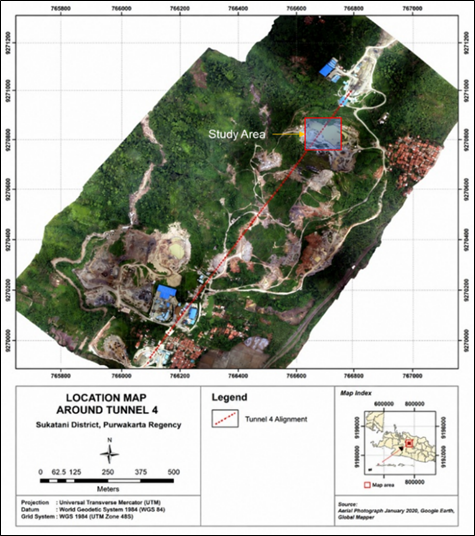
Blasting for Tunnel 4 of the Jakarta–Bandung High-Speed Railway is conducted close to an active andesite quarry, where blast-induced vibration may interact with pre-existing discontinuities and groundwater to reduce slope stability. This study evaluates the combined effects of joint structure, groundwater conditions, and tunnel-blasting vibration on quarry-slope stability using two-dimensional finite-element analysis in RS2 with the shear-strength-reduction method. Field characterization comprised scanline discontinuity mapping, rock-mass classification, laboratory testing, and Minimate vibration monitoring. Jointless and explicitly jointed slope models were evaluated under four scenarios: dry-static, dry-dynamic, saturated-static, and saturated-dynamic. The monitored blast dataset was additionally evaluated using the site-specific scaled-distance relationship, PPV = 156.3(SD)−1.056 (R2=0.376), where SD = R/√Q, to characterize vibration attenuation and its uncertainty. Under static conditions, explicit joints reduced the factor of safety (FoS) by 3% in the dry model and 6% in the saturated model. Under dynamic conditions, the joint-related FoS reduction increased to 15% in the dry model (4.1 to 3.5) and 42% in the saturated model (3.4 to 2.0), with the probability of failure reaching 17% in the critical saturated-dynamic-jointed scenario. A charge-per-delay sensitivity analysis at a fixed source-to-slope distance of 25 m further showed that increasing explosive charge progressively increased the predicted longitudinal peak particle acceleration (PPA) and reduced slope stability. Based on the adopted stability criteria, the analysis supports maximum site-specific charges of 30 kg/delay under dry conditions and 20 kg/delay under saturated conditions at 25 m. These results demonstrate that groundwater saturation substantially amplifies the destabilizing influence of blasting on joint-controlled slope response and highlight the need for groundwater-dependent blast control, controlled trial blasts, and field monitoring before operational implementation.
Downloads
References
Aditya, F. et al. (2025) ‘Mine Slope Stability Analysis CV . Putra Idola Against the Padang-Painan Cross Road with GSI Method and Rock Mass Rating’, pp. 129–144.
Al-E’Bayat, M. et al. (2024) ‘Numerical Investigation for the Effect of Joint Persistence on Rock Slope Stability Using a Lattice Spring-Based Synthetic Rock Mass Model’, Sustainability, 16(2), p. 894.
Azizi, M. A. (2018) ‘Three dimensional slope stability analysis of open pit limestone mine in Rembang District’, in. Central Java: IOP Conference Series: Earth and Environmental Science.
Barton and Choubey (1977) ‘The shear strength of rock joints. Rock Mechanics.pdf’.
Barton, N. R. (1972) ‘A model study of rock-joint deformation’, International Journal of Rock Mechanics and Mining Sciences and, 9(5), pp. 579–582.
Devy, S. D. and Hutahayan, P. P. (2021) ‘Engineering , Environment , and Technology Groundwater Effect on Slope Stability in Open Pit Mining : a Case of West Kutai Regency, East Kalimantan, Indonesia’, 6(4).
Dowding, C. H. (1985) Blast Vibration Monitoring and Control. Englewood Cliffs: Prentice Hall.
Du, S.-G. et al. (2022) ‘A new approach for evaluation of slope stability in large open-pit mines: a case study at the Dexing Copper Mine, China’, Environmental Earth Sciences, 81(3), p. 102.
Gofar, N. and Rahardjo, H. (2017) ‘Saturated and unsaturated stability analysis of slope subjected to rainfall infiltration’, MATEC Web of Conferences. Edited by I. Iskandar et al., 101, p. 05004.
Heriyadi, B. et al. (2026) ‘GEOTECHNICAL STABILITY AND ENVIRONMENTAL RISK’, 30(141), pp. 56–66.
Irwandy Arif (2016) Geoteknik Tambang. 1st editio. Edited by A. L. dan Suprianto. Jakarta: PT Gramedia Pustaka Utama.
Jiang F., Xiong, Y., Han, R., & X. Y. (2014) ‘Analysis of Instability and Controlling Measurements for Super-Large Cross Section of High Speed Railway Tunnel Portal’.
Lee, W.-S. et al. (2013) ‘Determination of Optimized Blasting Pressure through Critical Volumetric Strain Monitoring’, Journal of korean society of hazard mitigation, 13(4), pp. 191–197.
Luo, S. et al. (2023) ‘Dynamic Response and Safety Evaluation for the Adjacent Viaduct Under the Influence of Subway Connecting Passage Blasting’, Indian Geotechnical Journal, 53(2), pp. 362–376.
Ma, C. et al. (2025) ‘Radar Monitoring and Numerical Simulation Reveal the Impact of Underground Blasting Disturbance on Slope Stability’, Remote Sensing, 17(15), p. 2649.
Ma, Z. et al. (2021) ‘Slope Stability Analysis under Complex Stress State with Saturated and Unsaturated Seepage Flow’, Geofluids. Edited by G. Zhang, 2021, pp. 1–11.
Al Mandalawi, M. (2024) ‘The Influence of Rock Slope Scales of Joint Network and Slope Height on the Stability and Failure Mechanisms’, IRAQI BULLETIN OF GEOLOGY AND MINING, 20(1), pp. 139–149.
Prassetyo, S. H. et al. (2024) ‘Evaluation of Blast-Induced Ground Vibration in Urban Area for the Jakarta-Bandung HSR Tunnel #11’, Geotechnical and Geological Engineering, 42(8), pp. 7255–7285.
Putra, K. E. et al. (2026) ‘Engineering , Environment , and Technology Optimization of Bench Width and Vertical Bench Position for Claystone Slopes Using the Limit Equilibrium Method under a Safety Factor Constraint’, 11(2).
Sun, P. and Li, R. (2023) ‘Dynamic response of high and thin rock slope under blasting vibration: a case study’, Journal of Vibroengineering, 25(6), pp. 1181–1197.
Sun, Z. et al. (2024) ‘Numerical Analysis of Slope Stability in Open Pit Mining Based on an Integrated Geology and Geomechanics Approach’, in 58th U.S. Rock Mechanics/Geomechanics Symposium. ARMA.
Wang, H. et al. (2023) ‘Safety Evaluation and Application of Blasting Vibration Based on an Improved Hilbert–
Huang Transform’, Rock Mechanics and Rock Engineering, 56(6), pp. 3971–3991.
Wong, H. N. dan Pang, P. L. R. (1992) Assessment of Stability of Slopes Subjected to Blasting Vibration. Hongkong: Geotechnical Engineering Office.
Xiong, Q. et al. (2021) ‘Study on slope stability during tunnel construction in water rich soft soil area’, IOP Conference Series: Earth and Environmental Science, 783(1), p. 012001.
Zvarivadza, T. et al. (2025) ‘Deep learning-powered rock mass classification: Predicting RMR from Q-system parameters with high accuracy’, Rock Mechanics Bulletin, 4(4), p. 100219.
Downloads
Published
Issue
Section
License
Copyright (c) 2026 Journal of Geoscience, Engineering, Environment, and Technology

This work is licensed under a Creative Commons Attribution-ShareAlike 4.0 International License.
Copyright @2019. This is an open-access article distributed under the terms of the Creative Commons Attribution-ShareAlike 4.0 International License which permits unrestricted use, distribution, and reproduction in any medium. Copyrights of all materials published in JGEET are freely available without charge to users or / institution. Users are allowed to read, download, copy, distribute, search, or link to full-text articles in this journal without asking by giving appropriate credit, provide a link to the license, and indicate if changes were made. All of the remix, transform, or build upon the material must distribute the contributions under the same license as the original.


