Optimization of Bench Width and Vertical Bench Position for Claystone Slopes Using the Limit Equilibrium Method under a Safety Factor Constraint
DOI:
https://doi.org/10.25299/jgeet.2026.11.02.28001Keywords:
Slope optimization, slope stability, limit equilibrium method, open pit mining, bench geometryAbstract
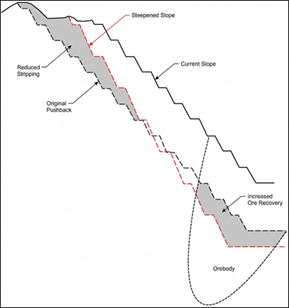
One important aspect of open pit mine planning is slope geometry design, which affects the stability of the slope and the efficiency of overburden removal. This study aims to investigate the influence of vertical bench position and bench width on slope stability and their effect on stripping volume. The limit equilibrium method was used for slope stability analysis, with the assistance of Rocscience Slide2 software. The stripping volume estimate was obtained from pit shell simulations using GEOVIA Surpac software. The vertical bench positions analyzed were ¼, ½, and ¾ of the total slope height, which was 60 m. The bench width variations tested were 0, 5, 10, 15, 20, and 25 m, while maintaining a minimum safety factor requirement of 1,3. The analysis indicated that the optimal configuration is achieved by placing the bench at the vertical position of ½ of the overall slope height with a bench width of 10 m, which results in an overall slope angle of 44°. The result is steeper than the no-bench scenario, with an overall slope angle of 42°. This geometry produces an estimated overburden volume of 195,123,000 m3, which is smaller than the no-bench scenario of 196,559,500 m3. Therefore, the reduction in stripping volume is 1,436,500 m3 or approximately 0.73%. This study shows that optimizing the bench configuration enables the implementation of steeper overall slope angles while reducing the required stripping volume in open pit mine planning.
Downloads
References
Aisah, E. and Ardiansyah, D. (2023) ‘Pengaruh Geometri Lereng Terhadap Stabilitas Lereng menggunakan Aplikasi SLOPE/W 2012’. Jurnal Tekno Global 12(01), pp. 1–7.
Azizi, Ahmad, M., Karim, R., Marwanza, I. and Ghifari, M.K. (2019) ‘Prediksi Volume Longsoran Tambang Terbuka Nikel Menggunakan Metode Kesetimbangan Batas 3 Dimensi’. Indonesian Mining Professional Journal 1(1), pp. 43–48.
Bezie, G., Chala, E.T., Jilo, N.Z., Birhanu, S., Berta, K.K., Assefa, S.M. and Gissila, B. (2024) ‘Rock Slope Stability Analysis of a Limestone Quarry in a Case Study of a National Cement Factory in Eastern Ethiopia’. Scientific Reports 14(1), p. 18541.
Contreras, L.F. (2015) ‘An Economic Risk Evaluation Approach for Pit Slope Optimization’. Journal of the Southern African Institute of Mining and Metallurgy 115(7), pp. 607–622.
Deng, T., He, J., Sun, J., Peng, S., Pang, X., Chen, T. and Zhang, X. (2025) ‘Intelligent Optimization of Slope Step Parameters in Open Pit Mines Containing Weak Interbedded Layers Based on Machine Learning and Multi-Objective Optimization Methods’. Frontiers in Earth Science 13, p. 1666375.
Duncan, J.M. (1996) ‘State of The Art: Limit Equilibrium and Finite-Element Analysis of Slopes’. Journal of Geotechnical Engineering 122, pp. 577–596.
Fleurisson, J.-A. (2012) ‘Slope Design and Implementation in Open Pit Mines: Geological and Geomechanical Approach’. Procedia Engineering 46, pp. 27–38.
Fleurisson, J.-A. and Cojean, R. (2014) ‘Error Reduction in Slope Stability Assessment’. Surface Mining Methods and Technology Systems 1, pp. 1–41.
Haeriska, H., Chaerul, M., Desi, N., Harun, A.Muh.Y., Erniati, E. and Marzuki, I. (2025) ‘Evaluation of Slope Stability in Mining Areas Using the Morgenstern Price Method’. Journal La Multiapp 6(6), pp. 1347–1364.
Hilman, Z., Edo Kharisma Army and Rezki Naufan Hendrawan (2026) ‘Slope Stability Analysis Through the Application of Digital Imagery and Field Validation Using SMR and Q-Slope Methods: A Case Study of Bandar Lampung City, Indonesia’. Journal of Geoscience, Engineering, Environment, and Technology 11(1), pp. 1–8.
Hustrulid, W.A., McCarter, M.K. and Van Zyl, D.J.A. (2000) Slope Stability in Surface Mining. Littleton, CO, USA: Society for Mining, Metallurgy, and Exploration.
Irfan, Trides, T., Winarno, A., Litha Respati, L. and Dina Devy, S. (2023) ‘Studi Perbandingan Nilai Kuat Geser Batu Lempung Berdasarkan Kondisi Jenuh, Kondisi Natural, Dan Kondisi Kering Formasi Palau Balang Menggunakan Metode Direc Shear Di Kalimantan Timur (Comparative Study Of Clasystone Shear Strength Value Based On Saturated Conditions, Natural Conditions, And Dry Conditions Of The Palau Balang Formation Using The Using The Direct Shear Method In East Kalimantan)’. Journal Scientific of Mandalika (JSM) 4(5).
Karthik, A.V.R., Manideep, R. and Chavda, J.T. (2022) ‘Sensitivity Analysis of Slope Stability Using Finite Element Method’. Innovative Infrastructure Solutions 7(2), p. 184.
Kolapo, P., Oniyide, G.O., Said, K.O., Lawal, A.I., Onifade, M. and Munemo, P. (2022) ‘An Overview of Slope Failure in Mining Operations’. Mining 2(2), pp. 350–384.
Labuz, J.F. and Zang, A. (2012) ‘Mohr–Coulomb Failure Criterion’. Rock Mechanics and Rock Engineering 45(6), pp. 975–979.
Matius Sesa, H., Najib, N., Luthfi Dalimunthe, H. and Handietri, Z. (2024) ‘Slope Stability Evaluation and Geometrical Recommendation Using The Morgenstern Price Method’. Jurnal Teknologi 16(1), p. 53.
Mosquera, J. (2013) Static and Pseudo-Static Stability Analysis of Tailings Storage Facilities Using Deterministic and Probabilistic Methods. Montréal, QC, Canada: McGill University.
Nicholas, D.E. and Sims, D.B. (2000) ‘Collecting and Using Geological Structure Data for Slope Design’. in Hustrulid, W. A., McCarter, M. K., and Van Zyl, D. J. A. (eds.) Slope Stability in Surface Mining. Golden, CO, USA: Society for Mining, Metallurgy, and Exploration
Pasorong, E.P., Chaerul, M. and Desi, N. (2025) ‘Pemetaan Resiko Bencana Longsor Menggunakan Sistem Informasi Geografis (SIG) pada Jalan Tambang PT. Ifishdeco, Tbk’. Jurnal Teknik 5(1)
Radityo, D., Bilal Al Farishi, Rezky Naufan Hendrawan, Alviyanda and Imam Ahmad Sadisun (2024) ‘Slope Stability Analysis Throughout Road Around Bukit Barisan Selatan National Park (BBSNP) using Fellenius Method’. Journal of Geoscience, Engineering, Environment, and Technology 9(3), pp. 279–286.
Rahmat Rahman, Albertus Juvensius Pontus and Agus Winarno (2025) ‘Pengaruh Parameter Geoteknik Hasil Pengeboran terhadap Desain Tambang di PT. Insani Baraperkasa, Kutai Kartanegara’. Globe: Publikasi Ilmu Teknik, Teknologi Kebumian, Ilmu Perkapalan 3(2), pp. 17–31.
Read, J. and Stacey, P. (2009) Guidelines for Open Pit Slope Design. 1st edn. Canberra, Australia: CSIRO Publishing.
Rotaru, A., Bejan, F. and Almohamad, D. (2022) ‘Sustainable Slope Stability Analysis: A Critical Study on Methods’. Sustainability 14(14), p. 8847.
Safitri, O., Safitri, M. and Alvaro, R.R. (2024) ‘Manajemen Risiko pada Sektor Pertambangan Informal: Analisis Longsor Tambang Emas Ilegal di Nagari Sungai Abu, Hiliran Gumanti, Solok pada Tahun 2024’.
Sahya, M.M.Z. and Misbahuddin (2026) ‘Analysis of the Factor of Safety (FS) in Slope Stability Against Blasting Activities at Pit X, South Kalimantan’. Journal of Geoscience, Engineering, Environment, and Technology 10(4), pp. 1–11.
Shiferaw, H.M. (2021) ‘Study on the Influence of Slope Height and Angle on the Factor of Safety and Shape of Failure of Slopes Based on Strength Reduction Method of Analysis’. Beni-Suef University Journal of Basic and Applied Sciences 10(1), p. 31.
Simatupang, I.D., Kausarian, H. and Elizar (2025) ‘Geotechnical Insights into Andesite Quarry Slope Stability: A Case Study from Desa Usul, Indragiri Hulu, Riau, Indonesia’. Journal of Geoscience, Engineering, Environment, and Technology 9(04), pp. 591–599.
Sobko, B.Y., Lozhnikov, O. V, Chebanov, M.O. and Vinivitin, D. V (2022) ‘Substantiation of the Optimal Parameters of the Bench Elements and Slopes of Iron Ore Pits’. Naukovyi Visnyk Natsionalnoho Hirnychoho Universytetu (5), pp. 26–32.
Syafar, Z. (2017) ‘Analisis Kestabilan Lereng Dengan Metode Bishop Pada Penabangan Nikel’. Jurnal Geomine 4(3), pp. 90–93.
Syarbini, K. et al. (2025) ‘Sensitivity Analysis of Phase 5 Batu Hijau Pit Walls’. Journal of Geoscience, Engineering, Environment, and Technology 10(2)
Downloads
Published
Issue
Section
License
Copyright (c) 2026 Journal of Geoscience, Engineering, Environment, and Technology

This work is licensed under a Creative Commons Attribution-ShareAlike 4.0 International License.
Copyright @2019. This is an open-access article distributed under the terms of the Creative Commons Attribution-ShareAlike 4.0 International License which permits unrestricted use, distribution, and reproduction in any medium. Copyrights of all materials published in JGEET are freely available without charge to users or / institution. Users are allowed to read, download, copy, distribute, search, or link to full-text articles in this journal without asking by giving appropriate credit, provide a link to the license, and indicate if changes were made. All of the remix, transform, or build upon the material must distribute the contributions under the same license as the original.