MCDA-AHP-GIS-Based Site Suitability Assessment for a Multi-Utility Tunnel in Panakkukang Sub-district, Makassar City , Indonesia
DOI:
https://doi.org/10.25299/jgeet.2026.11.02.26770Keywords:
Multi-Utility Tunnel, GIS, MCDA-AHP, WLC, Land Suitability, Panakkukang Sub-districtAbstract
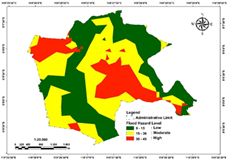
This study develops a transparent MCDA–AHP–GIS framework to screen Multi-Utility Tunnel (MUT) corridor suitability in Panakkukang Sub-district, Makassar City, using 2024 baseline datasets and five criteria: utility/network density (C1), road functional class and corridor capacity (C2), flood susceptibility (C3), activity intensity (C4; proxied by kelurahan-level population density), and spatial planning compatibility with RTRW/RDTR (C5). All layers were standardized and reclassified (1–3 or 1–5) and integrated using Weighted Linear Combination (WLC) with AHP-derived weights (CR = 0.028), where C1 (0.26) and C5 (0.24) were highest, followed by C2 (0.19), C4 (0.16), and C3 (0.15). The 2,918.3-ha study area was classified into Very Unsuitable (88.2 ha; 3.0%), Unsuitable (405.8 ha; 13.9%), Moderately Suitable (764.9 ha; 26.2%), Suitable (935.8 ha; 32.1%), and Highly Suitable (723.6 ha; 24.8%). A corridor-focused overlay shows that 436.9 ha fall within the Suitable–Highly Suitable mask, of which 127.3 ha (29.1%) intersect high flood-hazard zones, indicating that some priority segments require attention during detailed planning. Uncertainty mainly arises from buffer distances and reclassification thresholds and from non-differentiating attributes in some utility layers; however, a ±10% weight sensitivity test yields only minor shifts in class areas and preserves the main priority-corridor pattern.
Downloads
References
Bergman, F., Anderberg, S., Krook, J., & Svensson, N. (2022). A Critical Review of the Sustainability of Multi-Utility Tunnels for Colocation of Subsurface Infrastructure. 4 (February), 1–15.
Deng, F., Pu, J., Huang, Y., & Han, Q. (2023). ScienceDirect 3D geological suitability evaluation for underground space based on the AHP-cloud model. Underground Space, 8, 109–122.
Deng, Z., He, X., & Chai, Y. (2023). An Investment Decision Model for Underground Urban Utility Tunnel Based on MIVES and Real Option Theory from a Sustainable Perspective.
Faisal, M., Hasiri, E. M., Darniati, Asrul, B. E. W., Gani, H., Wahyuni, S., Aini, N., Namruddin, R., & Akib, F. (2025). A Machine Learning-Driven Framework for Evaluating and Clustering City-Level Carbon Trading Strategies. International Journal of Mathematical, Engineering and Management Sciences, 10 (6), 2171–2200.
Faisal, M., Irmawati, Rahman, T. K. A., Jufri, Sahabuddin, Herlinah, & Mulyadi, I. (2025). A Hybrid MOO, MCGDM, and Sentiment Analysis Methodologies for Enhancing Regional Expansion Planning: A Case Study Luwu - Indonesia. International Journal of Mathematical, Engineering and Management Sciences, 10(1), 163–188.
Faisal, M., Sahabuddin, Hasiri, E. M., Darniati, Abd Rahman, T. K., Mulyadi, I., William Asrul, B. E., Wahyuni, S., & Widia, I. D. M. (2025). Assessing AI-Driven Personalization in Smart Cities Using Hybrid Machine Learning and MCDM Approach. HighTech and Innovation Journal, 6 (3), 770–792.
Frimpong, T., Papa, E., Dzifa, L., Ama, M., Rockson, D., & Kemausuor, F. (2025). Optimal siting of waste-to-energy facilities in cape coast metropolis using an integrated GIS-based MCDA and waste characterization approach. Cleaner Waste Systems, 12 (January), 100353.
Gao, Y., Jiang, P., & Li, M. (2021). Spatial planning zoning based on land-type mapping : a case study in Changzhou City , Eastern. Journal of Land Use Science, 16 (5–6), 498–521.
Getachew, B., Lakhan, R., Shantha, N., & Gurau, S. (2025). Progress in Disaster Science Integrating multi-criteria decision analysis and geospatial data for flood susceptibility mapping in Texas , USA. Progress in Disaster Science, 28 (June), 100462.
Hao, M., Ren, W., Xia, W., Fu, J., Zhu, H., Sun, P., Wang, K., & Xu, M. (2024). applied sciences Suitability Evaluation of Urban Underground Space Development : A Case Study of Qingdao City.
Hosen, B., Islam, R., Tahera-tun-humayra, U., Sharker, R., & Hossain, A. (2025). Smart Agricultural Technology Assessing land suitability for dragon fruit cultivation in Bangladesh : a GIS-based AHP approach. Smart Agricultural Technology, 12(May), 101241.
Irawan, S., Anggoro, P., Pratama, R. W., Rassarandi, F. D., Nainggolan, M., Adi, M., Basri, H., Hakim, M. R. Al, Sembiring, R., Simanjuntak, P., Artini, T., & Aji, S. B. (2025). Engineering , Environment , and Technology An Integrated Approach to Land Condition Mapping : Combining Terrestrial Surveys , Photogrammetry , and GIS for Data Center Development in Nongsa Special Economic Zone. 10 (2), 145–153.
Iskandar, B., Zannah, F., & Anshari, R. (2023). Engineering , Environment , and Technology Impact of Land Use Change on Land Capability in Katingan Regency , Central Kalimantan , Indonesia. 8 (3), 229–235.
Majid, M., & Mir, B. A. (2021). Landfill site selection using GIS based multi criteria evaluation technique . A case study of Srinagar city , India. 3 (December 2020).
Mati, E., Tefera, Y., & Bayu, K. 2021. (2021). Landfill Site Selection Using GIS Based Multicriteria Evaluation Technique in Harar City , Eastern Ethiopiaa 2021. 15 (1).
Mulyadi, I., Thamrin, M., Faisal, M., Yunarti, S., Saharuddin, Abd Djalil, A., & Mallu, S. (2024). A Hybrid Model for Palm Sugar Type Classification: Advancing Image-Based Analysis for Industry Applications. Ingénierie Des Systèmes d Information, 29 (5), 1937–1948.
Oh, W., Cho, C., & Lee, M. (2025). Optimized Route Selection for Urban Utility Tunnels Based on Prioritization Analysis. KSCE Journal of Civil Engineering, 100409
Peng, F. Le, Dong, Y. H., Wang, W. X., & Ma, C. X. (2023). The next frontier : data ‑ driven urban underground space planning orienting multiple development concepts. Smart Construction and Sustainable Cities, 1–21.
Peng, Z., Zhang, Y., Tan, F., Lv, J., & Li, L. (2023). Variable-Weight Suitability Evaluation of Underground Space Development Considering Socioeconomic Factors.
Popescu, N., & Alina, B. (2023). Flood Hazard Evaluation Using a Flood Potential Index. 1–18.
Pu, J., Huang, Y., Bi, Y., Guo, Z., Deng, F., Li, X., & Xu, C. (2024). ScienceDirect 3D suitability evaluation of urban underground space using a variable weight method and considering ground restrictions. Underground Space, 19, 208–226.
Rekik, S., & Alimi, S. El. (2023). Energy Conversion and Management : X Optimal wind-solar site selection using a GIS-AHP based approach : A case of Tunisia. Energy Conversion and Management: X, 18 (February), 100355.
Taki, H. M., & Maatouk, M. M. H. (2018). Spatial Statistical Analysis for Potential Transit Oriented Development (TOD ) in Jakarta Metropolitan Region. 03 (01), 47–56.
Taki, H. M., Maatouk, M. M. H., Qurnfulah, E. M., & Aljoufie, M. O. (2017). Engineering , Environment , and Technology Planning TOD with land use and transport integration : a review. 02 (01), 84–94.
Ullah, N., Tariq, A., Qasim, S., Panezai, S., Uddin, G., & Wadud, M. A. Al. (2024). Geospatial analysis and AHP for flood risk mapping in Quetta , Pakistan : a tool for disaster management and mitigation. Applied Water Science, 14 (11), 1–18.
Waheeb, S. A., Zerouali, B., Elbeltagi, A., Alwetaishi, M., & Wong, Y. J. (2023). Enhancing Sustainable Urban Planning through GIS and Multiple-Criteria Decision Analysis : A Case Study of Green Space Infrastructure in Taif Province , Saudi Arabia.
Wang, M., & Yin, X. 2022. (2022). Automation in Construction Construction and maintenance of urban underground infrastructure with digital technologies. Automation in Construction, 141 (May), 104464.
Wang, S., & Fu, S. (2022). Risk Evaluation of Urban Integrated Pipe Corridor Operation and Maintenance Based on Improved AHP-CIM Model. 2022.
Yin & Wang. (2022). Science Mapping for Recent Research Regarding Urban Underground Infrastructure.
Zhang, P., Jin, T., Wang, M., Zhou, N., & Jia, X. (2025). Evaluation of the Suitability of Urban Underground Space Development Based on Multi-Criteria Decision-Making and Geographic Information Systems.
Zhang, Y., Chen, Y., Jiang, F., Deng, Z., Xie, Z., & Zhang, Y. (2023). A Comprehensive Study of the Suitability of Urban Underground Spaces for Connection Development : A Case Study of the Erhai Lake Basin , China.
Zhang, Y., & Peng, H. (2024). Bibliometric analysis of research challenges and trends in urban underground space. August 2023, 207–215.
Zamroni, A., Kurniati, A. C., Nur, H., & Prasetya, E. (2020). Engineering , Environment , and Technology The assessment of landslides disaster mitigation in Java Island , Indonesia : a review. 5 (3), 124–128.
Zhao, H., Li, Z., & Zhou, R. (2022). Tunnelling and Underground Space Technology incorporating Trenchless Technology Research Risk assessment method combining complex networks with MCDA for multi-facility risk chain and coupling in UUS. Tunnelling and Underground Space Technology Incorporating Trenchless Technology Research, 119, 104242.
Downloads
Published
Issue
Section
License
Copyright (c) 2026 Journal of Geoscience, Engineering, Environment, and Technology

This work is licensed under a Creative Commons Attribution-ShareAlike 4.0 International License.
Copyright @2019. This is an open-access article distributed under the terms of the Creative Commons Attribution-ShareAlike 4.0 International License which permits unrestricted use, distribution, and reproduction in any medium. Copyrights of all materials published in JGEET are freely available without charge to users or / institution. Users are allowed to read, download, copy, distribute, search, or link to full-text articles in this journal without asking by giving appropriate credit, provide a link to the license, and indicate if changes were made. All of the remix, transform, or build upon the material must distribute the contributions under the same license as the original.