Soft Layer Identification in Kedamaian District Using the HVSR-Derived Shear Wave Velocity Distribution
DOI:
https://doi.org/10.25299/jgeet.2026.11.1.25294Keywords:
HVSR method, shear wave velocity, seismic vulnerability, microtremor, Kedamaian District, Particle Swarm OptimizationAbstract
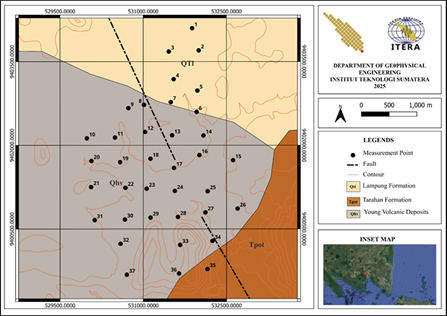
The Kedamaian District in Bandar Lampung City is a densely populated urban area characterized by complex geological settings that are highly susceptible to seismic amplification and geotechnical hazards. Despite its vulnerability, high-resolution characterization of subsurface soft soil deposits in this specific district remains underexplored. The study aims to evaluate local site effects for designing seismic-resistant infrastructures and mitigating geotechnical hazards. This study attempts to locate and determine the characteristics of soft soil deposits in the Kedamaian District, Bandar Lampung City, by means of the HVSR method (Horizontal to Vertical Spectral Ratio) based on the shear wave velocity distribution result. Microtremor measurements were taken from 37 points and processed to estimate the amplification factor (A0), dominant frequency of soil deposit (f0), and seismic vulnerability index (Kg). HVSR inversion used the Particle Swarm Optimization (PSO) to propose average shear wave velocity down to 30 m depth (VS30). Analysis indicated that the amplification values range from 2.31 to 9.11, with most values falling within a moderate level, indicating a moderate local site response. Dominant frequencies range from 0.63 to 18.76 Hz, and higher f0 values are characteristic of more compact and/or complex rock formations, whilst lower f0 values correspond to thicker sediments. Values of the seismic vulnerability index range from 0.48 to 119.24 s, with most sites showing a high seismic vulnerability related to the combined effect of high amplification and low dominant frequency. The distribution suggests that the study region consists predominantly of soft soils (type E) with VS30 ranging from 80.9 to 132.6 m/s, interspersed with medium soils (type D) and less abundant hard rocks (type C). The results show that the Kedamaian is primarily covered with soft sediment formations, which have the potential to enhance strong ground motion during seismic events, as well as for a geotechnical investigation database and hazard assessment of earthquake activities and urban development within the region.
Downloads
References
Ahadi, R.W., Ghifari, S. Al, Taufiquds, K.B., Rasyid, M.F. Al, Makki, M.A., Mulyasari, R., 2023. Studi Pendahuluan Potensi Likuefaksi Menggunakan Pendekatan Geologi, Hidrogeologi, dan Data Vs30 pada Kecamatan Kalianda, Lampung Selatan. Journal Online of Physics 8, 70–74.
Amirudin, Madrinovella, I., Sofian, 2023. Seismic Vulnerability Analysis Using the Horizontal to Vertical Spectral Ratio (HVSR) Method on the West Palu Bay Coastline. Journal of Geoscience, Engineering, Environment, and Technology 8, 23–34.
Antsiferov, A. V., Glukhov, A.A., Kamburova, L.A., 2025. Analysis data of microseismic monitoring of coal–rock mass. Gornyi Zhurnal 35–40.
Apriana, Y., Refrizon, Farid, M., Onawa, J., Hardianza, M., Setyowati, Y., Verentina, S., 2025. Analysis of Potential New Flood Basin in Ratu Agung Sub-district Using the HVSR Method. Journal of Geoscience, Engineering, Environment, and Technology 10, 356–363.
Ariyanto, A., Farduwin, A., Styawan, Y., Putri, I.A., Junian, W.E., Prasetyo, N., Rizki, R., Wulandari, R., 2024. Pemetaan Kerentanan Seismik Melalui Analisis Mikrotremor HVSR di Wilayah Kecamatan Kemiling dan Sekitarnya. JGE (Jurnal Geofisika Eksplorasi) 10, 82–99.
Asnawi, Y., Muksin, U., Tarniati, Y.P., Simanjuntak, A.V.H., Rizal, S., Syukri, M., 2023. Seismic Vulnerability Based on Microtremor Data and HVSR Method in Krueng Raya, Aceh Besar, in: AIP Conference Proceedings. p. 020008.
Dewi, I.K., Resta, I.L., Amin, S.S., Nuklirullah, N., Juventa, J., Situmorang, S., Ramadhani, A.F., 2023. Analisis Kerentanan Tanah Fakultas Sains dan Teknologi Universitas Jambi dengan Menggunakan Data Mikrotremor. Journal Online of Physics 9, 109–115.
Farduwin, A., Antosia, R.M., Putri, I.A., Santoso, N.A., Irawati, S.M., 2021. Inversi Data Geolistrik Menggunakan Particle Swarm Optimization: Studi Kasus Desa Gayau. JGE (Jurnal Geofisika Eksplorasi) 7, 88–99.
Farduwin, A., Yudistira, T., 2021. Shear velocity inversion from ambient seismic noise using RR-PSO: A case study of Nusa Tenggara Island, in: Journal of Physics: Conference Series. p. 012022.
Harlianto, B., Fadli, D.I., Sumanjaya, E., Hadi, A.I., Maulidiyah, A., Suwarsono, Purwanto, E.H., 2025. Seismic Vulnerability Along the Kaur-South OKU Highway in Bengkulu, Indonesia: Planning for More Resilient and Safer Cities. Indian Geotechnical Journal 55, 3042–3057.
Işık, E., Avcil, F., Büyüksaraç, A., Arkan, E., Harirchian, E., 2025. Impact of Local Soil Conditions on the Seismic Performance of Reinforced Concrete Structures: In the Context of the 2023 Kahramanmaraş Earthquakes. Applied Sciences (Switzerland) 15, 2389.
Khayati, N.N., Sudarmaji, Hartantyo, E., 2022. The Effect of Weathered Layer Thickness and Slope on Potential Areas of Landslides in Gerbosari Village, Samigaluh District, Kulonprogo Regency, Indonesia. Journal of Geoscience, Engineering, Environment, and Technology 7, 124–131.
Kubicek, J., Varysova, A., Cerny, M., Skandera, J., Oczka, D., Augustynek, M., Penhaker, M., 2023. Novel Hybrid Optimized Clustering Schemes with Genetic Algorithm and PSO for Segmentation and Classification of Articular Cartilage Loss from MR Images. Mathematics 11, 1027.
Künzel, L.A., Leibfarth, S., Dohm, O.S., Müller, A.C., Zips, D., Thorwarth, D., 2020. Automatic VMAT planning for post-operative prostate cancer cases using particle swarm optimization: A proof of concept study. Physica Medica 69, 101–109.
Ma, H., Liao, B.Y., 2024. Study on Site Effect in Nanning City Using HVSR Method. Civil Engineering and Architecture 12, 1165–1179.
Mahapatra, A.K., Panda, N., Pattanayak, B.K., 2023. Hybrid PSO (SGPSO) with the Incorporation of Discretization Operator for Training RBF Neural Network and Optimal Feature Selection. Arabian Journal for Science and Engineering 48, 9991–10019.
Manan, A., Puspitafuri, C., Chahyani, R., Irawati, Pertiwi, I.I., 2023. Identification of Shear Strain on the Surface Ground of Wangi-Wangi Island, Southeast Sulawesi, Indonesia, Using Nakamura’s Technique and the Possibility of Its Impacts. Journal of Geoscience, Engineering, Environment, and Technology 8, 275–280.
Mangga, S.A., Amirudin, Suwarti, T., Gafoer, S., Sidarto, 2010. Peta Geologi Lembar Tanjungkarang, Sumatera, Edisi Kedua. ed. Pusat Survei Geologi, Bandung.
Molnar, S., Cassidy, J.F., Castellaro, S., Cornou, C., Crow, H., Hunter, J.A., Matsushima, S., Sánchez-Sesma, F.J., Yong, A., 2018. Application of Microtremor Horizontal-to-Vertical Spectral Ratio (MHVSR) Analysis for Site Characterization: State of the Art. Surveys in Geophysics 39, 613–631.
Nakamura, Y., 2019. What is the Nakamura method? Seismological Research Letters 90, 1437–1443.
Nasrudin, A., Sari, A.P., Desmarini, A., Fuadina, F.N., Putri, W.A., 2024. Statistik Daerah Kota Bandar Lampung 2024. Bandar Lampung.
Nateqi, M.H., Amelsakhi, M., Nateqi, M., 2025. A study of the effects of different layering characteristics on the response of two and three-layered semi-sine hills. Iranian Journal of Geophysics 19, 101–120.
Prasetya, A.R., Faris, F., Rahardjo, A.P., 2024. Seismic Vulnerability Assessment Using the HVSR Method at Yogyakarta International Airport Underpass, Indonesia. International Journal of GEOMATE 26, 25–33.
Qadri, S.M.T., Mirza, M.Q., Raja, A., Yaghmaei-Sabegh, S., Hakimi, M.H., Ali, S.H., Khan, M.Y., 2023. Application of Probabilistic Seismic Hazard Assessment to Understand the Earthquake Hazard in Attock City, Pakistan: A Step towards Linking Hazards and Sustainability. Sustainability 15, 1023.
Risa, I.N., Maison, M., Dewi, I.K., 2023. Analisis Kerentanan Tanah Berdasarkan Pengukuran Mikrotremor di Desa Jati Mulyo, Tanjung Jabung Timur. JGE (Jurnal Geofisika Eksplorasi) 9, 18–31.
Saadalla, H., Abdelhafiez, H.E., Ali, S., 2023. Seismic station sites response as a discriminant tool between earthquakes and quarry blasts in Aswan region, Upper Egypt. Journal of African Earth Sciences 199, 104826.
Simanjuntak, N.S., Umar Muksin, Idris, Y., Andi A. Rusdin, 2025. Resonance and Damping Ratio Analysis of the Baiturrahman Mosque Tower Based on Earthquake Ground Shaking. Journal of Geoscience, Engineering, Environment, and Technology 10, 270–274.
Wang, Q., Li, Y., Wu, Y., 2024. Sedimentary structures beneath the Northern Bohai basin constrained by the autocorrelation of receiver function. Chinese Journal of Geophysics (in Chinese) 67, 2291–2303.
Wibowo, N.B., Fathani, T.F., Pramumijoyo, S., Marliyani, G.I., 2024. Comparison of the VS30 model and site class based on MASW, microtremor and N-SPT data in the Opak River Basin, in: IOP Conference Series: Earth and Environmental Science. p. 012002.
Xv, X., Li, Q., 2023. A Study of Soil Shear Strength Sensing Based on Soil Shear Save Velocity, in: 2023 China Automation Congress (CAC). IEEE, pp. 6382–6387.
Yao, X., Wu, B., 2024. Progress in Seismic Isolation Technology Research in Soft Soil Sites: A Review. Buildings 14, 3198.
Yatini, Y., Kustanto Putra, A., Paripurno, E.T., 2023. Application of HVSR Method on Microtremor Data for Analysis of Earthquake Potential in Candipuro District, Lumajang, Indonesia. Journal of Geoscience, Engineering, Environment, and Technology 8, 288–294.
Yudha, A., Laby, D.A., Suprayitno, A., 2023. Implementasi Algoritma Particle Swarm Optimization (PSO) pada Inversi Data Resistivitas 1-D untuk Identifikasi Gas Dangkal. Jurnal Geosaintek 9, 96–105.
Zaenudin, A., Darmawan, I.G.B., Farduwin, A., Wibowo, R.C., 2022. Shear wave velocity estimation based on the particle swarm optimization method of HVSR curve inversion in Bakauheni district, Indonesia. Turkish Journal of Earth Sciences 31, 480–493.
Downloads
Published
Issue
Section
License
Copyright (c) 2026 Journal of Geoscience, Engineering, Environment, and Technology

This work is licensed under a Creative Commons Attribution-ShareAlike 4.0 International License.
Copyright @2019. This is an open-access article distributed under the terms of the Creative Commons Attribution-ShareAlike 4.0 International License which permits unrestricted use, distribution, and reproduction in any medium. Copyrights of all materials published in JGEET are freely available without charge to users or / institution. Users are allowed to read, download, copy, distribute, search, or link to full-text articles in this journal without asking by giving appropriate credit, provide a link to the license, and indicate if changes were made. All of the remix, transform, or build upon the material must distribute the contributions under the same license as the original.