
Analysis of the Potential and Impact of Utilizing Nickel Slag Powder and Recycled Plastic on the Technical Properties of Concrete Blocks: In Terms of Strength and Cost Efficiency
DOI:
https://doi.org/10.25299/jgeet.2025.10.4.24979Keywords:
Concrete Block, Building Materials, Compressive Strength, HDPE, Nickel Slag Powder, Plastic WasteAbstract
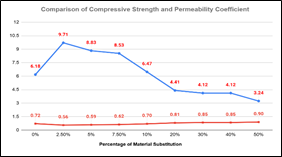
Plastic waste and nickel slag are significant environmental pollutants, while the construction sector demands sustainable building materials. This study investigates the use of nickel slag powder as a partial cement replacement and recycled High-Density Polyethylene (HDPE) plastic as a partial replacement for fine aggregate in concrete block production. Laboratory tests were conducted in accordance with SNI standards for compressive strength, splitting tensile strength, porosity, permeability, and cost. Results showed that low substitution levels (2.5–10%) improved both strength and durability. The highest compressive strength of 10.43 MPa was achieved at a 5% substitution level, compared to 7.13 MPa in the control mix, while the maximum tensile strength of 1.32 MPa was observed at a 2.5% substitution level. Porosity was reduced to 0.97% and permeability to 4.13 × 10⁻⁷ cm/s, indicating a denser microstructure. Cost analysis revealed a reduction from Rp9,128.80 per block (0% substitution) to Rp8,252.36 at 10%, yielding savings of about 9.6%. However, higher substitution levels (>10%) led to strength loss and increased porosity due to incomplete hydration and weak bonding. The results confirm that the optimal substitution range of 2.5–10% balances performance and cost, providing an eco-friendly and cost-effective solution for sustainable concrete block production within a circular economy framework.
Downloads
References
Ahmed, S.N., Hamah Sor, N., Ahmed, M.A. and Qaidi, S.M.A. (2022) ‘Thermal conductivity and hardened behavior of eco-friendly concrete incorporating waste polypropylene as fine aggregate’, Materials Today: Proceedings, 57, pp. 818–823.
Ali, N., Din, N., Khalid, F.S., Shahidan, S., Abdullah, S.R., Abdul Samad, A.A., and Mohamad, N. (2017) ‘Compressive strength and initial water absorption rate for cement brick containing high-density polyethylene (HDPE) as a substitutional material for sand’, IOP Conference Series: Materials Science and Engineering, 271, 012083.
Almeshal, I., Tayeh, B.A., Alyousef, R., Alabduljabbar, H. and Mohamed, A.M. (2020) ‘Eco-friendly concrete containing recycled plastic as partial replacement for sand’, Journal of Materials Research and Technology, 9, pp. 4631–4643.
Ashad, H., Nasution, A., Imran, I. & Soegiri, S. (2010) ‘Optimisasi Bubuk Slag Nikel dengan Sistem Ternary C-A-S’, Jurnal Teknik Sipil, 15(3), p. 123.
Belmokaddem, M., Mahi, A., Senhadji, Y. and Pekmezci, B.Y. (2020) ‘Mechanical and physical properties and morphology of concrete containing plastic waste as aggregate’, Construction and Building Materials, 257, 119559.
Dimitrioglou, N., Tsakiridis, P.E., Katsiotis, N.S., Katsiotis, M.S., Perdikis, P. and Beazi, M. (2016) ‘Production and characterization of concrete paving blocks containing ferronickel slag as a substitute for aggregates’, Waste and Biomass Valorization, 7, pp. 941–951.
El-Metwally, Y., Dewidar, K., Ismail, M. and El-Mahallawi, I. (2023) ‘Optimization of plastic waste integration in cement bricks’, Journal of Engineering and Applied Science, 70, 55.
Fatmawati, L., Supriono, L. & Amadi, D.N. (2021) ‘Pelatihan Pembuatan Batako Desa Jatimulyo Kecamatan Kauman Kabupaten Tulungagung Lokal’, Jurnal Daya-Mas, 6(1), pp. 33–39.
Fenollera, M., Míguez, J., Goicoechea, I. & Lorenzo, J. (2015) ‘Experimental study on thermal conductivity of self-compacting concrete with recycled aggregate’, Materials, 8(7), pp. 4457–4478.
Hadipramana, J., Sari, D.N., Putra, R.A. and Riza, F.V. (2023) ‘Studi terhadap potensi campuran abu kulit kakao dan serbuk cangkang telur sebagai pengganti pasir silika terhadap kekuatan tekan bata ringan’, Jurnal MESIL (Mesin Elektro Sipil), 4, pp. 46–58.
Harahap, S. (2021) Analisa perbandingan biaya serta waktu pelaksanaan material dinding batu bata dan batako pada rumah type 36.
Harmiyati, Ihsyan, N.A. and Syahputri, D. (2024) ‘Analysis of the effect of bagasse addition on compressive strength, porosity and permeability of pervious concrete as material for green building program’, Journal of Geoscience, Engineering, Environment, and Technology, 9(4), pp. 420–425.
Kumara, I.N.I., Tapa, I.G.F.S., Indrashwara, D.C., Pancane, I.W.D. and Predana, M.A. (2025) ‘Value engineering in enhancing green building innovation’, Journal of Geoscience, Engineering, Environment, and Technology, 10, pp. 64–70.
Lamba, P., Kaur, D.P., Raj, S. and Sorout, J. (2022) ‘Recycling/reuse of plastic waste as construction material for sustainable development: A review’, Environmental Science and Pollution Research, 29, pp. 86156–86179.
Limami, H., Manssouri, I., Cherkaoui, K. and Khaldoun, A. (2020) ‘Study of the suitability of unfired clay bricks with polymeric HDPE and PET waste additives as a construction material’, Journal of Building Engineering, 27, 100956.
Meyrena, S.D. & Amelia, R. (2020) ‘Analisis Pendayagunaan Limbah Plastik Menjadi Ecopaving Sebagai Upaya Pengurangan Sampah’, Indonesian Journal of Conservation, 9(2), pp. 96–100.
Mildawati, R., Puri, A. and Handayan, M.Z. (2022) ‘Effects of corn stalk ash as a substitution material of cement due to the concrete strength of rigid pavement’, Journal of Geoscience, Engineering, Environment, and Technology, 7(1), pp. 21–26.
Nabiilah, B.Y., Nelfia, L.O. and Astutiningsih, S. (2019) ‘An innovation of high-performance concrete by replacing cement with nickel slag powder’, International Journal on Livable Space, 4, pp. 77–83.
Nihayah, D.M., Mafruhah, I., Hakim, L. and Suryanto, S. (2022) ‘CO₂ emissions in Indonesia: The role of urbanization and economic activities towards net zero carbon’, Economies.
Oksri-Nelfia, L., Akbar, R. and Astutiningsih, S. (2020) ‘A study of the properties and microstructure of high-magnesium nickel slag powder used as a cement supplement’, IOP Conference Series: Materials Science and Engineering, 829.
Padang, I., Matana, H., Pongbura, S.B. and Marthen, A. (2024) ‘Pemanfaatan limbah plastik HDPE sebagai subsitusi parsial agregat halus terhadap sifat mekanis campuran batako’, Jurnal Cahaya Mandalika, 3, pp. 1720–1726.
Rajawat, S.P.S., Rajput, B.S. & Jain, G. (2022) ‘Concrete strength analysis using waste plastic as a partial replacement for sand’, Materials Today: Proceedings, 62, pp. 6824–6831.
Rosanti, A., Juhana, H. and Ruswandi, U. (2022) Pendidikan hijau (green education) dalam menghadapi isu nasional dan global.
Sarwar, S., Shaibur, M.R., Hossain, M.S., Hossain, M.R., Ahmmed, I., Ahmed, F.F., Sarker, M.A.H. and Shamim, A.H.M. (2023) ‘Preparation of environmentally friendly plastic brick from high-density polyethylene waste’, Case Studies in Chemical and Environmental Engineering, 7, 100291.
Selatan, T., Amalia, I.Y., Studi, P., Metalurgi, T., Lingkungan, J.T. and Editor, K.D. (2024) ‘Pemanfaatan serbuk terak nickel pig iron untuk aplikasi material’, Jurnal Teknologi Lingkungan, 25, pp. 204–209.
Sunarno, Y., Abduh, N., Eka Yuniarto, T., Tumpu, M. and Nelfia, L.O. (2025) ‘Application of carbon nanotube (CNT) to improve mechanical properties of concrete: A comparative analysis with superplasticizer’, Journal of Geoscience, Engineering, Environment, and Technology, 10, pp. 91–96.
Syahrul, La, N., Riska, N., Rio, N. and Masri, N. (2025) ‘Assessing the carbon sequestration potential of ultramafic rocks in the Kolaka Ophiolite Complex, Southeastern Sulawesi: A petrographic, geochemical, and mineralogical study’, Journal of Geoscience, Engineering, Environment, and Technology, 10, pp. 43–50.
Wijaya, R. and Astutiningsih, S. (2021) ‘Studi literatur potensi pemanfaatan terak nikel (slag nikel) sebagai agregat pada mortar dan beton’, Bentang: Jurnal Teoritis dan Terapan Bidang Rekayasa Sipil, 9, pp. 93–100.
Yansiku, S.I. and Duran, Y.G.G.L. (2025) ‘Terak non-besi sebagai tambah semen portland pada beton struktural’, Jurnal Teknik Sipil dan Arsitektur, 30, pp. 138–149.
Zhong, W., Pan, J., Wang, J. & Zhang, C. (2021) ‘Size effect in dynamic splitting tensile strength of concrete: Experimental investigation’, Construction and Building Materials, 270, p. 121449.
Downloads
Published
Issue
Section
License
Copyright (c) 2025 Journal of Geoscience, Engineering, Environment, and Technology

This work is licensed under a Creative Commons Attribution-ShareAlike 4.0 International License.
Copyright @2019. This is an open-access article distributed under the terms of the Creative Commons Attribution-ShareAlike 4.0 International License which permits unrestricted use, distribution, and reproduction in any medium. Copyrights of all materials published in JGEET are freely available without charge to users or / institution. Users are allowed to read, download, copy, distribute, search, or link to full-text articles in this journal without asking by giving appropriate credit, provide a link to the license, and indicate if changes were made. All of the remix, transform, or build upon the material must distribute the contributions under the same license as the original.


