
Seawater Curing Effects on the Long-Term Performance of High-Volume Fly Ash Concrete (HVFAC)
DOI:
https://doi.org/10.25299/jgeet.2026.11.3.22595Keywords:
seawater curing, fly ash, HFVAC, longterm performance, compressive strengthAbstract
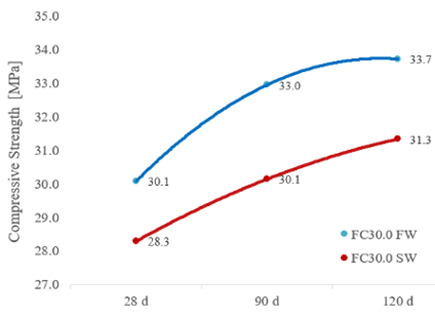
As a maritime nation, Indonesia has many concrete buildings that interact directly with the marine environment. Concrete must be designed to withstand seawater's deteriorative effects on strength and durability of material. This study's objective was to analyze the influence of immersion in seawater on the performance of concrete with 50% fly ash as a supplementary binder material. Three variants of concrete mixes, Fc 22.5, Fc 25, and Fc 30, each with 50% fly ash, were formed into cylindrical specimens and treated by curing in fresh water and seawater. The compressive strength of each specimen was assessed at ages 28, 90, and 120 days. The compressive strength test results of Fc 22.5 with curing treatment in freshwater were 22.0, 26.3, and 27.9 MPa. Conversely, when subjected to seawater curing, the compressive strength values were recorded as 20.3, 25.9, and 27.6 MPa. The results of Fc 25 compressive strength in freshwater curing based on age are (MPa): 27.3, 30.3, and 31.5, while seawater curing produced compressive strengths of (MPa): 25.2, 28.2, and 29.9. In freshwater curing, the Fc 30 compressive strength values were (MPa): 30.1, 33.0, and 33.7, while in seawater curing, the Fc 30 compressive strength values were (MPa): 28.3, 30.1, and 31.3. It was concluded that the compressive strength of concrete with 50% fly ash treated with seawater curing method was lower than that of freshwater curing method at 28, 90, and 120 days. The substitution of cement content with 50% fly ash causes the compressive strength of concrete to continue to increase after 28 days until 120 days of age
Downloads
References
Alterary, S. S., & Marei, N. H. (2021). Fly ash properties, characterization, and applications: A review. In Journal of King Saud University - Science (Vol. 33, Number 6). Elsevier B.V.
Arsyad, F., Lakawa, I., Ilham, V. A., & Hakiman, H. (2023). Study Of Concrete Mixture Using Sea Sand With Fresh Water and Sea Water Cure. Sultra Civil Engineering Journal, 4(1).
Aswad, N. H., Mustika, W., Tachrir, & Hartono, Y. D. (2021). The behaviour of self-compacting concrete (SCC) with nickel slag as fine aggregate towards seawater curing. IOP Conference Series: Earth and Environmental Science, 622(1).
Bachtiar, E., Setiawan, A. M., Setiawan, A., & Fudlailah, P. (2024). Mikrostruktur, Porositas Dan Sifat Mekanik Beton Curing Air Laut. Jurnal Talenta Sipil, 7(1).
Chrismaningwang, G., Basuki, A., & Sambowo, K. A. (2017). The Effect of Seawater Curing on the Correlation between Split Tensile Strength and Modulus of Rupture in High-strength Concrete Incorporating Rice Husk Ash. Procedia Engineering, 171.
Dasar, A., Patah, D., Hamada, H., Sagawa, Y., & Yamamoto, D. (2020). Applicability of seawater as a mixing and curing agent in 4-year-old concrete. Construction and Building Materials, 259, 119692.
Fraternali, F., Spadea, S., & Berardi, V. P. (2014). Effects of recycled PET fibres on the mechanical properties and seawater curing of Portland cement-based concretes. Construction and Building Materials, 61.
Harmiyati, Al Ihsyan, N., & Syahputri, D. (2024). Analysis of the Effect of Bagasse Addition on Compressive Strength, Porosity, and Permeability of Pervious Concrete as Material for Green Building Program. Journal of Geoscience, Engineering, Environment, and Technology, 9(04), 420–425.
Hosseini, S. A. (2022). Seawater curing effects on the permeability of concrete containing fly ash. Advances in Concrete Construction, 14(3), 205–214.
Indriyanto, L. A., Saputra, A., & Sulistyo, D. D. (2020). Pengaruh Air Laut Pada Masa Perawatan Terhadap Infiltrasi Ion Klorida pada Beton Dengan Penambahan Fly Ash 12.5%. Jurnal Riset Rekayasa Sipil Universitas Sebelas Maret, 3(2), 61–67.
Kurniawandy, A., Ismeddiyanto, Haekal, M., & Zikri, R. (2025). Study of the Mechanical Properties of Underwater Concrete in Seawater Environments. Journal of Geoscience, Engineering, Environment, and Technology, 10(1),51–58.
Li, G., Zhou, C., Ahmad, W., Usanova, K. I., Karelina, M., Mohamed, A. M., & Khallaf, R. (2022). Fly Ash Application as Supplementary Cementitious Material: A Review. In Materials (Vol. 15, Number_7).MDPI.
Li, X., Wang, Z., Zhang, M., Liu, R., Wang, Z., Zhang, C., Yan, J., Liu, Y., Zhang, Z., & Wu, W. (2024). Properties of the cement containing hybrid micro-fibers and polymer latex using the orthogonal test: A comparative study of freshwater and seawater curing conditions. Construction and Building Materials, 411.
Moinul Islam, M., Saiful Islam, M., Al-Amin, M., & Mydul Islam, M. (2012). Suitability of sea water on curing and compressive strength of structural concrete. In Journal of Civil Engineering (IEB) (Vol. 40, Number 1).
Nasr, A. A., Chen, S., Wang, Y., Jin, F., & Qiu, L. C. (2022). Strength evaluation of a new underwater concrete type. Case Studies in Construction Materials, 16.
Nelfia, L. O., Rahman, M. R. F., Adijaya, K., & Sunarno, Y. (2025). Analysis of the Potential and Impact of Utilizing Nickel Slag Powder and Recycled Plastic on the Technical Properties of Concrete Blocks: In Terms of Strength and Cost Efficiency. Journal of Geoscience, Engineering, Environment, and Technology, 10(4), 478–485.
Sunarno, Y. (2025a). The influence of fly ash characteristics as a supplementary cementitious material (SCM) on concrete’s mechanical properties. Materials Research Proceedings, 48, 587–596.
Sunarno, Y., Abduh, N., Eka Yuniarto, Tumpu, M., & Nelfia, L. O. (2025b). Application of Carbon Nanotube (CNT) to Improve Mechanical Properties of Concrete: A Comparative Analysis with Superplasticizer. Journal of Geoscience, Engineering, Environment, and Technology, 10(1), 91–96.
Sunarno, Y., Rangan, P. R., Ambun, E., Tumpu, M., Rinanti, A., & Nelfia, L. O. (2024a). Utilization of High-Volume Fly Ash As A Supplementary Cementitious Material In Environmentally Friendly Concrete. Indonesian Journal of Environmental Technology, 7(1), 106–118.
Sunarno, Y., Tjaronge, M. W., & Muhiddin, A. B. (2024b). Mechanical Properties of High-Volume Fly Ash Concrete With Varying Fly Ash Content. ARPN Journal of Engineering and Applied Sciences, 19(16), 1063–1068.
Suraneni, P., Burris, L., Shearer, C. R., & Hooton, R. D. (2021). ASTM C618 Fly Ash Specification: Comparison with Other Specifications, Shortcomings, and Solutions. ACI Materials Journal, 118(1).
Tandilino, F., Hutabarat, L. E., & Simanjuntak, R. M. (2024). Bestmittel and Silicafume Effect on Concrete Compressive Strentgh with Seawater Curing. Jurnal PenSil, 13(1).
Wang, C., Liu, Z., Zhang, T., & Zhang, Y. (2022). Influence of Seawater and Curing Conditions on the Hydration Performance of Portland Cement. Cailiao Daobao/Materials Reports, 36(10).
Wegian, F. M. (2010). Effect of seawater for mixing and curing on structural concrete. IES Journal Part A: Civil and Structural Engineering, 3(4).
Wirth, X., Benkeser, D., Nortey Yeboah, N. N., Shearer, C. R., Kurtis, K. E., & Burns, S. E. (2019). Evaluation of alternative fly ashes as supplementary cementitious materials. ACI Materials Journal, 116(4).
Xiao, S., Zhang, M., Zou, D., Liu, T., Zhou, A., & Li, Y. (2023). Influence of seawater and sea sand on the performance of Anti-washout underwater concrete: The overlooked significance of Mg2+. Construction and Building Materials, 374.
Xu, X., Yang, J., Gu, M., & Li, X. (2017). Effect of Seawater Curing on Microstructure and Properties of Magnesium Potassium Phosphate Cement Paste. Jianzhu Cailiao Xuebao/Journal of Building Materials, 20(5).
Yahya, Z., Abdullah, M. M. A. B., Li, L. Y., Nergis, D. D. B., Hakimi, M. A. A. Z., Sandu, A. V., Vizureanu, P., & Razak, R. A. (2021). Behavior of alkali-activated fly ash through underwater placement. Materials, 14(22).
Yunus, A. (2010). Compressive Strength and Flexural Strength of Concrete with Added Material of Fly Ash as Material of Rigid Pavement. Universitas Sebelas Maret Surakarta.
Zahlim, A., Bachtiar, E., & Makbul, R. (2022). Efek Curing Air Laut Terhadap Kuat Tekan Beton Mutu Tinggi Yang Menggunakan Fly Ash Sebagai Subtitusi Pasir. Borneo Engineering : Jurnal Teknik Sipil, 1(1).
Downloads
Published
Issue
Section
License
Copyright (c) 2026 Journal of Geoscience, Engineering, Environment, and Technology

This work is licensed under a Creative Commons Attribution-ShareAlike 4.0 International License.
Copyright @2019. This is an open-access article distributed under the terms of the Creative Commons Attribution-ShareAlike 4.0 International License which permits unrestricted use, distribution, and reproduction in any medium. Copyrights of all materials published in JGEET are freely available without charge to users or / institution. Users are allowed to read, download, copy, distribute, search, or link to full-text articles in this journal without asking by giving appropriate credit, provide a link to the license, and indicate if changes were made. All of the remix, transform, or build upon the material must distribute the contributions under the same license as the original.


