The Effect of Microsilica on Expanding Cement for Micro-Annulus Problem in Gas Migration
DOI:
https://doi.org/10.25299/jgeet.2025.10.1.1.24440Keywords:
Gas Migration, Laboratory Testing, Micro Annulus, MicrosilicaAbstract
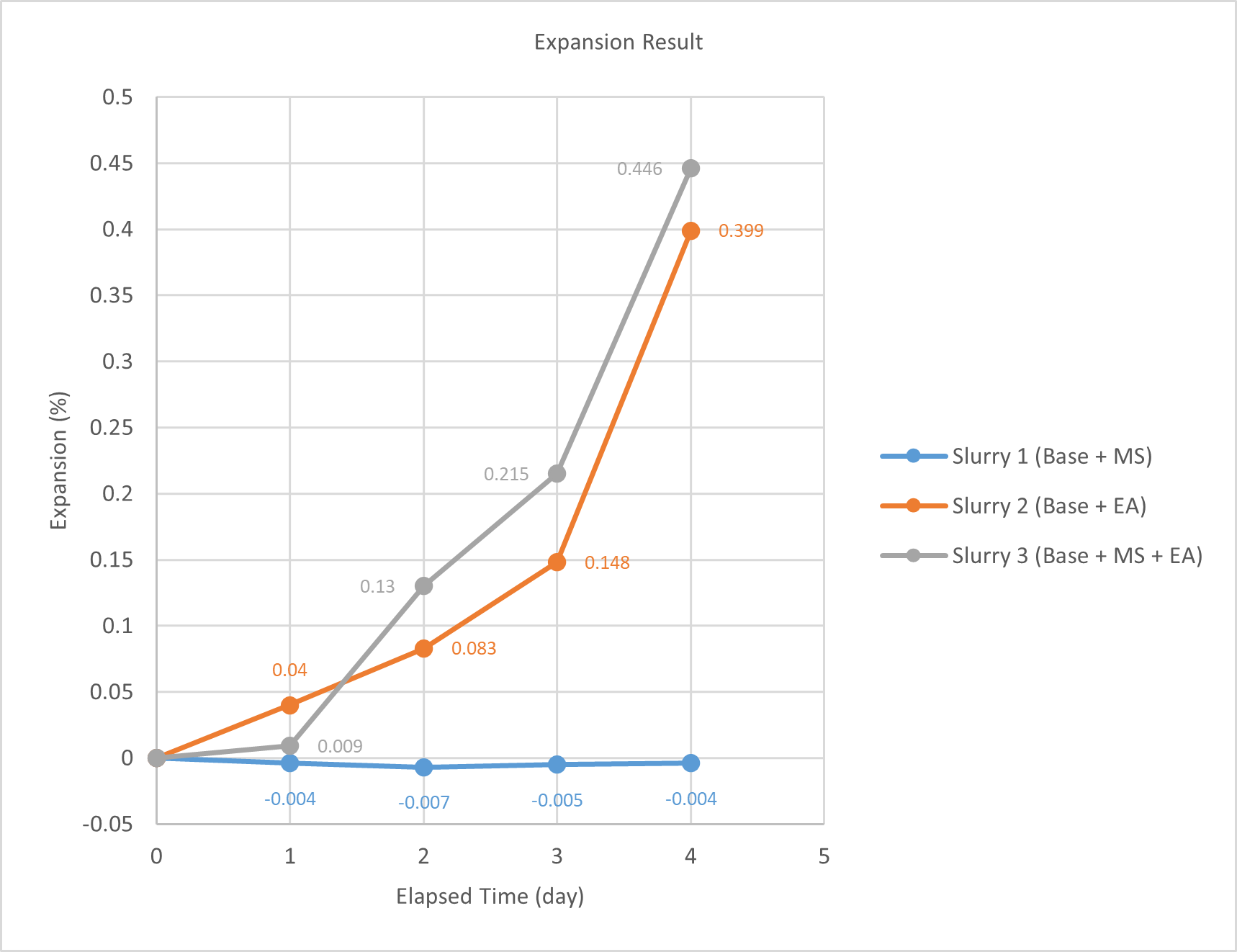
Gas migration through cement slurry and micro-annuli remains a major well integrity. Improper cementation can lead to micro-annulus formation, enabling gas leakage and increasing blowout risk as downhole pressure decreases. Microsilica has been widely used as an anti-gas migration additive due to its ability to reduce permeability and improve cement stability; however, its effect on expanding cement systems has not been fully evaluated. This study investigates the influence of microsilica on the physical and mechanical properties of expanding cement slurry and its interaction with conventional expanding additives. Three slurry formulations—base slurry with microsilica, base slurry with expanding additive, and a combined microsilica–expanding additive system—were prepared and tested following API RP 10B procedures, including density, rheology, fluid loss, free water, thickening time, compressive strength, and expansion ring testing. Results show that microsilica provides beneficial effects by reducing fluid loss, eliminating free water, increasing compressive strength, and enhancing post-set expansion performance when combined with expanding additives. However, microsilica also increases slurry viscosity and shortens thickening time, potentially affecting pumpability and placement. Expansion ring tests indicate that the combined microsilica–expanding additive slurry exhibits the highest expansion (0.446% at 96 hours), whereas cement with microsilica alone shows initial shrinkage before gradual expansion. Overall, microsilica acts as a complementary additive that improves the performance of expanding cement but requires careful optimization to avoid negative impacts on rheology and setting behavior. The findings highlight the importance of additive balancing in designing cement systems for gas-migration-resistant well completions.
Downloads
References
Al Ramadan, M., Salehi, S., Aljawad, M.S. and Teodoriu, C. (2021) Numerical modeling of gas migration through cement sheath and microannulus, ACS Omega, 6(50), pp. 34931–34944. doi:10.1021/acsomega.1c05566.
Al-Yami, A.S., Ramasamy, J. and Wagle, V. (2017) Chemical additives for oil well cementing, Journal of Chemistry, 6(4), pp. 1–14.
American Petroleum Institute (1997) API recommended practice for testing well cements (API RP 10B). Washington, DC: American Petroleum Institute.
BASF Corporation (2016) Concrete technology in focus: Overview.
Bayanak, M., Zarinabadi, S., Shahbazi, K. and Azimi, A. (2021) Comprehensive review on gas migration and preventative strategies through well cementing, International Journal of New Chemistry, 8, pp. 16–29.
Bubshait, A.A., Tahir, B.M. and Jannadi, M.O. (1996) Use of microsilica in concrete construction, Construction Science and Technology. Routledge. doi:10.1080/09613219608727497.
Cement Test Equipment Inc. (2017) CTE – expansion molds.
DeBruijn, G. (2024) Common well cementing problems and solutions. Pegasus Vertex, Inc.
Grinrod, M., Vassoy, B. and Dingsoyr, E.O. (1988) Development and use of a gas tight cement, SPE Drilling Engineering. doi:10.2118/17258-MS.
Haijin, Z., Jiansheng, Q., Aiping, L., Jianlong, Z. and Jiaxing, X. (2010) A new method to evaluate gas migration for cement slurries. doi:10.2118/131052-MS.
Jones, R.R. and Carpenter, R.B. (1991) New latex, expanding thixotropic cement systems improve job performance and reduce costs, in Proceedings of the SPE Conference. Society of Petroleum Engineers, pp. 125–134. doi:10.2118/21010-MS.
Kwatia, G., Al Ramadan, M., Salehi, S. and Teodoriu, C. (2019) Enhanced cement composition for preventing annular gas migration, in Proceedings of the ASME 2019 38th International Conference on Ocean, Offshore and Arctic Engineering (OMAE2019). American Society of Mechanical Engineers. doi:10.1115/OMAE2019-95589.
Lyons, W.C. (2010) Formation evaluation, in Working guide to reservoir engineering. Oxford: Elsevier, pp. 97–232. doi:10.1016/B978-1-85617-824-2.00002-2.
Nur, S., Rubiandini, R., Siregar, S. and Nawangsidi, D. (2005) The effect of expanding additives to improve cement isolation strength at 250°C and 2000 psi conditions.
Pattinasarany, A. and Irawan, S. (2012) The novel method to estimate the effect of cement slurry consistency on friction pressure in oil and gas well cementing, Research Journal of Applied Sciences, Engineering and Technology, 4(22), pp. 4596–4606.
Sabins, F.L. (1990) Problems in cementing horizontal wells. doi:10.2118/20005-PA.
Saroyo, B., Soeyatmo, I. and Supriyadi (2010) Pengembangan formulasi expanding agent material semen pengeboran dengan memanfaatkan dolomit alami. LEMIGAS, Indonesia.
Shadizadeh, S.R., Kholghi, M. and Salehi Kassaei, M.H. (2010) Experimental investigation of silica fume as a cement extender for liner cementing in Iranian oil and gas wells, Journal of Petroleum Science and Engineering.
Tao, C., Rosenbaum, E., Kutchko, B.G. and Massoudi, M. (2021) A brief review of gas migration in oilwell cement slurries, Energies, 14(9), Article 2369. doi:10.3390/en14092369.
Tran, N.P., Gunasekara, C., Law, D.W., Houshyar, S., Setunge, S. and Cwirzen, A. (2021) A critical review on drying shrinkage mitigation strategies in cement-based materials, Journal of Building Engineering, 41, 102210. doi:10.1016/j.jobe.2021.102210.
Velayati, A., Kazemzadeh, E., Soltanian, H. and Tokhmechi, B. (2015) Gas migration through cement slurries analysis: A comparative laboratory study.
Downloads
Published
Issue
Section
License
Copyright (c) 2025 Journal of Geoscience, Engineering, Environment, and Technology

This work is licensed under a Creative Commons Attribution-ShareAlike 4.0 International License.
Copyright @2019. This is an open-access article distributed under the terms of the Creative Commons Attribution-ShareAlike 4.0 International License which permits unrestricted use, distribution, and reproduction in any medium. Copyrights of all materials published in JGEET are freely available without charge to users or / institution. Users are allowed to read, download, copy, distribute, search, or link to full-text articles in this journal without asking by giving appropriate credit, provide a link to the license, and indicate if changes were made. All of the remix, transform, or build upon the material must distribute the contributions under the same license as the original.