
4D Seismic Analysis of Hydrocarbon Reservoir at Hugin Formation, Volve Field, North Sea
DOI:
https://doi.org/10.25299/jgeet.2025.10.1.1.24368Keywords:
4D Seismic Inversion, Acoustic Impedance, Time-lapse, Water InjectionAbstract
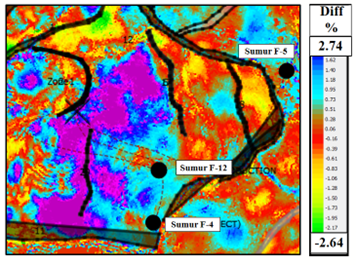
This study investigates the 4D seismic analysis of oil-filled hydrocarbon reservoirs in the Volve Field. A primary objective is to model reservoir changes resulting from water injection activities using a time-lapse model-based inversion approach. The study employs Volve 3D seismic data from 2002 as a baseline and 2010 data as a monitor. Well logs used for the inversion include injection wells F-4 and F-5 and production well F-12. Inversion of the baseline and monitor seismic volumes reveals a distribution of acoustic impedance values ranging from 6770 to 12008 (m/s)*(g/cc). Time-lapse analysis, conducted by differencing the inverted baseline and monitor acoustic impedance volumes, reveals an average increase of approximately 2.74% in acoustic impedance in the vicinity of the injection and production wells. This increase is interpreted as a response to the migration of injected fluids into the reservoir. The spatial distribution of impedance changes suggests that the injected fluids preferentially migrate within the Middle Zone, rather than the Lower Hugin Zone. This behavior is likely controlled by the increased shale content in the Lower Hugin Zone, which acts as a permeability barrier and restricts downward fluid movement.
Downloads
References
Cooke, D.A. and Schneider, W.A. (1983) Generalized linear inversion of reflection seismic data, Geophysics, 48(6), pp. 665–676. doi:10.1190/1.1441497.
Danaei, S., Hermana, M. and Ghosh, D.P. (2018) 4D seismic qualitative interpretation for water injection monitoring: Case study in Southeast Asia, in Offshore Technology Conference Asia, March 2018. OTC. doi:10.4043/28505-MS.
Lumley, D. (1996) 4D seismic reservoir monitoring. Course book.
Lumley, D.E. (2001) Time-lapse seismic reservoir monitoring, Geophysics, 66(1), pp. 50–53. doi:10.1190/1.1444921.
Rosa, D.R., Santos, J.M., Souza, R.M., Grana, D., Schiozer, D.J., Davolio, A. and Wang, Y. (2020) Comparing different approaches of time-lapse seismic inversion, Journal of Geophysics and Engineering, 17(6), pp. 929–939. doi:10.1093/jge/gxaa053.
Russell, B.H. (1988) Introduction to seismic inversion methods. Tulsa, OK: Society of Exploration Geophysicists. doi:10.1190/1.9781560802303.
Sastra, M.M. (2023) Karakteristik reservoir hidrokarbon silisiklastik: Studi kasus Formasi Hugin, North Sea, UNISTEK, 10(1), pp. 13–24. doi:10.33592/unistek.v10i1.3299.
Sen, S. and Ganguli, S.S. (2019) Estimation of pore pressure and fracture gradient in the Volve Field, Norwegian North Sea, in SPE Oil and Gas India Conference and Exhibition, April 2019. SPE. doi:10.2118/194578-MS.
Smith, T.M., Sondergeld, C.H. and Rai, C.S. (2003) Tutorial Gassmann fluid substitutions, Geophysics, 68(2), pp. 430–440. doi:10.1190/1.1567211.
Szydlik, T., Smith, P., Way, S., Aamodt, L. and Friedrich, C. (2007) 3D PP/PS prestack depth migration on the Volve Field, First Break, 25, pp. 43–47. doi:10.3997/1365-2397.25.1106.27412.
Downloads
Published
Issue
Section
License
Copyright (c) 2026 Journal of Geoscience, Engineering, Environment, and Technology

This work is licensed under a Creative Commons Attribution-ShareAlike 4.0 International License.
Copyright @2019. This is an open-access article distributed under the terms of the Creative Commons Attribution-ShareAlike 4.0 International License which permits unrestricted use, distribution, and reproduction in any medium. Copyrights of all materials published in JGEET are freely available without charge to users or / institution. Users are allowed to read, download, copy, distribute, search, or link to full-text articles in this journal without asking by giving appropriate credit, provide a link to the license, and indicate if changes were made. All of the remix, transform, or build upon the material must distribute the contributions under the same license as the original.


