
Integrated Analysis of Seismic and Well Data to Determine CO₂ Injection Zones in “W” Field of The Talang Akar Formation, Asri Basin
DOI:
https://doi.org/10.25299/jgeet.2025.10.1.1.24363Keywords:
Model-Based Inversion, Seal Storage, Injectivity, Saline AquiferAbstract
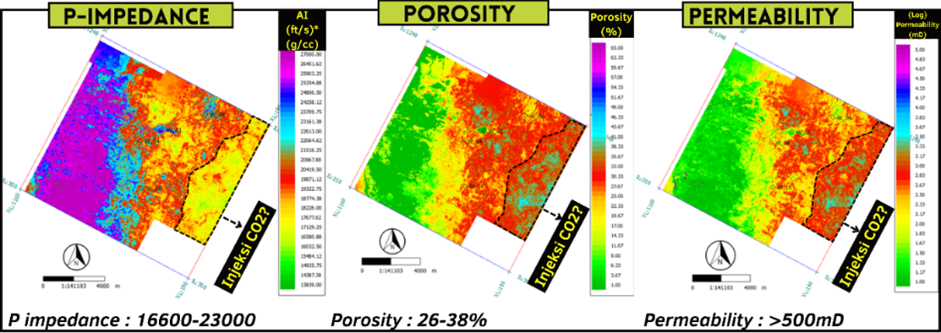
Asri Basin is one of the most prospective areas to store CO₂ in a CCS project in Indonesia. Previously, Asri basin was one of the most prolific oil and gas provinces in the region. This study characterizes the CO₂ injection zone in the saline aquifer reservoir by analyzing seal, storage, and injectivity. A model-based seismic inversion method was used to produce an acoustic impedance volume, which was then transformed into a porosity volume and a permeability volume. Also, analysis of seismic variance attributes was also carried out to investigate the presence of faults surrounding the seal. The results indicated that the seal quality criteria in the study area are satisfactory because no faults intersect the seal. The average distribution of porosity values in the injection target zone is 32%, with the distribution of permeability values being more than 500 mD, making the area satisfactory for CO₂ injection.
Downloads
References
Carter, D.C., Armon, J., Harmony, W.E., Himawan, R.S., Lukito, P., Syarkawi, I. and Tonkin, P.C. (1998) Channel and sandstone body geometry from 3D seismic and well control in Widuri Field, offshore SE Sumatra, Indonesia, in Proceedings of the Indonesian Petroleum Association, Twenty-Sixth Annual Convention, May 1998.
Carter, D.C., Harmony, W.E., Harvidya, L., Juniarto, G., Lestari, S. and Purba, A. (2002) Seismic interpretation methodology for fluvial sandstone reservoirs, in Proceedings of the Indonesian Petroleum Association, Twenty-Eighth Annual Convention & Exhibition, vol. 1.
Carvajal, C., Fernandez, J. and Aristimuno, J. (2022) Well tie tutorial and its importance in seismic interpretation and inversion.
Davis, T.L., Landrø, M. and Wilson, M. (eds.) (2019) Geophysics and geosequestration. Cambridge: Cambridge University Press. doi:10.1017/9781316480724.
Halland, E.K., Riis, F., Magnus, C., Johansen, W.T., Tappel, I.M., Gjeldvik, I.T. and Pham, V.T.H. (2013) CO₂ storage atlas of the Norwegian part of the North Sea, Energy Procedia, 37, pp. 4919–4926. doi:10.1016/j.egypro.2013.06.403.
Muliani, R., Widiatmo, R., Gunawan, H., Nugroho, P., Hairunnisa, M.A. and Saputra, R. (2018) New approach: Using relative inversion with spectral decomposition to distinguish thin layers in the 33-series sand reservoirs of the Widuri Field, Southeast Sumatra, Indonesia, in Proceedings of the Indonesian Petroleum Association, Forty-Second Annual Convention & Exhibition, May 2018. doi:10.29118/IPA18.10.G.
Ralanarko, D., Ramadhan, M.I., Fauzielly, L. and Syafri, I. (2021) Asosiasi fasies dan rekonstruksi paleogeografi pada zona transisi Formasi Talangakar, Cekungan Asri, lepas pantai Blok Tenggara Sumatra, Indonesia, Jurnal Geologi Kelautan, 19(2). doi:10.32693/jgk.19.2.2021.736.
Ravizon, Y., Nugroho, P., Dondo, M., Tumanggor, P. and Winiarti (2025) Low quality reservoir development of Upper Talang Akar Formation shaly sand reservoir in Widuri Field, Southeast Sumatra, in Proceedings of the Indonesian Petroleum Association, Forty-Ninth Annual Convention & Exhibition, May 2025.
Russell, B.H. (1988) Introduction to seismic inversion methods. Tulsa, OK: Society of Exploration Geophysicists. doi:10.1190/1.9781560802303.
Sukanto, J., Nunuk, F., Aldrich, J.B., Rinehart, G.P. and Mitchell, J. (1998) Petroleum systems of the Asri Basin, Java Sea, Indonesia, in Proceedings of the Indonesian Petroleum Association, Twenty-Sixth Annual Convention.
Sukaryadi, E.K.A. (2002) Characteristics and sandbody geometry of the 34-1 reservoir, Widuri Field offshore Southeast Sumatra, in Proceedings of the Indonesian Petroleum Association, Twenty-Eighth Annual Convention & Exhibition, vol. 1.
Downloads
Published
Issue
Section
License
Copyright (c) 2026 Journal of Geoscience, Engineering, Environment, and Technology

This work is licensed under a Creative Commons Attribution-ShareAlike 4.0 International License.
Copyright @2019. This is an open-access article distributed under the terms of the Creative Commons Attribution-ShareAlike 4.0 International License which permits unrestricted use, distribution, and reproduction in any medium. Copyrights of all materials published in JGEET are freely available without charge to users or / institution. Users are allowed to read, download, copy, distribute, search, or link to full-text articles in this journal without asking by giving appropriate credit, provide a link to the license, and indicate if changes were made. All of the remix, transform, or build upon the material must distribute the contributions under the same license as the original.


