
Semi-Automatic Segmentation of Igneous Rocks Thin Section Using SAGA: Application on Crystal Size Distribution (SCD) Based Residence Time Approximation
DOI:
https://doi.org/10.25299/jgeet.2025.10.1.1.24271Keywords:
Crystal Size Distribution (CSD), Segmentation, Petrography, Residence time, Igneous rocksAbstract
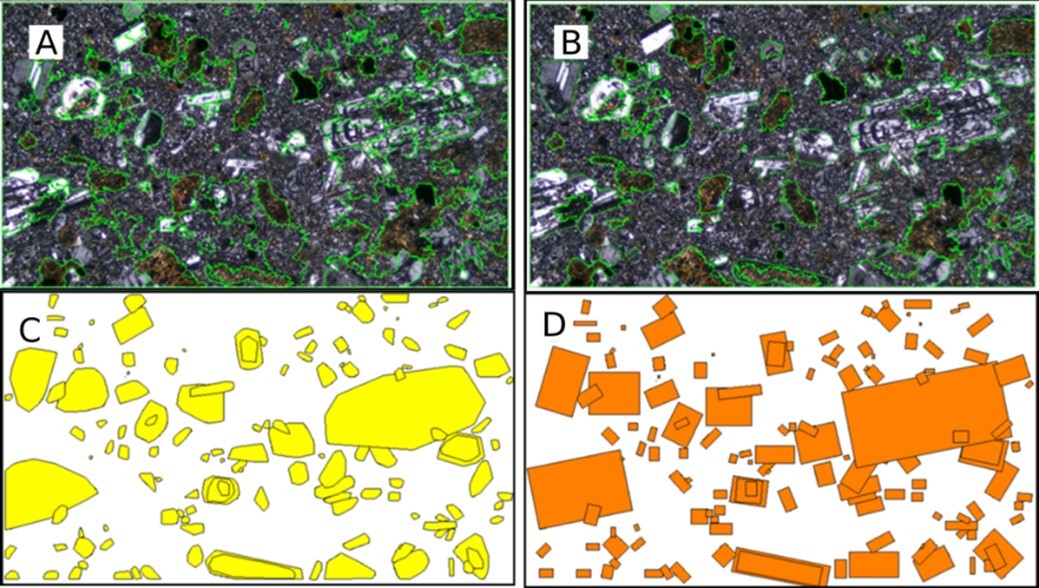
Crystal Size Distribution (CSD) is a quantitative method used to assess magmatic processes such as cooling rates, crystallization durations, and crystal growth dynamics. Traditionally, mineral segmentation in CSD analysis is performed manually, which is labor-intensive, particularly for large datasets. This study investigates a semi-automatic segmentation approach to improve efficiency in analyzing thin sections of igneous rocks. The segmentation process is divided into two methods: semi-automatic segmentation using SAGA software and manual segmentation for validation. The analysis focuses on phenocrysts (>0.2 mm) and microphenocrysts (0.2–<0.02 mm), with images taken using a polarizing microscope at 4x magnification. While the semi-automatic method showed limitations due to the thin section texture and the inherent characteristics of the OBIA algorithm, it proved effective in estimating magma residence time with an average absolute error of 0.4 years. Additionally, the method demonstrated a mean regression gradient error of 79% for microphenocrysts and 55% for phenocrysts, supporting its application in magma dynamics interpretation. This approach enhances the practicality of CSD analysis, particularly in large datasets, and provides a valuable tool for studying crystallization processes in igneous rocks. However, direct application for interpreting magma dynamic should be done with caution.
Downloads
References
Asmussen, P., Conrad, O., Günther, A., Kirsch, M. and Riller, U. (2015) ‘Semi-automatic segmentation of petrographic thin section images using a seeded-region growing algorithm with an application to characterize weathered subarkose sandstone’, Computers & Geosciences, 83, pp. 89–99. doi:10.1016/j.cageo.2015.05.001
Bechtel, B., Ringeler, A. and Böhner, J. (2008) ‘Segmentation for object extraction of trees using MATLAB and SAGA’, SAGA – Seconds Out: Hamburger Beiträge zur Physischen Geographie und Landschaftsökologie. Hamburg: University of Hamburg, Institute for Geography, pp. 1–12.
Blaschke, T. et al. (2014) ‘Geographic object-based image analysis – Towards a new paradigm’, ISPRS Journal of Photogrammetry and Remote Sensing, 87, pp. 180–191. doi:10.1016/j.isprsjprs.2013.09.014
Castilla, G. and Hay, G.J. (2008) ‘Image objects and geographic objects’, in Blaschke, T., Lang, S. and Hay, G.J. (eds.) Object-based image analysis: Spatial concepts for knowledge-driven remote sensing applications. Berlin and Heidelberg: Springer, pp. 91–110. doi:10.1007/978-3-540-77058-9_5
Chanou, A., Osinski, G.R. and Grieve, R.A.F. (2014) ‘A methodology for the semi-automatic digital image analysis of fragmental impactites’, Meteoritics & Planetary Science, 49, pp. 621–635. doi:10.1111/maps.12267
Conrad, O. et al. (2015) ‘System for automated geoscientific analyses (SAGA) v. 2.1.4’, Geoscientific Model Development, 8, pp. 1991–2007.
Higgins, M.D. (2000) ‘Measurement of crystal size distributions’, American Mineralogist, 85, pp. 1105–1116.
Higgins, M.D. (2006) Quantitative textural measurements in igneous and metamorphic petrology. Cambridge: Cambridge University Press. doi:10.1017/CBO9780511535574
Higgins, M.D. (2011) ‘Textural coarsening in igneous rocks’, International Geology Review, 53, pp. 354–376.
Higgins, M.D. and Roberge, J. (2003) ‘Crystal size distribution of plagioclase and amphibole from Soufrière Hills Volcano, Montserrat: Evidence for dynamic crystallization–textural coarsening cycles’, Journal of Volcanology and Geothermal Research, 44, pp. 1–11.
Juniati, E. and Arrofiqoh, E.N. (2017) ‘Comparison of pixel-based and object-based classification using parameters and non-parameters approach for the pattern consistency of multi-scale land cover’, The International Archives of the Photogrammetry, Remote Sensing and Spatial Information Sciences, 42, pp. 765–771.
Marsh, B.D. (1998) ‘On the interpretation of crystal size distributions in magmatic systems’, Journal of Petrology, 39, pp. 553–599. doi:10.1093/petrology/39.4.553
Morgan, D.J. and Jerram, D.A. (2006) ‘On estimating crystal shape for crystal size distribution analysis’, Journal of Volcanology and Geothermal Research, 154, pp. 1–7. doi:10.1016/j.jvolgeores.2005.09.016
Nugroho, R.P. et al. (2019) ‘Crystal size distribution (CSD) of plagioclase phenocryst–microphenocryst and the calculation of crystal residence times in the continuous central eruption sequences of Mount Lasem, Central Java, Indonesia’, Journal of Physics: Conference Series, 1363, 012041. doi:10.1088/1742-6596/1363/1/012041
Nugroho, R.P., Widjaya, V.V.B. and Roviansah, M. (2024) ‘Preliminary result on optimum seed generation bandwidth for object-based image segmentation (OBIS) of porphyritic igneous thin sections’, Jurnal Geologi dan Sumberdaya Mineral, 25, pp. 55–63.
Sobolev, S.N. et al. (2023) ‘Crystal size distribution as a key to understanding protocumulus evolution in layered intrusions: Experiments, calculations, and practice of CSD extraction’, Petrology, 31, pp. 648–663. doi:10.1134/S0869591123060097
Suhendro, I. et al. (2024) ‘Petrology, geochemistry, and crystal size distribution of the basaltic andesite–dacite association at Mt. Sumbing, Central Java, Indonesia: Insights to magma reservoir dynamics and petrogenesis’, Acta Geochimica, 43, pp. 838–855. doi:10.1007/s11631-024-00673-7
Van der Zwan, F.M., Chadwick, J.P. and Troll, V.R. (2013) ‘Textural history of recent basaltic andesites and plutonic inclusions from Merapi volcano’, Contributions to Mineralogy and Petrology, 166, pp. 43–63. doi:10.1007/s00410-013-0864-7
Downloads
Published
Issue
Section
License
Copyright (c) 2025 Journal of Geoscience, Engineering, Environment, and Technology

This work is licensed under a Creative Commons Attribution-ShareAlike 4.0 International License.
Copyright @2019. This is an open-access article distributed under the terms of the Creative Commons Attribution-ShareAlike 4.0 International License which permits unrestricted use, distribution, and reproduction in any medium. Copyrights of all materials published in JGEET are freely available without charge to users or / institution. Users are allowed to read, download, copy, distribute, search, or link to full-text articles in this journal without asking by giving appropriate credit, provide a link to the license, and indicate if changes were made. All of the remix, transform, or build upon the material must distribute the contributions under the same license as the original.


