Characteristic of Mineral Alteration of Geothermal in Endut Mount Based on Petrography, Spectra, XRD, and MeB methods
DOI:
https://doi.org/10.25299/jgeet.2026.11.1.21933Keywords:
Mineral Alteration, Geothermal Prospect, Endut Mount, Propylitic Type, Reservoir ZoneAbstract
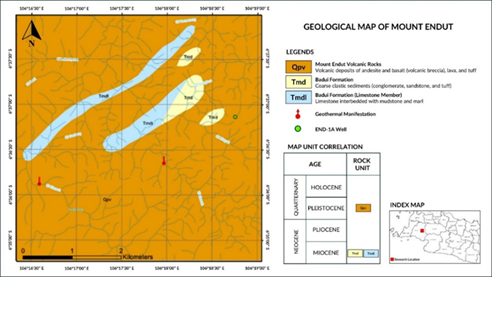
Endut Mount is one of the geothermal prospect locations in Indonesia. In order to optimize the geothermal potential of the research area, it is necessary to conduct research on geothermal characteristics. One such study is the examination of altered minerals in geothermal manifestations. The primary objective of this research is to conduct alteration investigations utilizing coring data obtained from the drilling of Well 1 by petrography, MeB, Spectra, and XRD method approaches. The result of the research shows that the lithology of this Well is a product of Endut Mount activity, with an intensity ranging from medium to strong. The lithology is composed of altered tuff and altered andesite breccia, which are a product of the Pleistocene period, and altered volcanic breccia and altered tuff breccia, which are a product of the Miocene period. This lithology is based on the oldest to the youngest succession. The alteration assemblages in Well 1 are classified into two zones based on the assemblage of alteration minerals: the illite-chlorite±epidote zone, which is located at a depth of 9.7– 40.9 MD, and the smectite-sericite-chlorite-epidote zone, which is located at a depth of 40.9 – 111.15 MD. The type of alteration in Well 1 is propylitic, with a neutral pH and a temperature range of 200oC to 300oC, as indicated by the mineral composition and alteration zone. This alteration zone has the potential to function as a reservoir zone.
Downloads
References
Adikusuma, R., Supriyanto, Sahdarani, D.N., 2019. Petrologi dan Petrogenesis Batuan Beku Daerah Gunung Endut, Provinsi Banten. Universitas Indonesia.
Augusty, D.G., Bagaskara, M.F., Alya Oktaviani, dan D., 2022. Analysis of Geothermal Potential in Mt. Karang, Banten, Using Remote Sensing Method, Ilmu Pengetahuan dan Teknologi.
Beaufort, D., Papapanagiotou, P., Fouillac, A., H, H.T., 1996a. I/S and C/S Mixed Layers, some Indicators of Recent Physicalchemical Changes in Active Geothermal Systems: the Case Study of Chipilapa (El Salvador). Stanford, California:
Calvin, W.M., Pace, E.L., 2016. Mapping Alteration in Geothermal Drill Core Using a Field Portable Spectroradiometer. Geothermics 61, 12–23.
Corbett, G., Leach, T.., 1998. Southwest Pacific Rim Gold-Copper System:Structure, Alteration, and Mineralization, in: Soc Econ Geol.
Deer, W.A., Howie, R.A., Zussman, J., 2013. An Introduction to the Rock-Forming Minerals.
Fournier, R., 1985. The Behavior of Silica in Hydrothermal Solutions, in: in: Berger BR, Bethke PM, Editors, Geology and Geochemistry of Epithermal Systems. Littleton: Society of Economic Geologists.
Fulignati, P., 2020. Clay Minerals in Hydrothermal Systems. Minerals 10, 1–17.
Heap, M.J., Gravley, D.M., Kennedy, B.M., Gilg, H.A., Bertolett, E., Barker, S.L.L., 2020. Quantifying the Role of Hydrothermal Alteration in Creating Geothermal and Epithermal Mineral Resources: The Ohakuri ignimbrite (Taupō Volcanic Zone, New Zealand). J. Volcanol. Geotherm. Res. 390, 106703.
Hedenquist, J.W., Arribas, A., 2022. Exploration Implications of Multiple Formation Environments of Advanced Argillic Minerals. Econ. Geol. 117, 609–643.
Khasmadin, M.F., Harmoko, U., 2021. Kajian Potensi dan Pemanfaatan Energi Panas Bumi di Wilayah Kerja Panas Bumi Patuha Ciwidey. J. Energi Baru dan Terbarukan 2, 101–113.
Kraal, K.O., Ayling, B.F., DeOreo, S., Calvin, W.M., 2024. Infrared Spectroscopy as a Tool for Hydrothermal Alteration Mineral Analysis to Support Geothermal Reservoir Characterization at The Geysers, California, USA. J. Volcanol. Geotherm. Res. 445, 107968.
Lagat, J., 2017. Hydrothermal Alteration Mineralogy in Geothermal Fields with Case Examples from Olkaria Domes Geothermal Field, Kenya.
Maitre, R.W. Le, 2002. Igneous Rocks; A Classification and Glossary of Terms., 2nd ed. Cambridge Unievrsity Press.
Marry, R.., Armawi, A., Hadna, A.., Pitoyo, A.J., 2017. Panas Bumi Harta Karun Yang Terpendam Menuju Ketahanan Energi. J. Ketahanan Nas. 23, 93.
Maza, S.N., Collo, G., Morata, D., Taussi, M., Vidal, J., Mattioli, M., Renzulli, A., 2021. Active and Fossil Hydrothermal Zones of the Apacheta Volcano: Insights for the Cerro Pabellón Hidden Geothermal System (Northern Chile). Geothermics 96.
Milicich, S.D., Chambefort, I., Wilson, C.J.., Charlier, B.L.., Tepley, F.J., 2018. Hydrothermal-Geothermal New Zealand. J. Volcanol. Geotherm. Res. 353, 114–131.
Morrison, K., 1996. The Kingston Morrison of Hydrothermal Minerals.
Nurdin, N.M., Aditya, L.P., Rezky., Y., Munandar, A., 2023. Pengeboran dan survei landaian suhu panas bumi di daerah Gunung Endut (2 x 500 m), in: Prosiding Hasil Kegiatan Pusat Sumber Daya Mineral Batubara Dan Panas Bumi Tahun Anggaran 2023. Pusat Sumber Daya Mineral Batubara Dan Panas Bumi, Kelompok Kerja Keprospekan Dan Evaluasi Sumber Daya Dan Cadangan Panas Bumi. Bandung. Bandung.
Padrique, M.G.C., Narag, M.J.G., Fernando, A.G.S., Soriano, M.N., 2025. Enhancing Geothermal Petrography with Convolutional Neural Networks. Geothermics 127.
Permana, A.L., Sukaesih, Candra, 2021. Survey Rinci Geologi Daerah Panas Bumi Gunung Endut, Kabupaten Lebak, Provinsi Banten, in: Hasil Kegiatan Pusat Sumber Daya Mineral Batubara Dan Panas Bumi Tahun Anggaran 2021.
Permana, L.A., Candra, Rezky, Y., 2021. Geologi Rinci Daerah Gunung Endut dan Implikasinya terhadap Pembentukan Sistem Panas Bumi Gunung Endut, Kabupaten Lebak, Provinsi Banten, in: Hasil Kegiatan Pusat Sumber Daya Mineral Batubara Dan Panas Bumi. pp. 299–308.
Reyes, A.G., 1990. Petrology of Philippine Geothermal System and the Application of Alteration Mineralogy to their Assessment. J. Volcanol. Geotherm. Res. 43, 279–304.
Schaefer, L.N., Kereszturi, G., Villeneuve, M., Kennedy, B., 2021. Determining Physical and Mechanical Volcanic Rock Properties via Reflectance Spectroscopy. J. Volcanol. Geotherm. Res. 420, 107393.
Schmid, R., 1981. Descriptive Nomenclature and Classification of Pyroclastic Deposits and Fragments: Recommendations of the IUGS Subcommission on the Systematics of Igneous Rocks. Geology 9, 41–43.
Stimac, J., Goff, F., Goff, C.J., 2015. Intrusion-Related Geothermal Systems, in: The Encyclopedia of Volcanoes. Elsevier, pp. 799–822.
Streckeisen, A., 1979. Classification and Nomenclature of Volcanic Rocks, Lamprophyres, Carbonatites, and Melilitic Rocks: Recommendation and Suggestion of the IUGS, Subcommission on the Systematic of Igneous Rock. Geology 4, 331–335.
Sudjatmiko, Santosa, 1992. Peta Geologi Lembar Leuwidamar skala 1:100.000. Bandung.
Waweru, K.M., 2019. Characterization of Hydrothermal Minerals in Up- Flow, Out-Flow and Cold in-Flux Zones in Olkaria Geothermal System Using Swir Hyperspectral Imaging Technique 1–71.
Weydt, L.M., Lucci, F., Lacinska, A., Scheuvens, D., Carrasco-Núñez, G., Giordano, G., Rochelle, C.A., Schmidt, S., Bär, K., Sass, I., 2022. The Impact of Hydrothermal Alteration on the Physiochemical Characteristics of Reservoir Rocks: the Case of the Los Humeros Geothermal field (Mexico). Geotherm. Energy 10.
Downloads
Published
Issue
Section
License
Copyright (c) 2026 Journal of Geoscience, Engineering, Environment, and Technology

This work is licensed under a Creative Commons Attribution-ShareAlike 4.0 International License.
Copyright @2019. This is an open-access article distributed under the terms of the Creative Commons Attribution-ShareAlike 4.0 International License which permits unrestricted use, distribution, and reproduction in any medium. Copyrights of all materials published in JGEET are freely available without charge to users or / institution. Users are allowed to read, download, copy, distribute, search, or link to full-text articles in this journal without asking by giving appropriate credit, provide a link to the license, and indicate if changes were made. All of the remix, transform, or build upon the material must distribute the contributions under the same license as the original.