
Quantifying the Effect of Natural Consolidation and Fluid Discharge on Land Subsidence of the Sidoarjo Mud Volcano, East Java, Indonesia
DOI:
https://doi.org/10.25299/jgeet.2026.11.02.21930Keywords:
Land subsidence, PLT D-InSAR, 1D consolidation, Sidoarjo mudAbstract
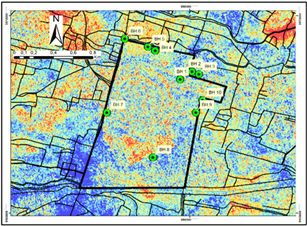
Land subsidence in the Sidoarjo Mud Volcano (SMV) area has been widely recognized as a consequence of sustained mud discharge and progressive subsurface consolidation. Earlier geodetic studies using GPS and InSAR, combined with geological and geomechanical investigations, have demonstrated persistent long‑term ground deformation, widespread flooding, and severe infrastructure damage linked to these processes. This study aims to (1) quantify spatial and temporal subsidence rates, (2) identify the dominant controlling mechanisms, and (3) estimate the relative contributions of fluid discharge and natural consolidation to total subsidence. Surface deformation was derived through time‑series analysis of Sentinel‑1A SAR data using the pair‑wise logic technique differential interferometric synthetic aperture radar (PLT‑D‑InSAR). These results were integrated with one‑dimensional (1D) consolidation modeling based on lithological coring data and mud discharge records.
The PLT‑D‑InSAR analysis successfully captured detailed subsidence patterns over a wide area and shows good agreement with GPS observations (R² ≈ 0.82). The combined D‑InSAR, consolidation, and discharge analysis reveals a very strong correlation (R² ≈ 0.97), indicating that subsidence is mainly governed by fluid discharge and consolidation processes. Fluid discharge accounts for approximately 72.2% of the total subsidence, while natural consolidation contributes about 16.5%. The highest subsidence rates are concentrated near the mudflow center and are structurally influenced by the Watukosek and Siring faults. These findings highlight the dominant role of discharge‑induced deformation and provide important constraints for long‑term hazard assessment and land‑use planning in the SMV region.
Downloads
References
Abidin, H., Davies, R., Kusuma, M., Andreas, H., & Deguchi, T. 2009. Subsidence and uplift of Sidoarjo (East Java) due to the eruption of the Lusi mud volcano (2006–present). Environmental Geology, pp. 57, 833–844.
Budiono, K., Handoko, H., Hernawan, U., & Godwin, G. (2010). Interpretation of subsurface geological structure in the Sidoarjo mudflow area based on ground penetrating radar (GPR) cross-section. Indonesian Journal on Geoscience, 5(3), 187–195.
Burhannudinnur, M. and Noeradi, D. 2021. Understanding mud volcano system using Hele-Shaw (H-S) Experiment: Seismic confirmation at East Java Mud Volcano. Journal of Geoscience, Engineering, Environment, and Technology, 6(4), 206–216.
Davies, R. J., & Stewart, S. A. 2005. Emplacement of giant mud volcanoes in the South Caspian Basin: three-dimensional seismic reflection imaging of root zones. Journal of the Geological Society, 162(1), 1–4.
Davies, R. J., Swarbrick, R. E., Evans, R. J., & Huuse, M. 2007. Birth of a mud volcano: East Java, 29 May 2006. GSA Today, 17(2), 4-9.
Das, B. M. 2010. Principle of Geotechnological Engineering, 7th ed. (Seventh). Cengage Learning, USA, 688 p.
European Space Agency (ESA).2016. Sentinel-1 Satellite Description,
Hanssen, R.F. 2001. Radar interferometry: Data interpretation and error analysis. Kluwer Academic, Dordrecht, Boston.
Hongdong, F., Kazhong, D., Chengyu, J., Chuanguang, Z., & Jiqun, X. 2011. Land subsidence monitoring by D-InSAR technique. Mining Science and Technology, 21(6), 869–872.
Istadi, B., Pramono, G., Sumintadireja, P., and Alam, S. 2009. Modeling study of growth and potential geohazard for LUSI mud volcano: East Java, Indonesia. Marine and Petroleum Geology, 26, 1724-1739.
Kopf, A.J. 2009. Significance of mud volcanism. Reviews of Geophysics,40(2).
Massonnet, D. and Feigl, K. L. 1998. Radar interferometry and its application to changes in the earth’s surface. Reviews of Geophysics, 36(4), 441–500.
Mazzini, A., Scholz, F., Svensen, H. H., Hensen, C., & Hadi, S. 2018. The geochemistry and origin of the hydrothermal water erupted at Lusi, Indonesia. Marine and Petroleum Geology, 90, 52–66.
MVMC.2022. Mud vulcano data from Sidoarjo Mud Volcano Monitoring Center, Ministery Public Works, and Housing, data obtained through the ministry's internet site PUPR
Rateb, A. & Abotalib, A. Z. 2020. Inferencing the land subsidence in the Nile Delta using Sentinel-1 satellites and GPS between 2015 and 2019. Science of the Total Environment, p. 729.
Saepuloh A, Sabrian P. G, and Fattah E.I. 2022: Pemrosesan Interferometric Syntetic Aperture Radar (Insar) untuk Eksplorasi dan Kebencanaan Geologi (Interferometric Synthetic Aperture Radar (Insar) Processing for Exploration and Geological Hazard). ITB Press, Bandung. (in Indonesian)
Saepuloh, A., Haeruddin, H., Heriawan, M. N., Kubo, T., Koike, K., and Malik, D. 2018. Application of lineament density extracted from the dual orbit of synthetic aperture radar (SAR) images to detect fluids paths in the Wayang Windu geothermal field (West Java, Indonesia). Geothermics, 72, 145–155.
Sarah, D., Soebowo, E., Satriyo, N. A., Zulfahmi, and Wahyudin. 2023: Predictive Modelling of Land Subsidence Due to Groundwater Level Decline in Gedebage District, Bandung, Indonesia. IOP Conference Series: Earth and Environmental Science, 1227(1).
Skempton, A. W. 1969. The consolidation of clays by gravitational compaction. Quarterly Journal of the Geological Society, 125(1–4), pp. 373–411.
Sudarsono, U. and Sudjarwo. B. S. 2008: Amblesan di daerah Porong Kabupaten Sidoarjo Jawa Timur (Subsidence in the Porong area, Sidoarjo Regency, East Java). Jurnal Geologi Indonesia, 3, 1–9. (in Indonesian – English abstract available)
Stewart, S. A., & Davies, R. J. 2006. Structure and emplacement of mud volcano systems in the South Caspian Basin. AAPG Bulletin, 90(5), 771–786.
Stickle, M., & Pastor, M. 2018. A practical analytical solution for 1D consolidation. Géotechnique.
Supandjono, Santosa, S., dan Suwarti, T. 1992: Peta geologi lembar Malang, Jawa skala 1:100.000 (Geological map sheet of Malang, Java scale 1:100,000). Direktorat Geologi P3, Bandung. (in Indonesian)
Terzaghi, K. 1943. Theoretical soil mechanics. Wiley, New York.
Tingay, M.R.P., Rudolph, M.L., Manga, M., Davies, R.J., & Wang, C.Y. 2015. Initiation of the Lusi mudflow disaster. Nature Publishing Group, Nature Geoscience, 8(7), 493–494.
Yamaguchi Y .1985. Image-scale and look-direction effects on the detectability of lineaments in radar images Remote Sensing of Environment 17 117–27.
Yulyta, S. A., Taufik, M., and Hayati, N. 2016. Land subsidence detection using synthetic aperture radar (SAR) in Sidoarjo Mudflow area. In: Meilano, I., and Zulfakriza (Eds.), 5th International Symposium on Earthhazard and Disaster Mitigation: The Annual Symposium on Earthquake and Related Geohazard Research for Disaster Risk Reduction Article 060002 (AIP Conference Proceedings; Vol. 1730). American Institute of Physics Inc.
Downloads
Published
Issue
Section
License
Copyright (c) 2026 Journal of Geoscience, Engineering, Environment, and Technology

This work is licensed under a Creative Commons Attribution-ShareAlike 4.0 International License.
Copyright @2019. This is an open-access article distributed under the terms of the Creative Commons Attribution-ShareAlike 4.0 International License which permits unrestricted use, distribution, and reproduction in any medium. Copyrights of all materials published in JGEET are freely available without charge to users or / institution. Users are allowed to read, download, copy, distribute, search, or link to full-text articles in this journal without asking by giving appropriate credit, provide a link to the license, and indicate if changes were made. All of the remix, transform, or build upon the material must distribute the contributions under the same license as the original.


