
Feasibility and Safety Study of Grounding Design with Soil Resistivity Method in Penajam Area, East Kalimantan, Indonesia
DOI:
https://doi.org/10.25299/jgeet.2026.11.1.21332Keywords:
Grounding, Resistivity, IKNAbstract
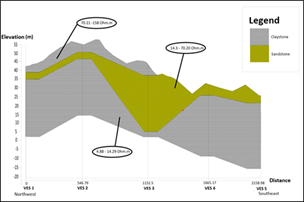
As the need for electrical energy for various sectors increases, especially in Penajam, East Kalimantan, which is currently under construction of the Indonesian Capital City (IKN), the existence of a power plant is very necessary. The construction and development of power plants require special studies to ensure feasibility and safety. Grounding is one of the important aspects in an electrical system to distribute unwanted current errors into the ground. Grounding design in an electrical system requires several important data such as soil resistivity values, the number of rods used, and the area of the installation. These data are used as input to calculate the actual design potential value with the permissible potential tolerance value starting from Ground Potential Rise (GPR), mesh, step, and touch potential. The grounding installation area plan is carried out in an area of in the form of a square or rectangle with a sandy lithology with an average resistivity value of and a clay area with an average value of . Another plan is carried out using a grid design with rods and without using rods. The rectangular sand area with a grid installation design using rods generally produces the smallest design potential value, namely a GPR value of , a mesh value of , and a step value of . The square clay area with a grid installation design without using rods generally produces the largest design potential value, namely a GPR value of , a mesh value of , and a step value of . The main factor that most influences the determination of the grounding design potential value is the soil resistivity value and the lithology of the installation area as evidenced by the difference in the measured potential design value which is quite significant. However, the overall design plan in this study produces a safe and feasible conclusion as evidenced by all design value acquisitions being less than the tolerance limit set in the case of a human weight of and such as a step potential of and a touch potential of .
Downloads
References
Abdel-Basset, M., Gamal, A., Chakrabortty, R. K., & Ryan, M. (2021). A new hybrid multi-criteria decision-making approach for location selection of sustainable offshore wind energy stations: A case study. Journal of Cleaner Production, 280, 124462.
Armansyah, R., Syam, M. A., & Azahra, N. (2024). Peran Ibu Kota Nusantara Sebagai Kota Sustainable Cities Dalam Mensejahterakan Masyarakat Indonesia. Eksekusi: Jurnal Ilmu Hukum dan Administrasi Negara, 2(1), 255-266.
Bharti, A. K., Prakash, A., Verma, A., Oraon, J., Chaudhary, D. K., Kumar, S., & Singh, K. K. K. (2022). Mapping of decades-old underground coal mine workings using electrical resistivity tomography. Journal of Earth System Science, 131(4), 258.
Dladla, V. M. N., Nnachi, A. F., & Tshubwana, R. P. (2022). Analysis of Design Parameters on Substation Earth Grid Safety Limits. Science Publishing Group, 10(2), 61-72.
Gouda, O. E., El Dein, A. Z., Tag-Eldin, E., Lehtonen, M., & Darwish, M. M. (2023). Proposed Approach to Investigate the Current and Voltage Distributions of Isolated and Grounded Systems during Earth Fault Conditions. IEEE Access.
IEEE Power and Energy Society. (2013). IEEE Guide for Safety in AC Substation Grounding (IEEE Std 80™-2013). IEEE Standards Association.
Lubang, J., Liu, H., & Chen, R. (2023). Combined application of hydrogeological and geoelectrical study in groundwater exploration in Karst-Granite areas, Jiangxi Province. Water, 15(5), 865.
Martinho, E. (2023). Electrical resistivity and induced polarization methods for environmental investigations: an overview. Water, Air, & Soil Pollution, 234(4), 215.
Nugroho, F. B., Murtiana, S., Pahlevi, R., & BZ, C. M. (2024). Analisis Strategi Pengembangan Pembangkit Listrik Wilayah Kalimantan Barat Guna Mendukung Pertahanan Negara Republik Indonesia. Austenit, 16(1), 33-41.
Penna, N. D. S., Porsani, J. L., Rangel, R. C., Costa, V. H. H., de Oliveira, N. C., Stangari, M. C., & Sousa, C. D. C. B. D. F. (2024). Near-Surface Geophysical Characterization of a Marble Deposit to Promote a Sustainable Small-Scale Mining. Remote Sensing, 16(7), 1147.
Putra, D. E., Nawawi, Z., & Jambak, M. I. (2022). Using Copper-Coated Round Rod Electrodes at Various Depths in Freshwater Marshes. vol, 2, 15-26.
Sangprasat, K., Puttiwongrak, A., & Inazumi, S. (2024). Comprehensive analysis of correlations between soil electrical resistivity and index geotechnical properties. Results in Engineering, 23, 102696.
Sidik, A., Lumbantobing, H., Indrawan, B., Edwinanto, E., Putra, Y., Imamulhak, Y., & Rinaldi, R. (2023). Studi Potensi Pemanfaatan Energi Baru Terbarukan (EBT) untuk Mendukung Sistem Ketenagalistrikan di Wilayah IKN. Jurnal SISKOM-KB (Sistem Komputer dan Kecerdasan Buatan), 6(2), 137-144.
Sunarto, S., Sudrajat, S., & Hikmat, Y. P. (2022). Analysis of Earth Resistance Effect on The TT-Grounding System Against Electric Shock. Eksergi: Jurnal Teknik Energi, 18(3), 190-195
Thabet, A., & Mobarak, Y. (2021). Innovative earthing systems for electric power substations using conductive nanoparticles. International Journal of Electrical and Computer Engineering, 11(3), 1857.
Zein, E. D. K., & Marshela, S. (2023). PENDUGAAN POTENSI TINGKAT KOROSIFITAS LAPISAN BAWAH PERMUKAAN MENGGUNAKAN TEKNIK VERTICAL ELECTRICAL SOUNDING (Studi Kasus: Kabupaten Penajam, Kalimantan). Jurnal Geosaintek, 9(3), 183-193.
Downloads
Published
Issue
Section
License
Copyright (c) 2026 Journal of Geoscience, Engineering, Environment, and Technology

This work is licensed under a Creative Commons Attribution-ShareAlike 4.0 International License.
Copyright @2019. This is an open-access article distributed under the terms of the Creative Commons Attribution-ShareAlike 4.0 International License which permits unrestricted use, distribution, and reproduction in any medium. Copyrights of all materials published in JGEET are freely available without charge to users or / institution. Users are allowed to read, download, copy, distribute, search, or link to full-text articles in this journal without asking by giving appropriate credit, provide a link to the license, and indicate if changes were made. All of the remix, transform, or build upon the material must distribute the contributions under the same license as the original.


