Depositional Environment of the Late Miocene of Lemau Formation from Bengkulu Basin Based on Palynology in Seluma, Bengkulu, Indonesia
DOI:
https://doi.org/10.25299/jgeet.2025.10.4.19568Keywords:
Depositional Environment, Lemau Formation, Palynology, Late Miocene, Bengkulu BasinAbstract
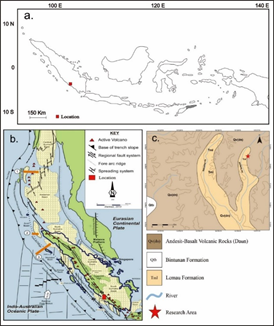
Indonesia has several sedimentary basins, one of which is the Bengkulu Basin. One of the rock formations that make up this basin is the Lemau Formation, which is of Middle-Late Miocene age. Determining the depositional environment can use pollen and spore fossils stored in rocks. In the Lemau Formation, very little has been done to determine the depositional environment using pollen and spores. This research aims to reconstruct the sedimentary environment of the Lemau Formation rocks in the Late Miocene. Analysis was carried out on ten rock samples from Seluma, Bengkulu, Indonesia. Data collection used the stratigraphic measurements method, and laboratory analysis used the hydrogen peroxide method. There were five changes in the depositional environment, starting from the mangrove environment in sample BIL 21. The shallow environment became back mangrove in sample BIL 22, shallowing again became a peat swamp environment in samples BIL 23-BIL 26, the flooded environment became mangrove in sample BIL 27 and shallowing returned to a freshwater environment in samples BIL 28-BIL 30. Determination of the Late Miocene age used the presence of the Stenochlaenidites papuanus index fossil found in sample BIL 21. This environmental change was possible due to tectonic activities on the island of Sumatra in the Late Miocene and global eustatic changes.
Downloads
References
Bishop, M. G., 2001. South Sumatra Basin Province, Indonesia: The Lahat/Talang Akar-Cenozoic Total Petroleum System. Open File Report 99-50-S USGS. Colorado
Birks, H.J.B and Birks, H.H., 2005. Global Change in the Holocene. London: Edward Arnold Publisher Ltd. 1007-123.
Boggs, S., Jr., 1995. Principles of Sedimentology and Stratigraphy. New Jersey: Prentice Hall.
Curray, J.R., Moore, D.G., Lawver, L.A., Emiviel, F.J., Raitt, R.W.,Henry, M. & Kieckheffer, R., 1979. Tectonics of the Andaman Sea and Burma. In: Waatkins, J.S., Montadert, L. & Dickenson, P.W.(eds) Geological and Geophysical Investigations of Continental Margins. American Association of Petroleum Geologists, Memoirs, 29:189-198.
Darman, H., 2011. Seismic Expression of Some Geological Features of Andaman-Offshore West Sumatra Subduction zone. Berita Sedimentologi, 20(1).
Erdtman, G., 1966. Pollen Morphology and Plant Taxonomy. New York and London: Hanfer Publishing Company.
Gafoer, S., Amin, T.C., and Pardede, R., 1992. Geological Map of Bengkulu Sheet, Sumatra, scale 1:250.000. Pusat Penelitian dan Pengembangan Geologi.
Haseldonckx, P., 1974. A Palynological Interpretation Of Palaeoenvironments In SE Asia. Sains Malaysiana, 3:119-127.
Hastuti, S., Sukandarrumidi and Pramumijoyo, S., 2001. Kendali Tektonik Terhadap Perkembangan Cekungan Ekonomi Tersier Ombilin, Sumatera Barat. Teknosains, 14:1-12.
Haq, B. U., Hardenbol, J.R., Vail, P.R., 1987. Chronology of fluctuating sea levels since theTriassic. Science v. 235, pp. 1156–1167.
Heryanto, R and Suyoko, 2007. Karakteristik batubara di Cekungan Bengkulu. Jurnal Geologi Indonesia, 2:247-259.
Husein, S., Barianto, D.H., Novian, M.I., Putra, A.F., Saputra, R., Rusdiyantara, M.A., and Nugroho, W., 2018. Persepektif Baru Dalam Evolusi Cekungan Ombilin Sumatera Barat. Proceeding, Seminar Nasional Kebumian Ke 11, September 2018.
Mentari, S.G., Winantris and Jurnaliah, L., 2023. Paleoenvironment of the Miocene Lemau Formation Based on the Palynology Analysis in Seluma, Bengkulu. Jambura Geoscience Revier, 5:33-41.
Metcalfe, I., 1996. Pre-Cretaceous evolution of SE Asian terranes. London: The Geological Society of London Special Publication, 106:97–122.
Moore, P.D and Webb, J.A., 1978. An Illustrated Guide to Pollen Analysis. New York: The Ronald Press Company, 133 pg.
Morley, R. J., 1990. Introduction to Palynology with Emphasis on Southeast Asia. Purwokerto: Fakultas Biologi UNSOED.
Morley, R. J., 1991. Tertiary Stratigraphic Palynology In Southeast Asia: Current Status And New Directions, Geological Society Of Malaysia 28:1-36.
Pulunggono, A., Agus Haryo, S., & Kosuma, C. G., 1992. Pre-Tertiary and Tertiary Fault Systems as a Framework of the South Sumatra Basin; A Study of SAR-Maps. 21st Annual Convention Proceedings Indonesian Petroleum Association, p.
Rahmad, B., Santoso, K., Hendaryono, Said, S., Widodo, S., 2013. Wisata Taman Nasional Bukit Duabelas (TNBD) hubungannya dengan Petrologi Organik dan Polen Sub-Cekungan Jambi, Provinsi Jambi, Sumatera. UPNV Yogyakarta: Teknik Geologi.
Riding, J.B., Huges, J.E.K., and Owens, B., 2007. An Effective Palynological Preparation Procedure Using Hydrogen Peroxide. Palynology 31:19-36.
Tarigan, S.A., and Sutriyono, E., 2018. Geologi Dan Lingkungan Pengendapan Formasi Lemau Daerah Tanjungdalam Dan Sekitarnya, Bengkulu Utara. Sriwijaya University. (thesis).
Traverse, A., 2007. Paleopalynology. Ed. To-2. Springer.
Trilaksana, M.J., 2017. Pola Struktur Geologi Dan Evolusi Tektonik Daerah Bengkulu, Lahat, Muara Enim dan Pagar Alam Cekungan Bengkulu Sumatera Selatan Berdasarkan Data Permukaan. Trisakti University. (thesis).
Yasrullah, M.H., 2018. Geologi Dan Tektonik Neogen Daerah Kedurang Dan Sekitarnya, Bengkulu Selatan. Sriwijaya University. (thesis).
Yulihanto, B., Situmorang, B., Nurdjajadi, A., & Sain, B., 1995.
Structural Analysis of the onshore Bengkulu Forearc Basin and Its Implication for Future Hydrocarbon Exploration Activity. 24th Annual Convention Proceedings Indonesian Petroleum Association, p. 85-96.
Downloads
Published
Issue
Section
License
Copyright (c) 2025 Journal of Geoscience, Engineering, Environment, and Technology

This work is licensed under a Creative Commons Attribution-ShareAlike 4.0 International License.
Copyright @2019. This is an open-access article distributed under the terms of the Creative Commons Attribution-ShareAlike 4.0 International License which permits unrestricted use, distribution, and reproduction in any medium. Copyrights of all materials published in JGEET are freely available without charge to users or / institution. Users are allowed to read, download, copy, distribute, search, or link to full-text articles in this journal without asking by giving appropriate credit, provide a link to the license, and indicate if changes were made. All of the remix, transform, or build upon the material must distribute the contributions under the same license as the original.