
Uncovering Carbon Dioxide Emission Patterns: Data-Driven Insights with K-Means Clustering Across 20 Countries
DOI:
https://doi.org/10.25299/itjrd.2026.25696Keywords:
Clustering Analysis, Dimensionality Reduction, CO2 emissions, Greenhouse gas, K-MeansAbstract
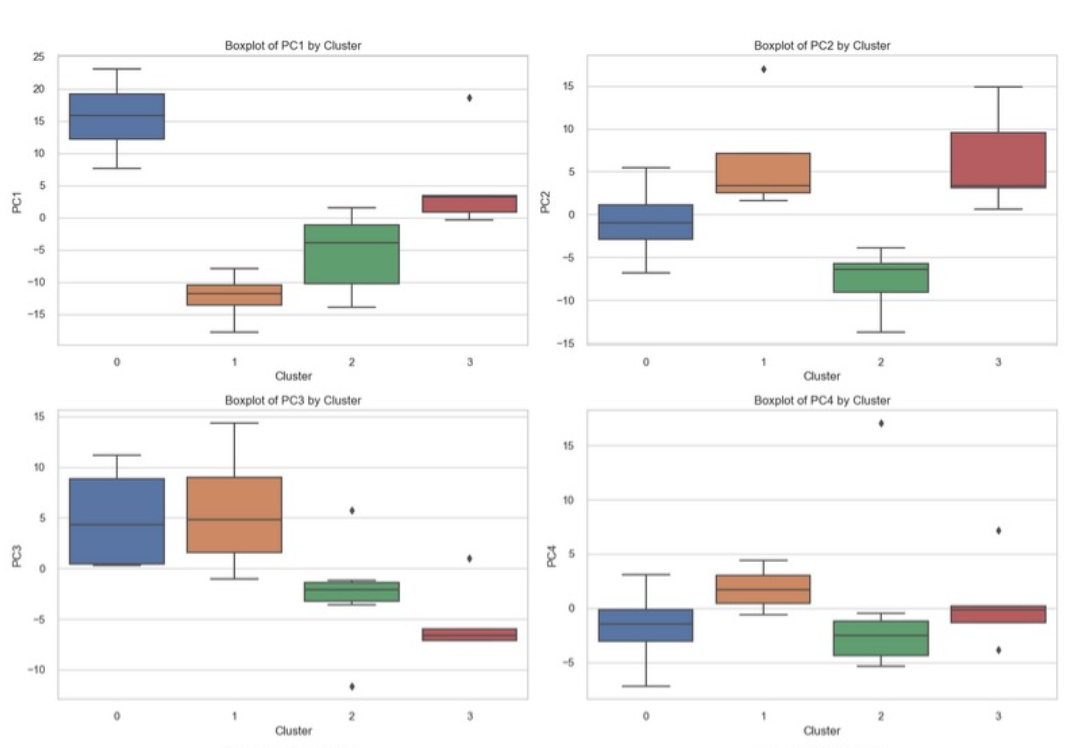
Greenhouse Gas (GHG) emissions pose a pressing global issue due to their significant environmental impacts, particularly climate change, which disrupts ecosystems and human life. Carbon dioxide emissions are a major contributor to GHGs. This study aims to gain insights into the sectors contributing to CO2 emissions across 20 countries, which is crucial for decision-making in emissions mitigation. The seven sectors investigated include electricity and heat generation, gas fuel consumption, liquid fuel consumption, manufacturing and construction industries, residential and commercial sectors, solid fuel consumption, and transportation. The
methods employed encompass clustering with the K-Means algorithm and dimensionality reduction using Principal Component Analysis (PCA). The clustering results yielded four clusters based on CO2 emission levels across these sectors, with PCA analysis and exploratory data analysis (EDA) findings supporting this grouping. The evaluation of the model uses the Davies-Bouldin Index (DBI), the Elbow Method, and the Silhouette Score to determine the optimal parameter for the K value in K-Means. Insights from these findings are discussed.
Downloads
References
[1] M. Crippa, D. Guizzardi, F. Pagani, M. Banja, M. Muntean, E. Schaaf, W. Becker, F. Monforti-Ferrario, R. Quadrelli, A. Risquez Martin, P. Taghavi-Moharamli, J. K¨oykk¨a, G. Grassi, S. Rossi, J. Brandao De Melo, D. Oom, A. Branco, J. San-Miguel, and E. Vignati, JRC Science for Policy Report: GHG Emissions of All World Countries. Publications Office of the European Union, 2023. [Online]. Available: https://edgar.jrc.ec.europa.eu/ booklet GHG emissions of all world countries booklet $2023$report.pdf
[2] EPA, “Impacts of climate change,” https://www.epa.gov/report-environment/greenhouse-gases# impacts, July 2023, diakses pada tanggal 02 April 2024.
[3] R. Quadrelli and S. Peterson, “The energy–climate challenge: Recent trends in co2 emissions from fuel combustion,” Energy Policy, vol. 35, no. 11, pp. 5938–5952, 2007. [Online]. Available: https://www.sciencedirect.com/science/article/pii/S0301421507003126
[4] A. Ahdiat, “Emisi gas rumah kaca indonesia meningkat pada 2022, tembus rekor baru,” Databoks, September 2023. [Online]. Available: https://databoks.katadata.co.id/datapublish/ 2023/09/29/emisi-gas-rumah-kaca-indonesia-meningkat-pada-2022-tembus-rekor-baru
[5] W. Eko Cahyono, Parikesit, B. Joy, W. Setyawati, and R. Mahdi, “Projection of co2 emissions in indonesia,” Materials Today: Proceedings, vol. 63, pp. S438–S444, 2022, 2nd International Conference on Chemical Engineering and Applied Sciences. [Online]. Available: https://www.sciencedirect.com/science/article/pii/S2214785322022258
[6] Grantham Research Institute on Climate Change and the Environment, London School of Economics and Political Science, “New study finds ai could reduce global emissions annually by 3.2 to 5.4 billion tonnes,” https://www.lse.ac.uk/granthaminstitute/news/ new-study-finds-ai-could-reduce-global-emissions-annually-by-3-2-to-5-4-billion-ton, Jun. 22 2025, accessed 2025-11-24.
[7] A. Yunita, H. Santoso, and Z. Hasibuan, “’everything is data’: towards one big data ecosystem using multiple sources of data on higher education in indonesia,” Journal of Big Data, vol. 9, no. 1, 2022.
[8] A. Mardani, H. Liao, M. Nilashi, M. Alrasheedi, and F. Cavallaro, “A multi-stage method to predict carbon dioxide emissions using dimensionality reduction, clustering, and machine learning techniques,” Journal of Cleaner Production, vol. 262, p. 122942, July 2020.
[9] M. Namazkhan, C. Albers, and L. Steg, “A decision tree method for explaining household gas consumption: The role of building characteristics, socio-demographic variables, psychological factors and household behaviour,” Renewable and Sustainable Energy Reviews, vol. 119, p. 109542, 2020. [Online]. Available: https://www.sciencedirect.com/science/article/pii/ S1364032119307506
[10] World Bank, “World development indicators,” World Bank Group, 2024, accessed: 2026-01 28. [Online]. Available: https://databank.worldbank.org/source/world-development-indicators
[11] W. Pratama, “Konsumsi bbm besar karena ketergantungan kendaraan pribadi,” https://ekonomi.bisnis.com/read/20230117/98/1619093/ konsumsi-bbm-besar-karena-ketergantungan-kendaraan-pribadi, 2023, diakses pada tanggal 25 Juni 2024.
[12] C. A. Romero, P. Correa, E. A. Ariza Echeverri, and D. Vergara, “Strategies for reducing automobile fuel consumption,” Applied Sciences, vol. 14, no. 2, 2024. [Online]. Available: https://www.mdpi.com/2076-3417/14/2/910
[13] D. Maarif, “Apa hasil tambang utama negara afrika selatan?” https://tirto.id/ apa-hasil-tambang-utama-negara-afrika-selatan-gVbV, 2024, diakses pada tanggal 25 Juni 2024.
[14] B. Imanda, “10 negara penghasil batu bara terbesar di dunia, indonesia salah satunya,” https://www.solarkita.com/blog/ 10-negara-penghasil-batu-bara-terbesar-di-dunia-indonesia-salah-satunya, 2024, diakses pada tanggal 25 Juni 2024.
[15] P. Guo, H. Shen, Y. Chen, H. Dai, Z. Mai, R. Xu, R. Zhang, Z. Wang, J. He, L. Zheng, H. Z. Sun, K. Ke, J. Meng, M. Liu, J. Li, W. Adalibieke, C. Wang, J. Ye, L. Zhu, G. Shen, T.-M. Fu, A. Tsang, X. Yang, A. G. Russell, C. T. Driscoll, and S. Tao, “Carbon dioxide emissions from global overseas coal-fired power plants,” Nature Climate Change, vol. 14, no. 11, pp. 1151–1157, 11 2024. [Online]. Available: https://doi.org/10.1038/s41558-024-02114-y
[16] C. Annur, “10 negara dengan konsumsi minyak bumi terbesar dunia (2022), https://databoks.katadata.co.id/datapublish/2023/10/06/ 10-negara-konsumen-minyak-bumi-terbesar-dunia-2022-as-juara, 2023, diakses pada tanggal 25 Juni 2024.
[17] A. Wibowo, “Penggunaan minyak di berbagai sektor industri di indonesia,” https://data. goodstats.id/statistic/penggunaan-minyak-di-berbagai-sektor-industri-di-indonesia-ejrtb, 2023, diakses pada tanggal 25 Juni 2024.
[18] Deendarlianto, A. Widyaparaga, T. Widodo, I. Handika, I. Chandra Setiawan, and A. Lindasista, “Modelling of indonesian road transport energy sector in order to fulfill the national energy and oil reduction targets,” Renewable Energy, vol. 146, pp. 504–518, 2020. [Online]. Available: https://www.sciencedirect.com/science/article/pii/S0960148119310092
[19] B. P. Statistik, “Produksi minyak mentah (ribu metrik ton), 2014-2016,” https://www.bps.go. id/id/statistics-table/2/MzUzIzI=/produksi-minyak-mentah.html, 2018, diakses pada tanggal 25 Juni 2024.
[20] W. B. Group, “The world bank,” https://www.worldbank.org/en/country, 2024, diakses pada tanggal 25 Juni 2024.
[21] T. Kalak, “Potential use of industrial biomass waste as a sustainable energy source in the future,” Energies, vol. 16, no. 4, 2023. [Online]. Available: https://www.mdpi.com/1996-1073/ 16/4/1783
[22] Amri, Khairul and Ningrum, Sinta, “Sustainable forestry policy: Indonesia’s adaptation in supporting sustainable development goals (sdgs),” E3S Web Conf., vol. 611, p. 03005, 2025. [Online]. Available: https://doi.org/10.1051/e3sconf/202561103005
[23] L. C. Voumik, M. A. Islam, A. Rahaman, and M. M. Rahman, “Emissions of carbon dioxide from electricity production in asean countries: Gmm and quantile regression analysis,” SN Business & Economics, vol. 2, no. 9, p. 133, 8 2022. [Online]. Available: https://doi.org/10.1007/s43546-022-00318-y
[24] A. Sugiyono, I. Fitriana, I. Rahardjo, and J. Santosa, “Peran kendaraan bermotor listrik berbasis baterai dalam mengurangi permintaan bbm di indonesia,” JTERA (Jurnal Teknologi Rekayasa), vol. 7, pp. 65–72, 2022.
[25] C. A. T. Force, “Oil and gas methane mitigation programoil and gas methane mitigation program,” https://www.catf.us/methane/mitigation-program/, 2024, diakses pada tanggal 26 Juni 2024.
[26] M. Senjak, I. Pesko, P. M.D, and V. Muˇcenski, “Reduction of carbon emissions in the construction industry using lean practices,” Journal of Computational and Applied Mathematics, 2023.
Downloads
Published
How to Cite
Issue
Section
License
Copyright (c) 2026 Ariana Yunita, Angelia Regina Dwi Kartika

This work is licensed under a Creative Commons Attribution-ShareAlike 4.0 International License.
This is an open access journal which means that all content is freely available without charge to the user or his/her institution. The copyright in the text of individual articles (including research articles, opinion articles, and abstracts) is the property of their respective authors, subject to a Creative Commons CC-BY-SA licence granted to all others. ITJRD allows the author(s) to hold the copyright without restrictions and allows the author to retain publishing rights without restrictions.


