Assessing National Reading Habits through Machine Learning
Insights from the Indonesian Reading Interest Rate Survey (2020–2023)
DOI:
https://doi.org/10.25299/itjrd.2025.24019Keywords:
Digital Disruptio, Machine Learning, Educational Development, Predictive Analytics, Digital DisruptionAbstract
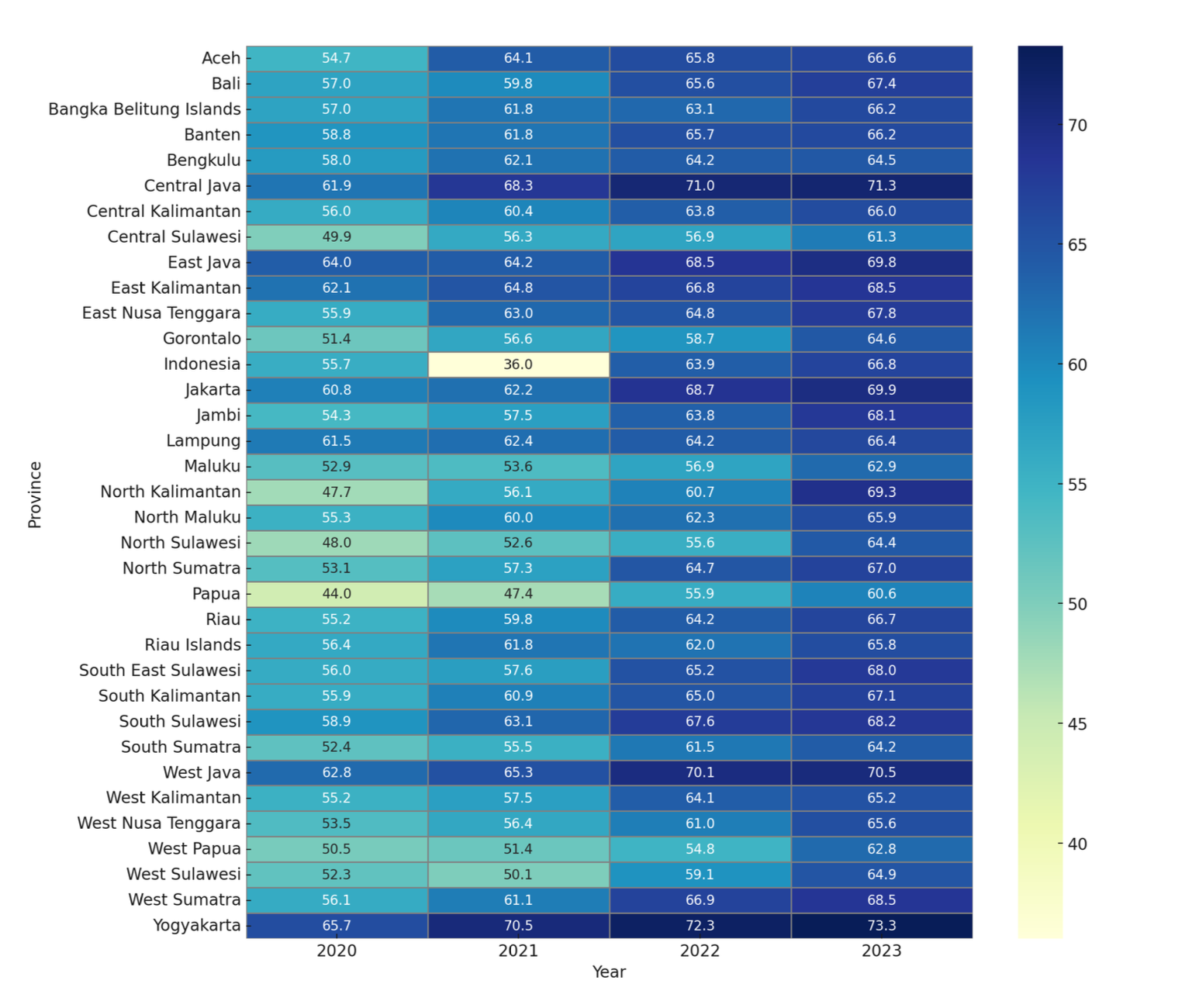
Reading interest is a vital component of educational development, yet many regions face low engagement in reading activities. This study employs advanced machine learning methods to analyze and predict provincial reading interest trends in Indonesia (2020–2023). We performed classification and regression analyses using top-performing models, including CatBoost, LightGBM, XGBoost, Random Forest, ExtraTrees, k-Nearest Neighbors, and neural networks. Classification models categorized provinces by reading interest level with exceptional accuracy, reaching up to 100% using ensemble neural networks. Regression models predicted continuous reading interest index scores precisely, achieving a root mean square error (RMSE) around 1.0 on a 0–100 scale. Our findings demonstrate that modern machine learning approaches effectively uncover underlying patterns in reading interest data. Additionally, we observed a notable decline in reading interest in 2021, coinciding with the COVID-19 pandemic, highlighting digital disruption effects. Ensemble tree-based models and neural networks exhibited superior performance, capturing both linear and non-linear relationships in the dataset, whereas simpler methods (e.g., k-NN) underperformed. This aligns with prior research emphasizing the impact of digital media on reading habits and literacy development. By leveraging predictive analytics, educators and policymakers can proactively identify declining reading interest and implement targeted interventions to foster sustained reading engagement in an increasingly digital world.
Downloads
References
[1] F. M. Locher and M. Philipp, “Measuring reading behavior in large-scale assessments and surveys,” 2 2023.
[2] S. N. Muhamad, M. N. L. Azmi, and I. Hassan, “Reading interest and its relationship with reading performance: A study of english as second language learners in malaysia,” Humanities and Social Sciences Reviews, vol. 7, pp. 1154–1161, 11 2019.
[3] L. D. Dawkins, “Factors influencing student achievement in reading,” 2017.
[4] S. Nurhasanah, M. Najib, and Ruknan, The Influence of Literacy Culture on Reading Interest of Elementary School Students, 2023, pp. 403–409.
[5] I. Peras, E. K. Mirazchiyski, B. J. Pave ˇsi ´c, and ˇZiga Meki ˇs Recek, “Digital versus paper reading: A systematic literature review on contemporary gaps according to gender, socioeconomic status, and rurality,” pp. 1986–2005, 10 2023.
[6] H. Liu, D. Yang, S. Nie, and X. Chen, “Identifying key factors of reading achievement: A machine learning approach,” iScience, vol. 27, 10 2024.
[7] A. Namoun and A. Alshanqiti, “Predicting student performance using data mining and learning analytics techniques: A systematic literature review,” Applied Sciences, vol. 11, no. 1, p. 237, 2020.
[8] M. Cubillos, M. Zegers, and H. Inciarte, “Examining adolescent reading engagement: Design and validation of the teacher-reported reading engagement survey (trres),” Reading Research Quarterly, vol. 60, no. 2, p. e611, 2025.
[9] S. Suggate, E. Schaughency, H. McAnally, and E. Reese, “From infancy to adolescence: The longitudinal links between vocabulary, early literacy skills, oral narrative, and reading comprehension,” Cognitive Development, vol. 47, pp. 82–95, 2018.
[10] C. Friman, “The effects of reading medium on children’s and adolescents’ reading comprehension–a two-phased systematic literature review,” 2025.
[11] L. Altamura, C. Vargas, and L. Salmer ´on, “Do new forms of reading pay off? a meta-analysis on the relationship between leisure digital reading habits and text comprehension,” Review of Educational Research, vol. 95, no. 1, pp. 53–88, 2025.
[12] R. E. Jensen, A. Roe, and M. Blikstad-Balas, “The smell of paper or the shine of a screen? students’ reading comprehension, text processing, and attitudes when reading on paper and screen,” Computers & Education, vol. 219, p. 105107, 2024.
[13] Y. Yang, H. Adnan, and M. Javed, “Research progress on digital reading behavior: A bibliometric study,” Studies in Media and Communication, vol. 13, p. 393, 01 2025.
[14] K. Bozkus¸ , “Predictors of reading performance of fourth-graders,” European Journal of Education, vol. 60, no. 2, p. e70062, 2025.
[15] G. C. da Silva, R. L. Rodrigues, A. N. Amorim, L. Jeon, E. X. Albuquerque, V. C. Silva, V. F. da Silva, A. L. Pinheiro, J. P. Nunes, S. X. de Souza, M. S. Silva, I. Mauro, and A. M. A. Maciel, “Assessing reading fluency in elementary grades: A machine learning approach,”Computers and Education: Artificial Intelligence, vol. 8, p. 100411, 2025. [Online]. Available: https://www.sciencedirect.com/science/article/pii/S2666920X25000517
[16] J. Santhosh, A. P. Pai, and S. Ishimaru, “Toward an interactive reading experience: Deep learning insights and visual narratives of engagement and emotion,” IEEE Access, vol. 12, pp. 6001–6016, 2024.
[17] H. Rasheed and A. Zahir, “A machine learning approach to personalizing learning by reading experiences based on individual cognitive profiles and preferences,” Transdisciplinary Advances in Social Computing, Complex Dynamics, and Computational Creativity, vol. 13, no. 11, pp. 1–13, 2023.
[18] V. Sowmya et al., “A meticulous analysis of diverse human traits in avid readers and non-readers through advanced data analytics and machine learning approach,” in 2024 IEEE International Conference on Information Technology, Electronics and Intelligent Communication Systems (ICITEICS). IEEE, 2024, pp. 1–6.
[19] X. Fang, HCI in Games. Springer, 2020.
[20] Imaditia, “Indonesia reading interest 2020-2023,” Available: https://www.kaggle.com/datasets/imaditia/indonesia-reading-interest-2020-2023
Downloads
Published
How to Cite
Issue
Section
License
Copyright (c) 2025 Winda Monika, Chiranthi Wijesundara, Nining Sudiar, Hadira Latiar

This work is licensed under a Creative Commons Attribution-ShareAlike 4.0 International License.
This is an open access journal which means that all content is freely available without charge to the user or his/her institution. The copyright in the text of individual articles (including research articles, opinion articles, and abstracts) is the property of their respective authors, subject to a Creative Commons CC-BY-SA licence granted to all others. ITJRD allows the author(s) to hold the copyright without restrictions and allows the author to retain publishing rights without restrictions.