
A Deep Learning Approach for Disease Detection in Maize Crops
DOI:
https://doi.org/10.25299/itjrd.2025.22875Keywords:
Data Classification, Deep Learning, Convolutional Neural Network, TensorFlow, Random ForestAbstract
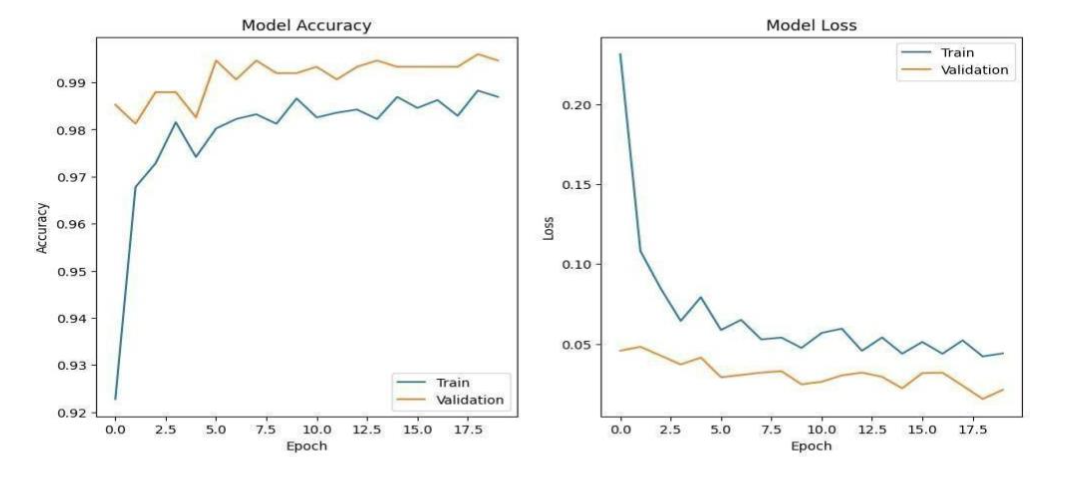
Maize is a vital global food crop, yet its production faces significant threats from leaf diseases that compromise yield and quality. In Nigeria, such diseases lead to an estimated 20–30% loss in annual maize production, equating to billions in economic damage. This research presents the development and deployment of a machine learning-based maize leaf disease classification model using deep learning techniques, specifically Convolutional Neural Networks (CNNs) with the MobileNetV2 architecture. A dataset of 12,000 maize leaf images encompassing four classes, namely Common Rust, Gray Leaf Spot, Leaf Blight, and Healthy was used. Leveraging TensorFlow, the model was trained and fine-tuned using the Nadam optimizer, which facilitated faster convergence and high classification accuracy, achieving a peak validation accuracy of 99.48%, with an F1 score of 0.9411. Compared to traditional algorithms such as Random Forest, MobileNetV2 demonstrated superior performance across all evaluation metrics. The trained model was deployed in a user-friendly web application, allowing for real-time disease diagnosis via image uploads. This approach not only enhances early detection but also contributes to precision agriculture and sustainable crop management.
Downloads
References
[1] L. Yadesa and D. Diro, “Nutritional and specialty maize production, consumption, and Promising Impact on Ethiopia's food and nutrition security: a review,” in EAS Journal of Nutrition and Food Sciences, pp. 142–157, 2023, doi: 10.36349/easjnfs.2023.v05i05.003.
[2] Statista, “Production quantity of maize in Nigeria,” 2023. [Online]. Available: https://www.statista.com/statistics/1300743/production-volume-of-maize-in-nigeria/. [Accessed: Dec. 10, 2024].
[3] Y. N. Katanga, A. Wudil, and E. Gama “Economics of maize (Zea mays L) production in Kazaure Local Government Area, Jigawa State, Nigeria,” Journal of Agriculture and Food Sciences, vol. 22, no. 2, pp. 1–14, 2024, doi: 10.4314/jafs.v22i2.1.
[4] T. Wossen, A. Menkir, A. Alena, T. Abdoulaye, S. Ajala, B. Badu-Apraku, M. Gedil, W. Mengesha, and S. Meseka, “Drivers of transformation of the maize sector in Nigeria,” in Global Food Security, vol. 38, pp. 100713, 2023, doi: 10.1016/j.gfs.2023.100713.
[5] R. W. Mwangi, M. Mustafa, K. Charles, I. W. Wagara, and N. Kappel, “Selected emerging and reemerging plant pathogens affecting the food basket: A threat to food security,” in Journal of Agriculture and Food Research, vol. 14, pp. 100827, 2023, doi: 10.1016/j.jafr.2023.100827.
[6] M. Shoaib, B. Shah, S. Ei-Sappagh, A. Ali, A. Ullah, F. Alenezi, T. Gechev, T. Hussain, and F. Ali, “An advanced deep learning models-based plant disease detection: A review of recent research,” in Frontiers in Plant Science, vol. 14, pp. 1-22, 2023, doi: 10.3389/fpls.2023.1158933.
[7] P. P. Singh, D. R. Kanth, G. S. Madhuri, A. Yadav, S. S. Chauhan, P. Kundu, U. K. Bhattacharyya, S. Banoo, Ritu, and U. S. Rajput, “Deep learning techniques for plant disease detection and classification: A comprehensive review,” in International Journal of Advanced Biochemistry Research, vol. 9, no. 1S, pp. 187-200, 2025, doi: 10.33545/26174693.2025.v9.i1sc.3457.
[8] D. Kalfas, S. Kalogiannidis, O. Papaevangelou, K. Melfou, and F. Chatzitheodoridis, “Integration of Technology in Agricultural Practices towards Agricultural Sustainability: A Case Study of Greece,” in Sustainability, vol. 16, no. 7, pp. 2664, 2024, doi: 10.3390/su16072664.
[9] R. Abiri, N. Rizan, S. K. Balasundram, A. B. Shahbazi, and H. Abdul-Hamid, “Application of digital technologies for ensuring agricultural productivity,” in Heliyon, vol. 9, no. 12, e22601, 2023, doi: 10.1016/j.heliyon.2023.e22601.
[10] J. Sun, Y. Yang, X. He, and X. Wu, “Northern Maize leaf blight detection under complex field environment based on deep learning,” in IEEE Access, vol. 8, pp. 33679-33688, 2020, doi: 10.1109/access.2020.2973658.
[11] A. Pfordt, and S. Paulus, “A review on detection and differentiation of maize diseases and pests by imaging sensors,” in Journal of Plant Diseases and Protection, vol. 132, no. 1, pp. 40, 2024, doi: 10.1007/s41348-024-01019-4.
[12] J. Logeshwaran, D. Srivastava, K. S. Kumar, M. J. Rex, A. Al-Rasheed, M. Getahun, and B. O. Soufiene, “Improving crop production using agro-deep learning framework in precision agriculture,” in BMC Bioinformatics, vol. 25, no. 1, pp. 341, 2024, doi: 10.1186/s12859-024-05970-9.
[13] T. Dominques, T. Brandão, and J. C. Ferreira, “Machine Learning for Detection and Prediction of Crop Diseases and Pests: A Comprehensive Survey,” in Agriculture, vol. 12, no. 9, pp. 1350, 2022, doi: 10.3390/agriculture12091350.
[14] H. Kibriya, I. Abdullah, and A. Nasrullah, “Plant Disease Identification and Classification Using Convolutional Neural Network and SVM,” in 2021 International Conference on Frontiers of Information Technology (FIT), pp. 264-268, 2021, doi: 10.1109/FIT53504.2021.00056.
[15] V. Dhanya, A. Subeesh, N. Kushwaha, D. K. Vishwakarma, T. N. Kumar, G. Ritika, and A. Singh, “Deep learning based computer vision approaches for smart agricultural applications,” in Artificial Intelligence in Agriculture, Vol. 6, pp. 211-229, 2022, doi: 10.1016/j.aiia.2022.09.007.
[16] K. P. Panigrahi, H. Das, A. K. Sahoo, and S. C. Moharana, “Maize leaf disease detection and classification using machine learning algorithms,” in Advances in intelligent systems and computing, pp. 659-669, 2020, doi: 10.1007/978-981-15-2414-1_66.
[17] A. Parashar, A. Parashar, W. Ding, M. Shabaz, and I. Rida, “Data preprocessing and feature extraction techniques in gait recognition: A comparative study of machine learning and deep learning approaches,” in Pattern Recognition Letters, Vol. 172, pp. 65-73, 2023, doi: 10.1016/j.patrec.2023.05.021.
[18] A. Upadhyay, N. S. Chandel, K. P. Singh, S. K. Chakraborty, B. M. Nandede, M. Kumar, A. Subeesh, K. Upendar, A. Salem, and A. Elbeltagi, “Deep learning and computer vision in plant disease detection: a comprehensive review of techniques, models, and trends in precision agriculture,” in Artificial Intelligence Review, Vol. 58, no. 3, pp. 92, 2025, doi: 10.1007/s10462-024-11100-x.
[19] M. E. Sakka, M. Ivanovici, L. Chaari, and J. Mothe, “A review of CNN applications in smart agriculture using multimodal data,” in Sensors, Vol. 25, no. 2, pp. 472, 2025, doi: 10.3390/s25020472.
[20] G. T. Askale, A. B. Yibel, B. M. Taye, and G. D. Wubneh, “Mobile based deep CNN model for maize leaf disease detection and classification,” in Plant Methods, Vol. 21, no. 1, pp. 72, 2025, doi: 10.1186/s13007-025-01386-5.
[21] L. Lutviana, N. R. Ardianto, and N. Purwono, “CNN-based Classification of Bladder Tissue Lessions from Endoscopy Images,” in IT Journal Research and Development, Vol. 9, no. 2, pp. 95–107, 2025, doi: 10.25299/itjrd.2025.17867.
Downloads
Published
How to Cite
Issue
Section
License
Copyright (c) 2025 Olayiwola Charles Adesoba

This work is licensed under a Creative Commons Attribution-ShareAlike 4.0 International License.
This is an open access journal which means that all content is freely available without charge to the user or his/her institution. The copyright in the text of individual articles (including research articles, opinion articles, and abstracts) is the property of their respective authors, subject to a Creative Commons CC-BY-SA licence granted to all others. ITJRD allows the author(s) to hold the copyright without restrictions and allows the author to retain publishing rights without restrictions.


