A Modified DBGE Method for Predicting National Science Olympiad Winners
DOI:
https://doi.org/10.25299/itjrd.2025.21431Keywords:
Link Prediction, Dynamic Bipartite Graph, Logistic Regression, OSN Winner Prediction, DBGEAbstract
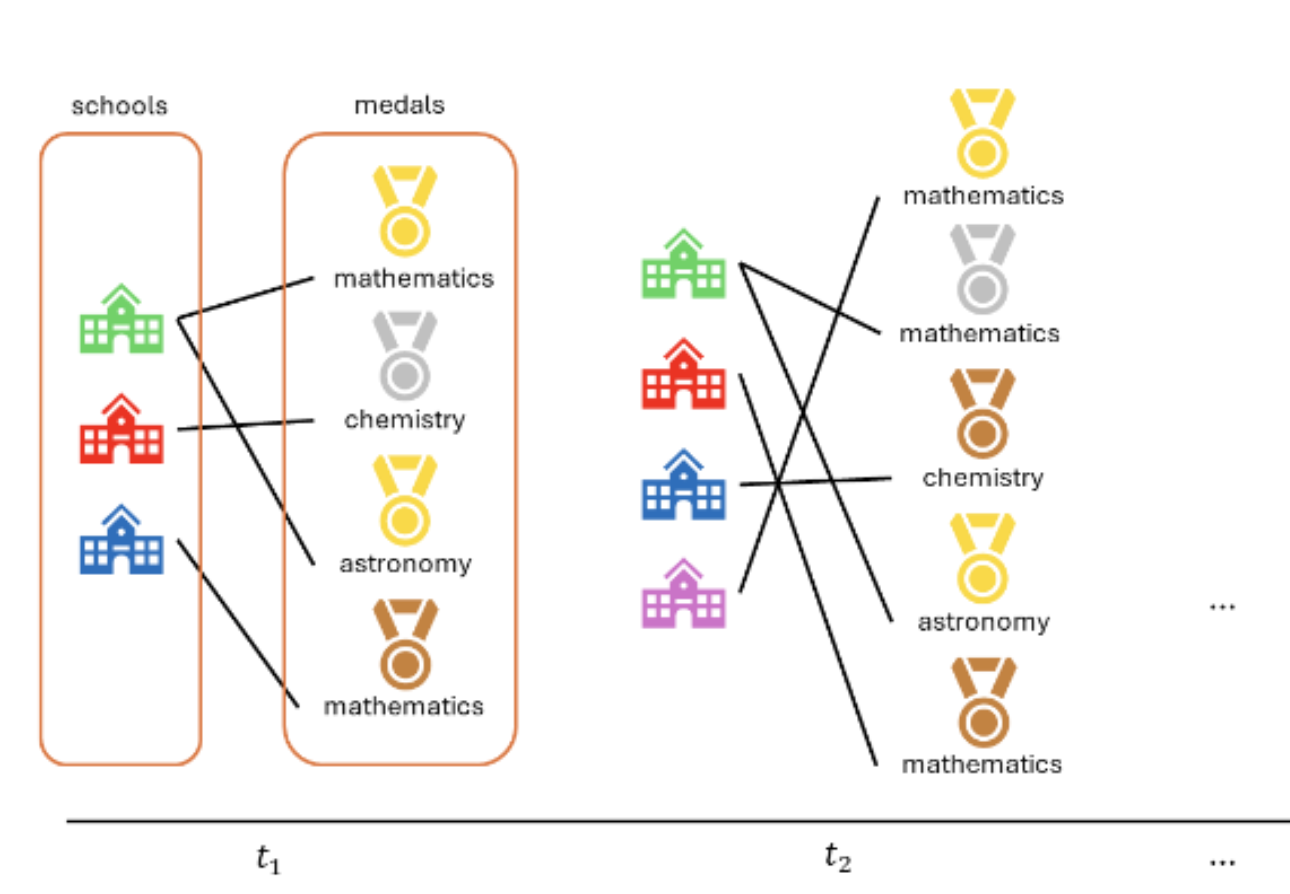
This study aims to predict the winners of the 2025 National Science Olympiad (OSN) using the Dynamic Bipartite Graph Embedding (DBGE) method. OSN is an annual competition organized by the Ministry of Education, Culture, Research, and Technology of the Republic of Indonesia to develop students' potential in various fields of science and social sciences. Predicting OSN winners is important for strategic planning, allocating human resources, and improving the quality of education. This study models data on OSN participants and winners from 2009 to 2024 in the form of a dynamic bipartite graph. The modified DBGE method is used to predict links, with additional logistic regression to predict the relationship between schools and OSN medals. The results show that the modified DBGE method has an accuracy of 84%, precision of 83%, recall of 86%, F1 score of 84%, and AUC of 0.92, which are better than the initial DBGE method. The prediction results show that several schools have a high probability of winning gold medals in various OSN categories. Schools such as SMA Kristen BPK Penabur Gading Serpong, SMAN 8 Jakarta, and SMA Semesta show dominance in several categories. This prediction can help in strategic planning and resource allocation to improve the quality of education in these schools. This study contributes by modifying the existing DBGE method so that there is an increase in accuracy. In addition, researchers added a local dataset taken from real cases to prove that this method can be applied and utilized in real terms. This method is expected to be a tool that helps in strategic planning to improve the quality of school education in various regions, especially in preparing students for future science competitions.
Downloads
References
[1] M. Bilal, M. Omar, W. Anwar, R. H. Bokhari, and G. S. Choi, “The role of demographic and academic features in a student performance prediction,” Sci Rep, vol. 12, no. 1, pp. 1–9, Dec. 2022, doi: 10.1038/S41598-022-15880-6.
[2] X. Du, J. Yang, J.-L. Hung, and B. Shelton, “Educational data mining: a systematic review of research and emerging trends,” Inf Discov Deliv, vol. 48, no. 4, pp. 225–236, May 2020, doi: 10.1108/IDD-09-2019-0070.
[3] E. Kalita et al., “Educational data mining: a 10-year review,” Discover Computing, vol. 28, no. 1, p. 81, May 2025, doi: 10.1007/s10791-025-09589-z.
[4] C. Romero and S. Ventura, “Educational data mining and learning analytics: An updated survey,” Wiley Interdiscip Rev Data Min Knowl Discov, vol. 10, no. 3, Feb. 2024, doi: 10.1002/widm.1355.
[5] W. Setyonugroho, S. Sesotya, I. Permana, T. Lestari, D. Mahendra, and H. Abda, “Enhancing Predictive Accuracy: Assessing the Effectiveness of SVM in Predicting Medical Student Performance,” E3S Web of Conferences, vol. 465, p. 02028, Dec. 2023, doi: 10.1051/e3sconf/202346502028.
[6] C. H. Chen and N. T. T. Phan, “Development of the self-efficacy beliefs of engineering undergraduates preparing for an international contest,” Pertanika Journal of Social Sciences and Humanities, vol. 29, no. 2, pp. 819–837, Jun. 2021, doi: 10.47836/pjssh.29.2.05.
[7] R. A. Young et al., “Jumble judging: Cognitive and affective outcomes of intercollegiate collaboration at a soil judging competition,” Natural Sciences Education, vol. 52, no. 1, Jun. 2023, doi: 10.1002/nse2.20104.
[8] A. Winata, B. Lian, and Mulyadi, “An Academic Supervision of School Principals and Teacher Performance and Its Implementation of Education Quality at State Junior High School in Cengal District,” Advances in Social Science, Education and Humanities Research, vol. 565, 2021.
[9] X. Cai et al., “DBGE: Employee Turnover Prediction Based on Dynamic Bipartite Graph Embedding,” IEEE Access, vol. 8, pp. 10390–10402, 2020, doi: 10.1109/ACCESS.2020.2965544.
[10] I. B. Suleiman, O. A. Okunade, E. G. Dada, and U. C. Ezeanya, “Key factors influencing students’ academic performance,” Journal of Electrical Systems and Information Technology 2024 11:1, vol. 11, no. 1, pp. 1–18, Sep. 2024, doi: 10.1186/S43067-024-00166-W.
[11] T. Nema and S. Palwe, “Predicting Students’ Academic Success using Machine Learning Algorithms,” in 2023 7th International Conference On Computing, Communication, Control And Automation (ICCUBEA), IEEE, Aug. 2023, pp. 1–7. doi: 10.1109/ICCUBEA58933.2023.10392079.
[12] A. L. J. Martinez, K. Sood, and R. Mahto, “Early Detection of At-Risk Students Using Machine Learning,” Communications in Computer and Information Science, vol. 2261 CCIS, pp. 396–406, 2025, doi: 10.1007/978-3-031-85930-4_36.
[13] Z. Wu and Z. Zhang, “Development Strategies for Higher Education Institutions Based on the Cultivation of Core Competitiveness,” International Journal of Emerging Technologies in Learning, vol. 16, no. 21, pp. 163–176, 2021, doi: 10.3991/ijet.v16i21.26873.
[14] E. López-Meneses, P. C. Mellado-Moreno, C. Gallardo Herrerías, and N. Pelícano-Piris, “Educational Data Mining and Predictive Modeling in the Age of Artificial Intelligence: An In-Depth Analysis of Research Dynamics,” Computers, vol. 14, no. 2, p. 68, Feb. 2025, doi: 10.3390/computers14020068.
[15] H. Shomer, Y. Ma, H. Mao, J. Li, B. Wu, and J. Tang, “LPFormer: An Adaptive Graph Transformer for Link Prediction,” Proceedings of the ACM SIGKDD International Conference on Knowledge Discovery and Data Mining, pp. 2686–2698, Jun. 2024, doi: 10.1145/3637528.3672025.
[16] Z. Zhu, Z. Zhang, L. P. Xhonneux, and J. Tang, “Neural Bellman-Ford Networks: A General Graph Neural Network Framework for Link Prediction,” Adv Neural Inf Process Syst, vol. 35, pp. 29476–29490, Jun. 2021, Accessed: Jul. 28, 2025. [Online]. Available: https://arxiv.org/pdf/2106.06935
[17] H. Fan, Z. Fan, Y. Lu, P. Jiao, and N. Ruan, “Helpormer: Heterogeneous Graph Transformer for Link Prediction,” 2025, doi: 10.2139/SSRN.5297031.
[18] J. Li, C. Yang, G. Ye, and Q. V. H. Nguyen, “Graph neural networks with deep mutual learning for designing multi-modal recommendation systems,” Inf Sci (N Y), vol. 654, Jan. 2024, doi: 10.1016/j.ins.2023.119815.
[19] H. Liang, S. Wang, H. Li, L. Zhou, X. Zhang, and S. Wang, “BiGNN: Bipartite graph neural network with attention mechanism for solving multiple traveling salesman problems in urban logistics,” International Journal of Applied Earth Observation and Geoinformation, vol. 129, May 2024, doi: 10.1016/j.jag.2024.103863.
[20] M. Gao, L. Chen, X. He, and A. Zhou, “BiNE: Bipartite Network Embedding,” in The 41st International ACM SIGIR Conference on Research & Development in Information Retrieval, New York, NY, USA: ACM, Jun. 2018, pp. 715–724. doi: 10.1145/3209978.3209987.
[21] C. Li, W. Wei, X. Feng, and J. Liu, “Research of Motif-Based Similarity for Link Prediction Problem,” IEEE Access, vol. 9, pp. 66636–66645, 2021, doi: 10.1109/ACCESS.2021.3077016.
[22] Y. Jiang, H. Lin, Y. Li, Y. Rong, H. Cheng, and X. Huang, “Exploiting node-feature bipartite graph in graph convolutional networks,” Inf Sci (N Y), vol. 628, pp. 409–423, May 2023, doi: 10.1016/j.ins.2023.01.107.
[23] C. He et al., “Cascade-BGNN: Toward Efficient Self-supervised Representation Learning on Large-scale Bipartite Graphs,” vol. 12, 2020, doi: 10.1145/1122445.1122456.
[24] H.-C. Chen et al., “Learning Performance Prediction with Imbalanced Virtual Learning Environment Students’ Interactions Data,” 2022, pp. 330–340. doi: 10.1007/978-3-030-79728-7_33.
[25] M. Yağcı, “Educational data mining: prediction of students’ academic performance using machine learning algorithms,” Smart Learning Environments, vol. 9, no. 1, p. 11, Dec. 2022, doi: 10.1186/s40561-022-00192-z.
[26] R. Tuanaya, S. Ali, S. Aslam, and A. Ajmal, “Machine Learning in Educational Data Mining: Current Trends and Emerging Gaps in Predicting Student Performance,” Journal of Technological Pedagogy and Educational Development, vol. 10, no. 1, pp. 10–27, 2025, doi: 10.59247/jtped.v2i1.5.
[27] N. T. Al Ghifari, G. A. P. Saptawati, M. L. Khodra, and B. Sitohang, “The Evaluation of DyHATR Performance for Dynamic Heterogeneous Graphs,” Journal of ICT Research and Applications, vol. 17, no. 2, pp. 231–248, Aug. 2023, doi: 10.5614/ITBJ.ICT.RES.APPL.2023.17.2.7.
[28] T. Fawcett, “An introduction to ROC analysis,” Pattern Recognit Lett, vol. 27, no. 8, pp. 861–874, Jun. 2006, doi: 10.1016/J.PATREC.2005.10.010.
Downloads
Published
How to Cite
Issue
Section
License
Copyright (c) 2026 Nasy`an Taufiq Al Ghifari, Luthfi Angger Ramdhani; Slamet Riyadi

This work is licensed under a Creative Commons Attribution-ShareAlike 4.0 International License.
This is an open access journal which means that all content is freely available without charge to the user or his/her institution. The copyright in the text of individual articles (including research articles, opinion articles, and abstracts) is the property of their respective authors, subject to a Creative Commons CC-BY-SA licence granted to all others. ITJRD allows the author(s) to hold the copyright without restrictions and allows the author to retain publishing rights without restrictions.