Comparative Analysis of SVM and XGBoost Classifiers with HOG Features for Concrete Crack Detection
DOI:
https://doi.org/10.25299/itjrd.2025.20560Keywords:
Comparative Analysis, Concrete Crack Detection, HOG, Support Vector Machine, XGBoost ClassifierAbstract
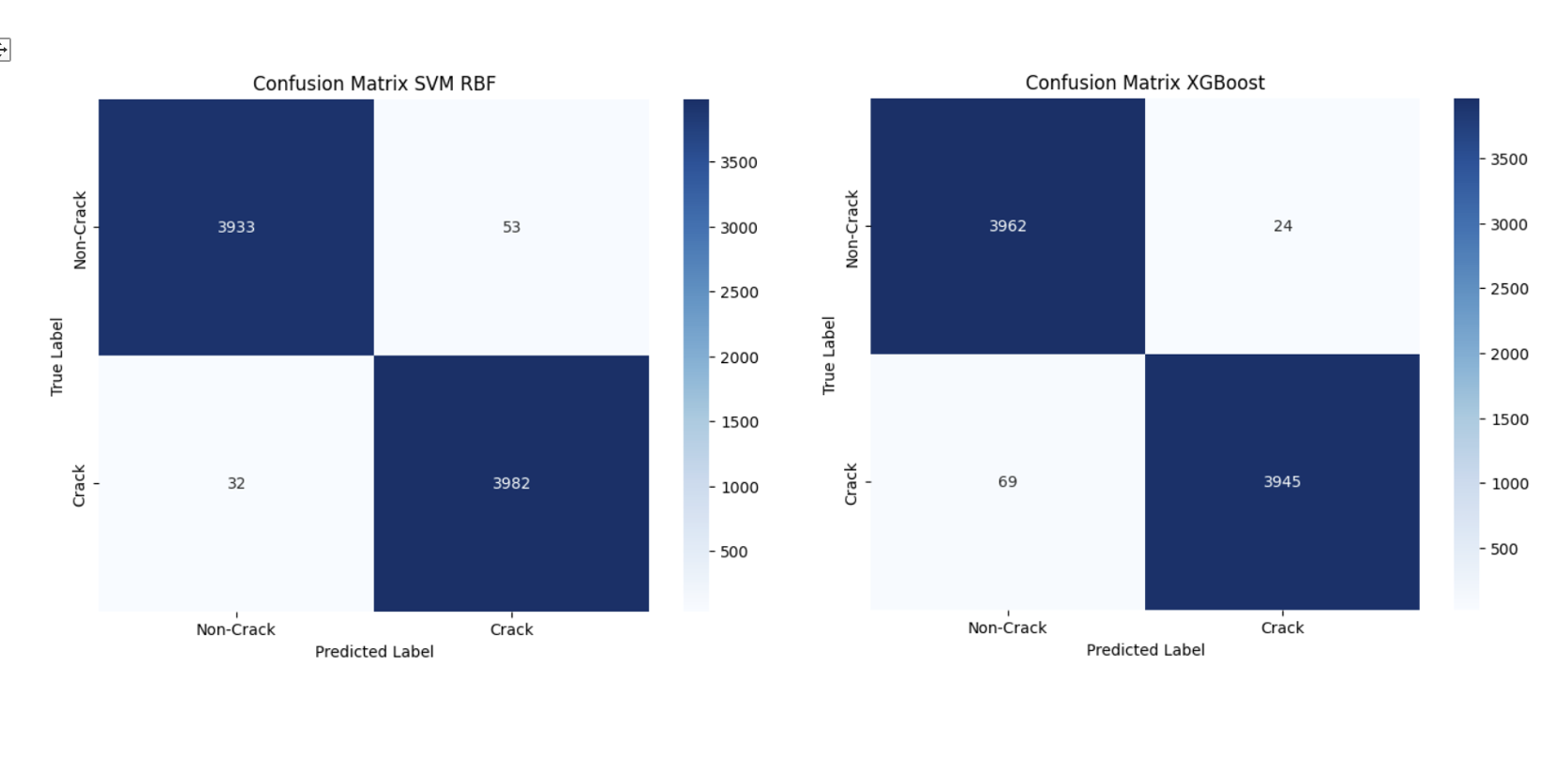
This study offers a comparative assessment of the Support Vector Machine with Radial Basis Function Kernel and Extreme Gradient Boosting for automated concrete crack detection based on Histogram of Oriented Gradients feature extraction. Data comprised 40,000 RGB concrete images from an open-source Mendeley dataset; half were cracked and half were non-cracked. They processed through a preprocessing pipeline that includes the Poisson noise reduction and bilateral filtering techniques. Two approaches, holdout validation over several training/testing configurations (50:50, 60:40, 70:30, and 80:20) and systematic 5-fold cross-validation, were adopted for evaluation of the Wilcoxon signed-rank test for statistical significance and inference time for computational efficiency assessment. The experimental results indicate that SVM achieved a better holdout accuracy of 98.94% with the 80:20 configuration, while XGBoost achieved a cross-validation mean accuracy of 98.83% ± 0.0015. However, no statistically significant performance difference was revealed between the models according to the Wilcoxon analysis. Results indicated SVM excels at minimising false positives on undamaged surfaces, whereas XGBoost is better for identifying cracks, meaning that the choice of models used should depend on the application requirements, where applications require either the minimisation of false alarms or maximum sensitivity for detection in the case of structural health monitoring.
Downloads
References
[1] A. Kadir, A. S. Sukri, N. H. Aswad, Masdiana, and Nasrul, “Evolution and Implications of Changes in Seismic Load Codes for Earthquake Resistant Structures Design,” Civil Engineering Journal, vol. 10, no. 1, pp. 62–82, Jan. 2024, doi: https://doi.org/10.28991/cej-2024-010-01-04.
[2] L. Zhang, F. Yang, Y. Daniel Zhang, and Y. J. Zhu, “Road crack detection using deep convolutional neural network,” IEEE Xplore, Sep. 01, 2016. https://ieeexplore.ieee.org/abstract/document/7533052.
[3] I. N. Sutarja, I. G. A. Susila, and M. A. A. Sumekar, "Strengthening strategy of old bridge in Indonesia (Tukad Yeh Bakung) by using optimization and preservation approach," J. Civ. Constr. Environ. Eng., vol. 6, no. 2, pp. 46–53, Mar. 2021, doi: 10.11648/j.jccee.20210602.13.
[4] A. N. A. Thohari, A. Karima, K. Santoso, and R. Rahmawati, "Crack detection in building through deep learning feature extraction and machine learning approach," J. Appl. Inform. Comput., vol. 8, no. 1, pp. 1–6, Jul. 2024, doi: 10.30871/jaic.v8i1.7431.
[5] H. K. Shin, Y. H. Ahn, S. H. Lee, and H. Y. Kim, “Automatic Concrete Damage Recognition Using Multi-Level Attention Convolutional Neural Network,” Materials, vol. 13, no. 23, p. 5549, Dec. 2020, doi: https://doi.org/10.3390/ma13235549.
[6] S. Li and X. Zhao, “Automatic Crack Detection and Measurement of Concrete Structure Using Convolutional Encoder-Decoder Network,” IEEE Access, vol. 8, pp. 134602–134618, 2020, doi: https://doi.org/10.1109/access.2020.3011106.
[7] L. Wu, "Applications of computer vision technologies of automated crack detection and quantification for the inspection of civil infrastructure systems," Ph.D. dissertation, Dept. Civil Engineering, Univ. of Central Florida, Orlando, FL, USA, 2015. [Online]. Available: https://stars.library.ucf.edu/etd/1320.
[8] Q. Yuan, Y. Shi, and M. Li, “A Review of Computer Vision-Based Crack Detection Methods in Civil Infrastructure: Progress and Challenges,” Remote Sensing, vol. 16, no. 16, pp. 2910–2910, Aug. 2024, doi: https://doi.org/10.3390/rs16162910.
[9] L. Meng, Z. Wang, Y. Fujikawa, and S. Oyanagi, "Detecting cracks on a concrete surface using histogram of oriented gradients," in Proc. Int. Conf. Adv. Mechatronic Syst. (ICAMechS), Beijing, China, 2015, pp. 103–107, doi: 10.1109/ICAMechS.2015.7287137.
[10] M. R. K., A. S., and Y. Mohana, "Inspection, identification and repair monitoring of cracked concrete structure – an application of image processing," in Proc. 3rd Int. Conf. Commun. Electron. Syst. (ICCES), Coimbatore, India, 2018, pp. 1151–1154, doi: 10.1109/CESYS.2018.8723898.
[11] Z. Sun, E. Caetano, S. Pereira, and C. Moutinho, “Employing histogram of oriented gradient to enhance concrete crack detection performance with classification algorithm and Bayesian optimization,” Engineering Failure Analysis, vol. 150, p. 107351, Aug. 2023, doi: https://doi.org/10.1016/j.engfailanal.2023.107351.
[12] I. Barkiah and Y. Sari, “Overcoming Overfitting Challenges with HOG Feature Extraction and XGBoost-Based Classification for Concrete Crack Monitoring,” International Journal of Electronics and Telecommunications, pp. 571–577, Jun. 2023, doi: https://doi.org/10.24425/ijet.2023.146509.
[13] H. Zoubir, M. Rguig, M. El Aroussi, A. Chehri, and R. Saadane, “Concrete Bridge Crack Image Classification Using Histograms of Oriented Gradients, Uniform Local Binary Patterns, and Kernel Principal Component Analysis,” Electronics, vol. 11, no. 20, p. 3357, Oct. 2022, doi: https://doi.org/10.3390/electronics11203357.
[14] V. Vapnik, The Nature of Statistical Learning Theory. New York: Springer, 1995.
[15] H. Hasan, H. Z. Shafri, and M. H. Habshi, "A comparison between support vector machine (SVM) and convolutional neural network (CNN) models for hyperspectral image classification," in IOP Conf. Series: Earth Environ. Sci., vol. 357, 2019, doi: 10.1088/1755-1315/357/1/012080.
[16] J. H. Friedman, "Greedy function approximation: A gradient boosting machine," The Annals of Statistics, vol. 29, no. 5, pp. 1189–1232, 2001.
[17] Y. Chen, X. Wang, Y. Jung, V. Abedi, R. Zand, M. Bikak, and M. Adibuzzaman, "Classification of short single-lead electrocardiograms (ECGs) for atrial fibrillation detection using piecewise linear spline and XGBoost," Physiol. Meas., vol. 39, no. 10, p. 104006, 2018, doi: 10.1088/1361-6579/aadf0f.
[18] C. Bentéjac, A. Csörgő, and G. Martínez-Muñoz, "A comparative analysis of XGBoost," arXiv, 2019, doi: 10.48550/arXiv.1911.01914.
[19] Z. He and W. Xu, “Deep learning and image preprocessing-based crack repair trace and secondary crack classification detection method for concrete bridges,” Structure and Infrastructure Engineering, pp. 1–17, Mar. 2024, doi: https://doi.org/10.1080/15732479.2024.2330702.
[20] I. Abdel-Qader, O. Abudayyeh, and M. E. Kelly, “Analysis of Edge-Detection Techniques for Crack Identification in Bridges,” Journal of Computing in Civil Engineering, vol. 17, no. 4, pp. 255–263, Oct. 2003, doi: https://doi.org/10.1061/(asce)0887-3801(2003)17:4(255).
[21] S. Dorafshan, R. J. Thomas, and M. Maguire, "Benchmarking image processing algorithms for unmanned aerial system-assisted crack detection in concrete structures," Infrastructures, vol. 4, no. 2, p. 19, May 2019, doi: 10.3390/infrastructures4020019.
[22] D. V. L. F. Fernandes, L. D. A. Tavares, and F. R. C. Silva, "A review of deep learning techniques for medical image analysis," J. Imaging, vol. 9, no. 2, pp. 46, 2023, doi: 10.3390/jimaging9020046.
[23] K. Alomar, H. I. Aysel, and X. Cai, "Data augmentation in classification and segmentation: A survey and new strategies," J. Imaging, vol. 9, no. 6, pp. 195, 2023, doi: 10.3390/jimaging9060195.
[24] F. T. Sabilillah, C. A. Sari, R. B. Abiyyi, and A. Susanto, "Comparison of machine learning algorithms on stunting detection for 'Centing' mobile application to prevent stunting," Sinkron: Jurnal dan Penelitian Teknik Informatika, vol. 8, no. 4, pp. 2360–2368, Oct. 2024, doi: 10.33395/sinkron.v8i4.13967.
[25] X. Zhong, B. Gallagher, K. Eves, E. Robertson, T. N. Mundhenk, and T. Y.-J. Han, "A study of real-world micrograph data quality and machine learning model robustness," npj Computational Materials, vol. 7, no. 1, p. 212, Oct. 2021, doi: 10.1038/s41524-021-00616-3.
[26] M. M. Ali, S. A. S. Asad, and S. A. R. Naqvi, "Design and development of a smart agriculture system using IoT," Proc. IEEE 2nd Int. Conf. Recent Trends in Electrical & Information Technologies (RTEICT), Noida, India, 2016, pp. 145–150, doi: 10.1109/RTEICT.2016.7808140.
[27] P. Pawara, E. Okafor, L. Schomaker, and M. Wiering, "Data augmentation for plant classification," in Advances in Intelligent Systems and Computing, vol. 744, A. B. M. S. Ali, Ed. Cham, Switzerland: Springer, 2017, pp. 499–506, doi: 10.1007/978-3-319-70353-4_52.
[28] F. Zhang, "Research on image denoising," M.S. thesis, Hangzhou Dianzi University, Hangzhou, China, 2017, doi: 10.7666/d.D01269744.
[29] R. Fan and N. Dahnoun, "Real-time stereo vision-based lane detection system," Measurement Science and Technology, vol. 29, no. 7, p. 074005, 2018, doi: 10.1088/1361-6501/aac94e.
[30] X. Yao, "Evolutionary artificial neural networks," Int. J. Neural Syst., vol. 4, no. 3, pp. 203–222, 1993, doi: 10.1142/S0129065793000282.
[31] H. M. Bui, M. Lech, E. Cheng, K. Neville, and I. S. Burnett, "Using grayscale images for object recognition with convolutional-recursive neural network," in Proc. IEEE, Piscataway, NJ, USA, 2016.
[32] Y. Xie and D. Richmond, "Pre-training on grayscale ImageNet improves medical image classification," in Proc. European Conf. Computer Vision (ECCV) Workshops, Munich, Germany, 8–14 Sep. 2018.
[33] Y. P. Pasrun, M. Muchtar, A. N. Basyarah, and Noorhasanah, "Indonesian license plate detection using morphological operation," in IOP Conf. Series: Mater. Sci. Eng., Institute of Physics Publishing, Jun. 2020, doi: 10.1088/1757-899X/797/1/012037.
[34] D. H. Abd, A. T. Sadiq, and A. R. Abbas, "Classifying political Arabic articles using support vector machine with different feature extraction," in Proc. Int. Conf. Appl. Comput. Support. Industry: Innovation Technol., Springer, pp. 79–94, 2019.
[35] M. Sokolova and G. Lapalme, "A systematic analysis of performance measures for classification tasks," Inf. Process. Manag., vol. 45, no. 4, pp. 427–437, 2009, doi: 10.1016/j.ipm.2009.03.002.
[36] E. A. Winanto, Y. Novianto, S. Sharipuddin, I. S. Wijaya, and P. A. Jusia, "Peningkatan performa deteksi serangan menggunakan metode PCA dan Random Forest," J. Teknol. Inf. dan Ilmu Komputer, vol. 24, no. 11, 2024, doi: 10.25126/jtiik.2024117678.
Downloads
Published
How to Cite
Issue
Section
License
Copyright (c) 2025 Ridha Adjie Eryadi

This work is licensed under a Creative Commons Attribution-ShareAlike 4.0 International License.
This is an open access journal which means that all content is freely available without charge to the user or his/her institution. The copyright in the text of individual articles (including research articles, opinion articles, and abstracts) is the property of their respective authors, subject to a Creative Commons CC-BY-SA licence granted to all others. ITJRD allows the author(s) to hold the copyright without restrictions and allows the author to retain publishing rights without restrictions.