
Pengaruh Porositas Beton Agregat Batu Apung Terhadap Kuat Tekan dan Permeabilitas Menggunakan Analisa X-ray CT
Effects of Porosity on the Compressive Strength and Permeability of Pumice Aggregate Lightweight Concrete Using X-ray Micro-CT
DOI:
https://doi.org/10.25299/saintis.2026.vol26(02).30343Keywords:
Beton ringan, Batu apung, X-ray micro-CT, Porositas, Kuat tekan, PermeabilitasAbstract
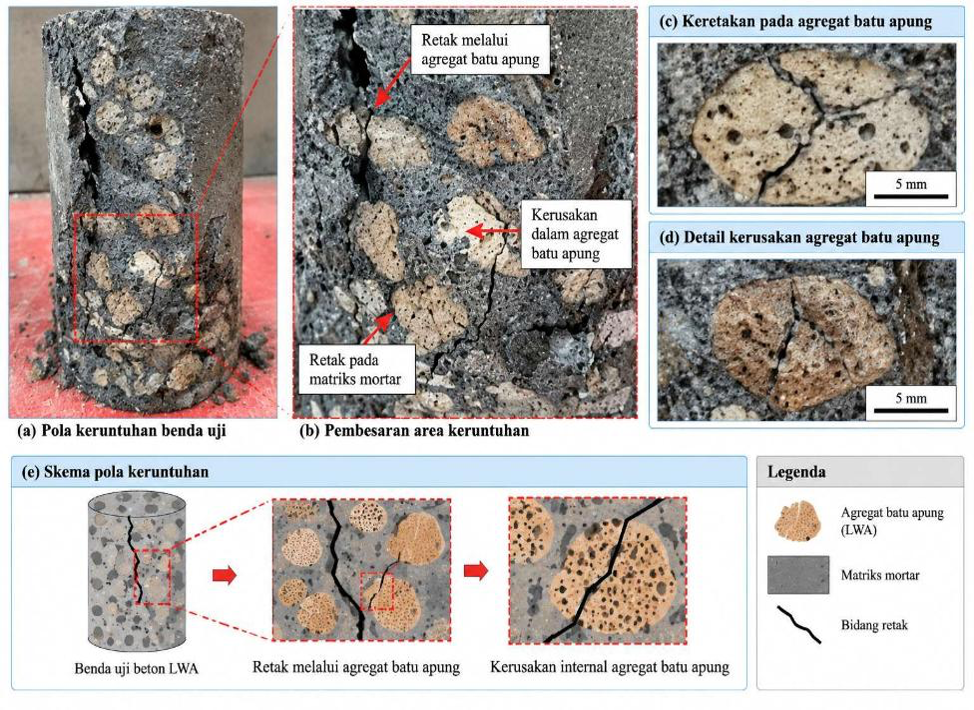
[IN] Beton ringan dengan agregat batu apung memiliki struktur internal berpori yang dapat memengaruhi kuat tekan dan permeabilitas. Penelitian ini bertujuan mengevaluasi hubungan antara distribusi porositas, kuat tekan, dan permeabilitas beton agregat batu apung melalui integrasi pengujian eksperimental dan analisis X-ray micro-computed tomography (micro-CT). Campuran beton dirancang dengan rasio air-semen (w/c) sebesar 0,35; 0,45; dan 0,60. Pengujian meliputi kuat tekan, penetrasi air bertekanan, serta karakterisasi porositas agregat dan mortar menggunakan X-ray micro-CT. Hasil penelitian menunjukkan bahwa sekitar 90% porositas terdeteksi berada di dalam agregat batu apung, dengan porositas total sebesar 17,68–18,62%. Peningkatan w/c dari 0,35 menjadi 0,60 menurunkan kuat tekan umur 28 hari sebesar 31,7%, dari 17,27 MPa menjadi 11,80 MPa, serta meningkatkan kedalaman penetrasi air dari 16,10 mm menjadi 19,88 mm. Estimasi koefisien permeabilitas menggunakan pendekatan Valenta dengan asumsi konektivitas pori menghasilkan rentang (1,18–1,30) × 10⁻¹² m/s hingga (1,90–2,09) × 10⁻¹² m/s. Pengamatan pola keruntuhan menunjukkan bahwa retak melintasi agregat batu apung, sedangkan evaluasi empiris berbasis porositas memperlihatkan keterbatasan penerapan model kuat tekan mortar pada beton ringan. Hasil penelitian menunjukkan bahwa dominasi volume pori agregat tidak secara langsung merepresentasikan kontribusinya terhadap kuat tekan maupun permeabilitas. Oleh karena itu, evaluasi kinerja beton agregat batu apung perlu mempertimbangkan distribusi porositas pada masing-masing fase material, karakteristik mekanis agregat, dan konektivitas jaringan pori.
[EN] Pumice aggregate lightweight concrete contains a highly porous internal structure that may influence its compressive strength and permeability. This study investigates the relationships among pore distribution, compressive strength, and permeability through an integrated experimental and X-ray micro-computed tomography (micro-CT) approach. Concrete mixtures with water-to-cement (w/c) ratios of 0.35, 0.45, and 0.60 were evaluated using compressive strength tests, pressurized water penetration tests, and X-ray micro-CT characterization of aggregate and mortar porosity. The results showed that approximately 90% of the detected pore volume was located within the pumice aggregates, while the total CT-detectable porosity ranged from 17.68% to 18.62%. Increasing the w/c ratio from 0.35 to 0.60 reduced the 28-day compressive strength by 31.7%, from 17.27 MPa to 11.80 MPa, and increased the water penetration depth from 16.10 mm to 19.88 mm. Permeability coefficients estimated using the Valenta approach with assumed pore connectivity ranged from (1.18–1.30) × 10⁻¹² m/s to (1.90–2.09) × 10⁻¹² m/s. Failure observations revealed cracks propagating through pumice aggregates, while porosity-based empirical analysis highlighted the limitations of applying mortar strength models to lightweight aggregate concrete. These findings indicate that the dominant pore volume within pumice aggregates does not directly represent their contribution to compressive strength or water permeability. Therefore, evaluating pumice aggregate concrete requires consideration of phase-specific pore distributions, aggregate mechanical characteristics, and pore network connectivity.
Downloads
References
[1] M. Tanyıldızı and İ. Gökalp, “Utilization of pumice as aggregate in the concrete: A state of art,” May 09, 2023, Elsevier Ltd. doi: 10.1016/j.conbuildmat.2023.131102.
[2] K. M. A. Hossain, S. Ahmed, and M. Lachemi, “Lightweight concrete incorporating pumice based blended cement and aggregate: Mechanical and durability characteristics,” Constr. Build. Mater., vol. 25, no. 3, pp. 1186–1195, Mar. 2011, doi: 10.1016/j.conbuildmat.2010.09.036.
[3] Muhtar, “Performance-based experimental study into quality zones of lightweight concrete using pumice aggregates,” Case Studies in Construction Materials, vol. 18, Jul. 2023, doi: 10.1016/j.cscm.2023.e01960.
[4] X. Chen, S. Wu, and J. Zhou, “Influence of porosity on compressive and tensile strength of cement mortar,” Constr. Build. Mater., vol. 40, pp. 869–874, 2013, doi: 10.1016/j.conbuildmat.2012.11.072.
[5] J. Yu, H. Wang, X. Sun, Z. Chen, and W. Dong, “Characterizing connectivity and tortuosity of pore network based on LF-NMR method to assess the water permeability of white cement mortar,” Journal of Building Engineering, vol. 93, Sep. 2024, doi: 10.1016/j.jobe.2024.109862.
[6] N. Bossa et al., “Micro- and nano-X-ray computed-tomography: A step forward in the characterization of the pore network of a leached cement paste,” Cem. Concr. Res., vol. 67, pp. 138–147, 2015, doi: 10.1016/j.cemconres.2014.08.007.
[7] ACI Committe, “ACI 211.2-98, reapproved 2004,” ACI Committee, vol. 211, 2004.
[8] SNI 1974:2011, “SNI 1974:2011”.
[9] European Committee for Standardization, “EN 12390–8. Testing hardened concrete—Part 8: Depth of penetration of water under pressure,” 2009.
[10] J. Liu, H. H. Khieu, M. Van Tran, and P. Tran, “Advancing microstructural insights in 3D-Printed cementitious materials via X-ray micro-computed tomography,” Aug. 01, 2025, Elsevier Ltd. doi: 10.1016/j.jobe.2025.112675.
[11] D. F. T. Razakamandimby R., H. T. Kim, T. S. Han, Y. H. Lee, and K. Park, “Recursive aggregate segmentation by erosion and reconstitution (RASER) to characterize concrete microstructure using complementarity of X-ray and neutron computed tomography,” Cem. Concr. Compos., vol. 148, Apr. 2024, doi: 10.1016/j.cemconcomp.2024.105437.
[12] O. Valenta, “The permeability and durability of concrete in aggressive conditions,” in Proceedings 10th International Congress on Large Dams, 1970, pp. 103–117.
[13] A. Hammal and A. Sulaiman, “Green synthesis of Fe2O3-MnO2 nano-hybrids on pumice for complete degradation of pharmaceutical pollutants,” PLoS One, vol. 20, no. 10 October, Oct. 2025, doi: 10.1371/journal.pone.0334324.
[14] H. Paulick and G. Franz, “The color of pumice: case study on a trachytic fall deposit, Meidob volcanic field, Sudan,” Springer-Verlag, 1997.
[15] H. M. N. Wright, J. J. Roberts, and K. V. Cashman, “Permeability of anisotropic tube pumice: Model calculations and measurements,” Geophys. Res. Lett., vol. 33, no. 17, Sep. 2006, doi: 10.1029/2006GL027224.
[16] R. Noviandi, T. Gomi, H. S. Kharismalatri, R. C. Sidle, R. P. Ritonga, and K. Shiraki, “The Mobility of Landslides in Pumice: Insights from a Flume Experiment,” Water (Switzerland), vol. 14, no. 19, Oct. 2022, doi: 10.3390/w14193083.
Downloads
Published
How to Cite
Issue
Section
License
Copyright (c) 2026 Ivan sandi Darma, Dimas Agustiana Putra, Husnah

This work is licensed under a Creative Commons Attribution-ShareAlike 4.0 International License.

This work is licensed under a Creative Commons Attribution-ShareAlike 4.0 International License.
Copyright. This is an open access article which means that all content is freely available without charge to the user or his/her institution. Jurnal Saintis allows the author(s) to hold the copyright without restriction. The copyright in the text of individual articles (including research articles, opinion articles, and abstracts) is the property of their respective authors distributed under the terms of the Creative Commons Attribution-ShareAlike 4.0 International License which permits unrestricted use, distribution, and reproduction in any medium. Users are allowed to read, download, copy, distribute, search, or link to full-text articles in this journal without asking by giving appropriate credit, provide a link to the license, and indicate if changes were made.