Effect of Shear Wall Configuration on Torsional Response and Seismic Performance of Irregular Buildings
DOI:
https://doi.org/10.25299/saintis.2026.vol26(02).30339Keywords:
: shear wall configuration, irregular building, dual system, pushover analysis, FEMA 440Abstract
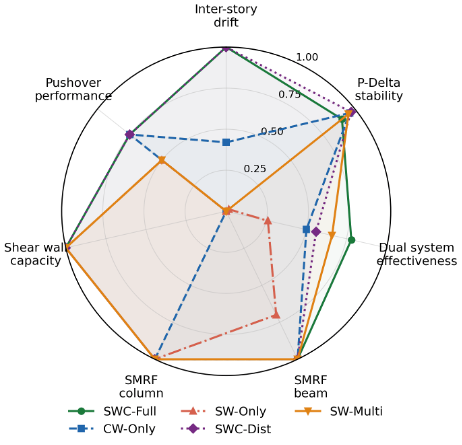
[EN] Indonesia lies in a region of high seismic intensity, so earthquake-resistant design is essential for buildings in high-risk categories. This study evaluates the seismic performance of the Public Service Building (GLU) of Institut Teknologi Sumatera (ITERA), a seven-story reinforced concrete building with an irregular plan, classified as Risk Category IV, under five shear wall placement configurations: SWC-Full, CW-Only, SW-Only, SWC-Dist and SW-Multi. The structure was modeled in ETABS as a dual system and analyzed using response spectrum analysis in accordance with SNI 1726:2019 and nonlinear static pushover analysis based on FEMA 440. Seven parameters were assessed: structural period and modal response, inter-story drift, P-Delta stability, dual system effectiveness, element compliance with the Special Moment-Resisting Frame (SMRF) requirements of SNI 2847:2019, shear wall capacity, and pushover performance level. The results show that the centralized configuration (SWC-Full) produces a dominant torsional first mode (RZ), whereas the distributed configuration (SWC-Dist) produces a translational first mode (UX). The X-direction period ranges from 0.876 s (SWC-Dist) to 1.673 s (SW-Only). Only SWC-Full and SWC-Dist satisfy all seven evaluation criteria simultaneously, with drift-based performance levels between Immediate Occupancy (IO) and Life Safety (LS) and practically equivalent relative scores (0.92 and 0.90). Removing the core wall (SW-Only) causes drift and beam failures, including a 42% exceedance of beam flexural strength, and leaves the walls only 13% of the X-direction base shear. These findings indicate that, for irregular Risk Category IV buildings, the shear wall–core wall combination is the decisive factor in satisfying the seismic requirements.
Downloads
References
[1] W. Triyoso, W. Kongko, G. S. Prasetya, and A. Suwondo, "Study on earthquake and tsunami hazard: evaluating probabilistic seismic hazard function (PSHF) and potential tsunami height simulation in the coastal cities of Sumatra Island," Frontiers in Built Environment, vol. 10, Art. no. 1310251, 2024, doi: 10.3389/fbuil.2024.1310251.
[2] Badan Standardisasi Nasional, Tata Cara Perencanaan Ketahanan Gempa untuk Struktur Bangunan Gedung dan Nongedung (SNI 1726:2019). Jakarta, Indonesia: Badan Standardisasi Nasional, 2019.
[3] M. Aslani and P. Tehrani, "Seismic response and collapse capacity assessment of dual RC buildings with vertical irregularities in shear walls," Scientific Reports, vol. 15, Art. no. 9966, 2025, doi: 10.1038/s41598-025-94328-z.
[4] S. Ruggieri and V. Vukobratović, "The influence of torsion on acceleration demands in low-rise RC buildings," Bulletin of Earthquake Engineering, vol. 22, no. 5, pp. 2433–2468, 2024, doi: 10.1007/s10518-024-01873-5.
[5] K. Pranava, A. R. Avinash, M. Chaithra, S. Anil, and K. Kamath, "Seismic performance of torsionally irregular multistorey RC buildings with optimised shear wall configurations," Infrastructures, vol. 10, no. 11, Art. no. 296, 2025, doi: 10.3390/infrastructures10110296.
[6] P. V. Shamrao, "Seismic fragility analysis for torsionally imbalanced shear wall concrete building," Journal of The Institution of Engineers (India): Series A, vol. 102, no. 2, pp. 553–563, 2021, doi: 10.1007/s40030-021-00527-y.
[7] F. Velarde et al., "Structural reliability assessment of dual RC buildings for different shear wall configuration," Buildings, vol. 15, no. 11, Art. no. 1783, 2025, doi: 10.3390/buildings15111783.
[8] M. Katrangi, M. M. Memarpour, and M. Yakhchalian, "Assessment of the seismic performance and the base shear contribution ratios of the RC wall-frame dual system considering soil–structure interaction," Journal of Earthquake Engineering, vol. 26, no. 10, pp. 5290–5317, 2022, doi: 10.1080/13632469.2021.1871678.
[9] M. C. R. Dumalanta, N. G. I. Rabilas, A. J. C. Rapacon, E. J. S. Urieta, and G. A. Frando, "Seismic performance evaluation of an irregular five-story reinforced concrete building under various shear wall placement configurations using pushover analysis," The Vector: International Journal of Emerging Science, Technology and Management (IJESTM), vol. 34, no. 1, 2025. [Online]. Available: https://vector.unp.edu.ph/index.php/1/article/view/340. [Accessed: Oct. 9, 2026].
[10] A. Khelaifia, R. Chebili, and A. Zine, "Impact of the position and quantity of shear walls in buildings on the seismic performance," Asian Journal of Civil Engineering, vol. 25, no. 1, pp. 953–964, 2024, doi: 10.1007/s42107-023-00824-w.
[11] M. Barser, R. C. Bush, and A. I. Shirkol, "Performance analysis of asymmetrical RC structures using different configurations of shear wall," Materials Today: Proceedings, vol. 88, pp. 52–65, 2023, doi: 10.1016/j.matpr.2023.04.493.
[12] A. Kurnia, S. H. Dewi, and M. Kurniawan, "Pengaruh posisi dinding geser terhadap kinerja struktur pada gedung tidak beraturan dengan menggunakan metode response spectrum [Effect of shear wall position on structural performance in irregular buildings using the response spectrum method]," Jurnal Saintis, vol. 18, no. 1, pp. 15–24, 2018, doi: 10.25299/saintis.2018.vol18(1).2809.
[13] M. A. Salmassi, A. Kheyroddin, and A. Hemmati, "Seismic behavior of end walls in RC tall buildings with torsional irregularity," Magazine of Civil Engineering, vol. 97, no. 5, Art. no. 9707, 2020, doi: 10.18720/mce.97.7.
[14] M. Yakhkeshi and P. Tehrani, "Seismic performance of dual RC frame-shear wall buildings with nonparallel shear walls: insights and recommendations," Bulletin of Earthquake Engineering, vol. 23, no. 11, pp. 4831–4869, 2025, doi: 10.1007/s10518-025-02233-7.
[15] RSA Cipta Karya, "Desain Spektra Indonesia 2021: aplikasi online spektrum respons," 2021. [Online]. Available: http://rsa.ciptakarya.pu.go.id/2021/. [Accessed: May 12, 2025].
[16] Badan Standardisasi Nasional, Beban Desain Minimum dan Kriteria Terkait untuk Bangunan Gedung dan Struktur Lain (SNI 1727:2020). Jakarta, Indonesia: Badan Standardisasi Nasional, 2020.
[17] Badan Standardisasi Nasional, Persyaratan Beton Struktural untuk Bangunan Gedung (SNI 2847:2019). Jakarta, Indonesia: Badan Standardisasi Nasional, 2019.
[18] R. A. Firdha, M. Isneini, H. R. Husni, and R. Widyawati, "Structural performance analysis of multi-story buildings under seismic loads using pushover analysis method (case study: non-surgical inpatient building RSUD Dr. H. Abdul Moeloek)," Jurnal Rekayasa Sipil dan Desain, vol. 9, no. 4, pp. 829–840, 2021, doi: 10.23960/jrsdd.v9i4.2201.
[19] K. K. Kuria and O. K. Kegyes-Brassai, "Pushover analysis in seismic engineering: a detailed chronology and review of techniques for structural assessment," Applied Sciences, vol. 14, no. 1, Art. no. 151, 2024, doi: 10.3390/app14010151.
[20] American Society of Civil Engineers, Seismic Evaluation and Retrofit of Existing Buildings (ASCE/SEI 41-17). Reston, VA, USA: ASCE, 2017, doi: 10.1061/9780784414859.
[21] Federal Emergency Management Agency, Prestandard and Commentary for the Seismic Rehabilitation of Buildings (FEMA 356). Washington, DC, USA: FEMA, 2000.
[22] Federal Emergency Management Agency, Improvement of Nonlinear Static Seismic Analysis Procedures (FEMA 440). Washington, DC, USA: FEMA, 2005.
[23] J. R. Sugianto and Y. A. Pranata, "Seismic performance evaluation using pushover analysis of four two-storey residential building types in West Bandung Regency," Journal of Green Science and Technology, vol. 10, no. 1, 2026, doi: 10.33603/jgst.v10i1.11748.
[24] A. P. Usman, Rosidawani, and S. P. Mutmainna, "Analisis respons dan kinerja struktur bangunan gedung menggunakan pushover analysis [Analysis of response and performance of building structures using pushover analysis]," Jurnal Saintis, vol. 21, no. 2, pp. 87–96, 2021, doi: 10.25299/saintis.2021.vol21(02).7585.
Downloads
Published
How to Cite
Issue
Section
License
Copyright (c) 2026 Ayu Sinta Aprilia, Rahmat Kurniawan

This work is licensed under a Creative Commons Attribution-ShareAlike 4.0 International License.

This work is licensed under a Creative Commons Attribution-ShareAlike 4.0 International License.
Copyright. This is an open access article which means that all content is freely available without charge to the user or his/her institution. Jurnal Saintis allows the author(s) to hold the copyright without restriction. The copyright in the text of individual articles (including research articles, opinion articles, and abstracts) is the property of their respective authors distributed under the terms of the Creative Commons Attribution-ShareAlike 4.0 International License which permits unrestricted use, distribution, and reproduction in any medium. Users are allowed to read, download, copy, distribute, search, or link to full-text articles in this journal without asking by giving appropriate credit, provide a link to the license, and indicate if changes were made.