
Komparasi Produktivitas Tenaga Kerja Pada Pekerjaan Kolom Menggunakan Metode Time Study Terhadap Permen PUPR No. 8 Tahun 2023
Comparison of Labor Productivity for Column Using Time Study Method and PUPR Regulation No. 8 of 2023
DOI:
https://doi.org/10.25299/saintis.2026.vol26(02).29517Keywords:
produktivitas tenaga kerja, time study, kolom beton bertulang, koefisien tenaga kerja, Permen PUPR No.08 Tahun 2023Abstract
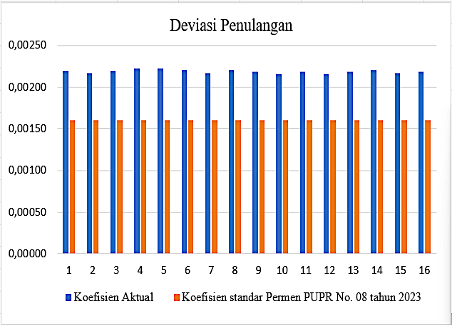
[IN] Produktivitas tenaga kerja merupakan salah satu faktor utama yang menentukan keberhasilan proyek konstruksi karena berpengaruh terhadap efisiensi waktu, biaya, dan mutu pekerjaan. Perbedaan antara produktivitas aktual di lapangan dengan standar yang digunakan dalam perencanaan berpotensi menyebabkan ketidaktepatan estimasi sumber daya. Penelitian ini bertujuan menganalisis produktivitas aktual tenaga kerja pada pekerjaan kolom beton bertulang, membandingkannya dengan standar Permen PUPR Nomor 8 Tahun 2023, serta mengidentifikasi faktor-faktor yang menyebabkan terjadinya deviasi. Ruang lingkup penelitian meliputi pekerjaan penulangan, bekisting, dan pengecoran kolom K1 lantai 4 pada Proyek Pengembangan Rumah Sakit. Metode yang digunakan adalah penelitian deskriptif kuantitatif dengan pendekatan Time Study melalui observasi langsung di lapangan. Data hasil pengamatan diolah untuk memperoleh nilai standard time, produktivitas tenaga kerja aktual, dan koefisien tenaga kerja lapangan. Hasil penelitian menunjukkan bahwa produktivitas aktual pekerjaan penulangan sebesar 457,094 kg/OH, bekisting sebesar 2,891 m²/OH, dan pengecoran sebesar 9,209 m³/OH. Hasil komparasi menunjukkan koefisien tenaga kerja aktual lebih besar dibandingkan standar Permen PUPR Nomor 8 Tahun 2023, dengan deviasi pembengkakan waktu sebesar 37% pada penulangan, 5% pada bekisting, dan 9% pada pengecoran. Temuan ini menunjukkan bahwa produktivitas aktual tenaga kerja masih di bawah standar normatif Permen PUPR No. 8 Tahun 2023, di mana rata-rata koefisien lapangan untuk pekerjaan penulangan 0,00219 OH/Kg, bekisting 0,346 OH/m², dan pengecoran 0,109 OH/m³, sedangkan standar normatif menetapkan koefisien sebesar 0,00160 OH/kg untuk penulangan, 0,3300 OH/m² untuk bekisting, dan 0,100 OH/m³ untuk pengecoran. Faktor utama yang memengaruhi deviasi tersebut meliputi kerumitan detail penulangan, kelelahan fisik pekerja pada elevasi tinggi, kondisi cuaca, serta waktu tunggu material.
[EN] Labor productivity is one of the main factors that determine the success of a construction project because it affects the efficiency of time, costs, and quality of work. The difference between actual productivity in the field and the standards used in planning has the potential to cause inaccurate resource estimates. This study aims to analyze the actual productivity of labor in reinforced concrete column work, compare it with the standards of the Minister of Public Works and Housing Regulation Number 8 of 2023, and identify the factors that cause deviations. The scope of the study includes reinforcement, formwork, and casting of the 4th-floor K1 column in the Hospital Development Project in Duri City. The method used is a quantitative descriptive study with a Time Study approach through direct observation in the field. The observation data are processed to obtain standard time values, actual labor productivity, and field labor coefficients. The results show that the actual productivity of reinforcement work is 457,094 kg/OH, formwork is 2,891 m²/OH, and casting is 9,209 m³/OH. The comparison results show that the actual labor coefficient is greater than the standard of PUPR Ministerial Regulation Number 8 of 2023, with a deviation of 37% in reinforcement, 5% in formwork, and 9% in casting. This finding indicates that the actual labor productivity is still below the normative standard of PUPR Ministerial Regulation No. 8 of 2023, where the average field coefficient for reinforcement work is 0.00219 OH/Kg, formwork 0.346 OH/m², and casting 0.109 OH/m³, while the normative standard sets a coefficient of 0.00160 OH/kg for reinforcement, 0.3300 OH/m² for formwork, and 0.100 OH/m³ for casting. The main factors influencing this deviation include the complexity of reinforcement details, physical fatigue of workers at high elevations, weather conditions, and waiting for material.
Downloads
References
[1] T. Suwondo, “Analisa Penerapan Manajemen Waktu Dan Biaya (Studi Kasus Pekerjaan Struktur Bawah Pada Proyek Pembangunan Gedung Arumaya),” J. Kaji. Tek. Sipil, vol. 6, no. 2, pp. 11–17, 2022, doi: 10.52447/jkts.v6i2.5560.
[2] S. Stringer, J. Jusmidah, M. Fikri, and N. Nurhidayah, “Analisis Persepsi Penerapan Manajemen Proyek Terhadap Keberhasilan Suatu Proyek Konstruksi,” J. Ilm. Ecosyst., vol. 25, no. 1, pp. 185–195, 2025, doi: 10.35965/eco.v25i1.5869.
[3] F. Activity, I. A. Factors, M. P. Faradina, and S. H. Dewi, “Analisis Produktivitas Tenaga Kerja Pekerjaan Pembesian Dan Bekisting Serta Faktor -Faktor yang Mempengaruhinya,” vol. 22, pp. 59–68, 2022, doi: 10.25299/saintis.2022.vol22(02).25190.
[4] Y. I. Silalahi, L. Masthura, and N. Fahriana, “Analisis Faktor - Faktor Penentu Keberhasilan Proyek Konstruksi Berdasarkan Mutu, Biaya dan Waktu,” J. Komposit, vol. 7, no. 2, pp. 233–240, 2023, doi: 10.32832/komposit.v7i2.14240.
[5] M. Fahri, H. Ashad, and W. Watono, “Pengaruh Faktor-Faktor Produktivitas Tenaga Kerja dalam Pembangunan Gedung Tinggi di Parepare,” J. Tek. Sipil MACCA, vol. 7, no. 1, pp. 66–74, 2022, doi: 10.33096/jtsm.v7i1.543.
[6] F. M. Azhari, S. Sumargono, and A. I. Candra, “Analisa Efisiensi Dan Produktivitas Pekerjaan Kolom Pada Proyek Gedung 7 Lantai Universitas Kadiri,” Publ. Ris. Orientasi Tek. Sipil, vol. 6, no. 1, pp. 102–109, 2024, doi: 10.26740/proteksi.v6n1.p102-109.
[7] S. Thioritz, Mursalim, and G. G. Sombolayuk, “Analisis Produktivitas Tenaga Kerja Pada Pekerjaan Kolom (Studi Kasus : Proyek Pagar Batas Cluster G Citraland Tallasa City Makassar),” J. Media Tek. Sipil, vol. 1, no. 1, pp. 8–15, 2023, doi: 10.56963/judiateks.v1i1.13.
[8] J. Setiawan, B. Sutriono, and N. Rochmah, “Analisis Produktivitas Tenaga Kerja Terhadap Pekerjaan Pembesian Kolom dan Balok Pada Proyek Vasa Hotel Extension", Jurnal Kacapuri vol. 5, No.1 pp. 260-268, 2022.
[9] D. P. Wahyudi, U. Saepudin, and A. Maskur, “Analisis Produktivitas Pelaksanaan Pekerjaan Beton Bertulang Pada Kolom Dan Balok Di Proyek Pembangunan Mesjid Fmipa Ugm (Studi Kasus Proyek Pembangunan Masjid FMIPA UGM Yogyakarta),” pp. 1–11, 2022.
[10] F. G. Bagaskara and A. B. Listyawan, “Produktivitas Pada Pekerjaan Kolom Beton Bertulang Lantai 3 Dan Lantai 4 Proyek Masjid Mibas,” Pros. Semin. Nas. Tek. Sipil 2023 Fak. Tek. Univ. Muhammadiyah Surakarta, no. 1, pp. 522–527, 2023.
[11] M. C. Putujaya, “Analisa Produktivitas Pekerjaan Kolom Dengan Metode Time Study Pada Proyek Pembangunan Ruang Kelas Mtsn 3 Pekanbaru,” 2020.
[12] Peraturan Mentri PUPR NO : 08/PRT/M/2023, “Pedoman Penyusunan Perkiraan Biaya Pekerjaan Konstruksi Bidang Pekerjaan Umum dan Perumahan Rakyat,” Kementrian PUPR, pp. 1–18, 2023.
[13] I. W. S. Arta, I. I. W. Arya, and I. G. A. Neny, “Perbandingan Koefisien Tenaga Kerja Pada Pekerjaan Struktur Kolom Berdasarkan Ahsp 2023 Dan Lapangan ( Studi Kasus : Pembangunan Villa Solair Pererenan Badung Bali ),” vol. 3, pp. 68–78, 2024.
[14] N. N. Rodhi, “Perencanaan Manajemen Proyek Dalam Meningkatkan Efektifitas Kinerja Sumber Daya Manusia Di Bojonegoro,” DEARSIP J. Archit. Civ., vol. 4, no. 01, pp. 25–32, 2024, doi: 10.52166/dearsip.v4i01.6262.
[15] Masca Indra Triana Wahyu Agung Ponco Ndriyo Galih Utomo, “Analisis Produktivitas Tenaga Kerja pada Proyek Pembangunan Airlangga Edupreneur Center ( AEC ) Tahap 1 Universitas Airlangga dengan Metode Time Study,” vol. 5, no. 3, pp. 499–509, 2025.
Downloads
Published
How to Cite
Issue
Section
License
Copyright (c) 2026 yudifitra yudi, Sapitri

This work is licensed under a Creative Commons Attribution-ShareAlike 4.0 International License.

This work is licensed under a Creative Commons Attribution-ShareAlike 4.0 International License.
Copyright. This is an open access article which means that all content is freely available without charge to the user or his/her institution. Jurnal Saintis allows the author(s) to hold the copyright without restriction. The copyright in the text of individual articles (including research articles, opinion articles, and abstracts) is the property of their respective authors distributed under the terms of the Creative Commons Attribution-ShareAlike 4.0 International License which permits unrestricted use, distribution, and reproduction in any medium. Users are allowed to read, download, copy, distribute, search, or link to full-text articles in this journal without asking by giving appropriate credit, provide a link to the license, and indicate if changes were made.