
Analisis dan Redesain Struktur Gedung Perpustakaan Daerah 3 Lantai Mengacu ACI 318M-14
Structural Analysis and Redesign of A Three-Story Regional Library Buillding Acordance ACI 318M-14
DOI:
https://doi.org/10.25299/saintis.2026.vol26(01).27771Keywords:
gempa, simpangan antar lantai, p-delta, software tekla structural designer, aci 318m-14Abstract
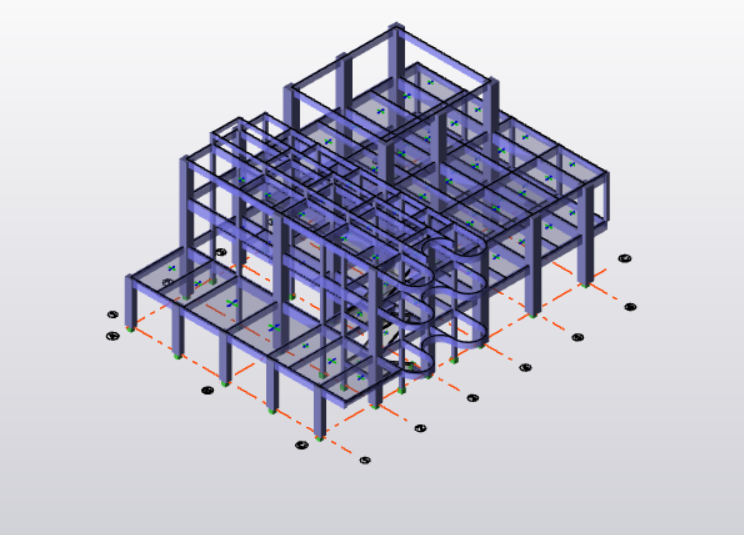
[IN] Penelitian ini bertujuan untuk mengevaluasi kinerja struktur Gedung Perpustakaan Daerah 3 lantai serta melakukan redesain pada elemen struktur yang belum memenuhi persyaratan kekuatan dan batas layanan. Ruang lingkup penelitian dibatasi pada struktur utama beton bertulang, meliputi balok, kolom, dan pelat, dengan acuan perencanaan ACI 318M-14, pembebanan SNI 1727:2020, serta analisis gempa SNI 1726:2019. Metode yang digunakan adalah analisis struktur tiga dimensi berbasis data sekunder dari dokumen Detail Engineering Design (DED) menggunakan perangkat lunak Tekla Structural Designer. Tahapan analisis meliputi penentuan beban mati, beban hidup, beban gempa metode respons spektrum, pemeriksaan partisipasi massa, simpangan antar lantai, efek orde kedua (P-Δ), dan kontrol kapasitas elemen. Hasil analisis struktur eksisting menunjukkan bahwa masih terdapat beberapa elemen yang tidak memenuhi kriteria desain, sehingga diperlukan penyesuaian dimensi penampang dan penambahan tulangan pada elemen tertentu. Setelah dilakukan redesain, seluruh elemen struktur dinyatakan memenuhi persyaratan kekuatan ultimit dan batas simpangan antar lantai yang diizinkan. Dengan demikian, struktur gedung perpustakaan dinyatakan stabil, aman terhadap beban gempa, dan layak digunakan.
[EN] This study aims to evaluate the structural performance of a three-story Regional Library Building and to redesign structural elements that do not meet strength and serviceability requirements. The scope of the study is limited to the reinforced concrete structural system, including beams, columns, and slabs, based on ACI 318M-14, loading standard SNI 1727:2020, and seismic analysis SNI 1726:2019. The method employed is a three-dimensional structural analysis using secondary data obtained from the Detail Engineering Design (DED) documents and modeled with Tekla Structural Designer software. The analysis stages include determination of dead loads, live loads, seismic loads using the response spectrum method, mass participation evaluation, inter-story drift control, second-order (P-Δ) effects, and structural element capacity checks. The results of the existing structure analysis indicate that several elements do not satisfy design criteria, thus requiring adjustment of cross-sectional dimensions and reinforcement detailing. After the redesign process, all structural elements meet the ultimate strength and allowable inter-story drift requirements. Therefore, the library building structure is considered stable, earthquake-resistant, and suitable for use.
Downloads
References
[1] L. Erianto, N. Nasution, A. P. Sani, S. Budi, and M. M. Kamal, “Penggunaan Beton Bertulang Sebagai Pembentuk Konstruksi,” Pros. Semin. Nas. Tek. Sipil dan Arsit., vol. 1, pp. 1–6, 2023.
[2] A. Suryani, S. H. Dewi, and Harmiyati, “Korelasi Kuat Lentur Beton Dengan Kuat Tekan Beton,” J. Saintis, vol. 18, no. 2, pp. 43–54, 2018.
[3] D. Anggraini and S. H. Dewi, “Evaluasi Desain Struktur Gedung Office 5 Lantai dan Basement Pemuda City Walk Pekanbaru Terhadap Gempa Berdasarkan SNI 03-1726-2012,” J. Saintis, vol. 16, no. 2, pp. 99–110, 2016.
[4] Badan Standardisasi Nasional, “SNI 1726-2019: Tata cara perencanaan ketahanan gempa untuk struktur bangunan gedung dan nongedung,” 2019, p. 248. [Online]. Available: www.bsn.go.id
[5] Badan Standardisasi Nasional, “SNI 1727:2020 Beban desain minimum dan Kriteria terkait untuk bangunan gedung dan struktur lain,” Jakarta, no. 8, pp. 1–336, 2020, [Online]. Available: www.bsn.go.id
[6] A. Mistavhirul, T. Setianingrum, I. Nurhuda, and Sukamta, “Redesain Struktur Gedung Hotel Citihub Magelang,” J. Karya Tek. Sipil, vol. 7, no. 2, pp. 67–76, 2018.
[7] F. N. Asy’arie and S. Wicaksono, “Redesain Struktur Gedung Empat Lantai Berdasarkan SNI 1726:2019,” J. Ilm. Sultan Agung, vol. 3, pp. 1–7, 2024.
[8] P. H. Karisoh, S. O. Dapas, and R. Pandaleke, “Perencanaan Struktur Gedung Beton Bertulang dengan Sistem Rangka Pemikul Momen Khusus,” J. Sipil Statik, vol. 6, no. 6, pp. 361–372, 2018.
[9] M. Ryanto, “Evaluasi Struktur Kolom Kuat Balok Lemah Struktur Rangka Baja Mengacu SNI 1729:2015,” J. Tek. Sipil, vol. 12, no. 2, pp. 131–138, 2020.
[10] R. J. Honarto, B. D. Handono, and R. Pandaleke, “Perencanaan Bangunan Beton Bertulang dengan Sistem Rangka Pemikul Momen Khusus di Kota Manado,” J. Sipil Statik, vol. 7, no. 2, pp. 201–208, 2019.
[11] A. Kristianto, Y. A. Pranata, and N. Sulandari, “Studi Parametrik Pengaruh Konfigurasi Tulangan Longitudinal dan Transversal Pada Efektivitas Pengekangan Kolom Persegi Beton Bertulang Menggunakan XTRACT,” J. Permukim., vol. 15, no. 2, pp. 73–83, 2020.
[12] F. Fajrul Falah, T. Sundari, and M. Wahyu Nugroho, “Redesain Struktur Gedung dengan Menggunakan Shear Wall (Studi Kasus RS. Bhayangkara TK III Nganjuk),” J. Ilm. Sains dan Teknol., vol. 2, no. 6, pp. 55–64, 2024.
[13] J. Maverick, G. C. Joelin, K. Kusbiantoro, and C. Lesmana, “Evaluasi Kinerja Struktur Rangka Beton Bertulang Bangunan Eksisting di Samarinda,” J. Mitra Tek. Sipil, vol. 8, no. 1, pp. 179–192, 2025.
[14] R. Ardiansyah, “Evaluasi Kapasitas Elemen Struktur Eksisting Food Court Untuk Perencanaan Cinemaxx Mal Pekanbaru,” J. Saintis, vol. 20, pp. 77–84, 2020, doi: 10.25299/saintis2020.vol20(02).5514.
[15] M. R. Panjaitan, “Evaluasi Perhitungan Struktur Gedung Bertingkat Pada Pembangunan Rumah Susun Tower C (Sukaramai Medan),” Universitas Medan, 2024.
Downloads
Published
How to Cite
Issue
Section
License
Copyright (c) 2026 Giri Mulya Bimo Putra

This work is licensed under a Creative Commons Attribution-ShareAlike 4.0 International License.

This work is licensed under a Creative Commons Attribution-ShareAlike 4.0 International License.
Copyright. This is an open access article which means that all content is freely available without charge to the user or his/her institution. Jurnal Saintis allows the author(s) to hold the copyright without restriction. The copyright in the text of individual articles (including research articles, opinion articles, and abstracts) is the property of their respective authors distributed under the terms of the Creative Commons Attribution-ShareAlike 4.0 International License which permits unrestricted use, distribution, and reproduction in any medium. Users are allowed to read, download, copy, distribute, search, or link to full-text articles in this journal without asking by giving appropriate credit, provide a link to the license, and indicate if changes were made.