
Analisis Komparatif Volcanic dan Flamed Andesite Stone sebagai Material Fasad Gedung Pesisir: Pendekatan AHP, LCC, dan Standar SMKK
Comparative Analysis of Volcanic and Flamed Andesite Stone as Facade Materials for Coastal Buildings: AHP, LCC, and SMKK Standard Approaches
DOI:
https://doi.org/10.25299/saintis.2026.vol26(01).27336Keywords:
Material Konstruksi, Analytical Hierarchy Process (AHP), Manajemen Biaya Konstruksi, Biaya Siklus Hidup, Keselamatan dan Kesehatan KerjaAbstract
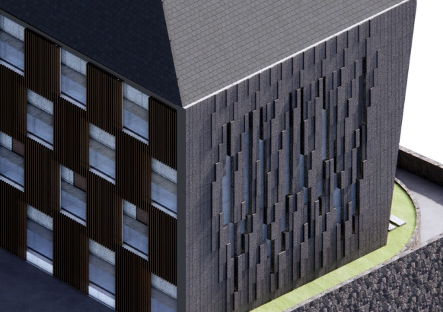
[IN] Proyek konstruksi di kawasan pesisir memiliki tingkat kompleksitas tinggi akibat pengaruh lingkungan yang ekstrem, seperti salinitas udara laut, kelembaban tinggi, serta paparan radiasi ultraviolet. Kondisi tersebut menuntut pemilihan material fasad yang tidak hanya memenuhi aspek estetika, tetapi juga mempertimbangkan ketahanan material, biaya siklus hidup (life cycle cost), serta risiko keselamatan dan kesehatan kerja (K3) selama proses pemasangan. Penelitian ini dilatarbelakangi oleh kebutuhan pemberi kerja dalam menentukan alternatif material fasad yang paling optimal pada tahap perencanaan Proyek Gedung yang berlokasi di kawasan pesisir Bali. Dua alternatif material yang dianalisis adalah volcanic andesite stone dan Flamed andesite stone. Tujuan dari penelitian ini adalah melakukan komparasi perbandingan 2 material dari sisi kecenderungan faktor pemilihan material, analisis biaya LCC dan keselamatan kerja pada saat pemasangan. Metode penelitian menggunakan pendekatan kuantitatif dengan AHP sebagai alat pengambilan keputusan multikriteria, analisis komparasi berbasis LCC dan keselamatan kerja. Hasil analisis AHP menunjukkan bahwa faktor ekonomi merupakan kriteria paling dominan dengan bobot 47,14%. Analisis perbandingan LCC, Volcanic andesite stone memiliki nilai LCC sekitar 75,4% dari Flamed andesite stone, yaitu sebesar Rp 7.384.544.524 dan Rp. 9.790.992.117, meskipun perbandingan nilai konstruksi Volcanic andesite stone lebih besar 1,43x. Dari sisi K3, pemasangan volcanic andesite stone memiliki risiko pemasangan lebih rendah karena karakteristik material yang lebih mudah ditangani.
[EN] Construction projects in coastal areas are highly complex due to extreme environmental factors, such as seawater salinity, high humidity, and exposure to ultraviolet radiation. These conditions require the selection of facade materials that not only meet aesthetic requirements but also take into account material durability, life cycle costs, and occupational safety and health (OSH) risks during the installation process. This study was motivated by the need for the client to determine the most optimal facade material alternatives during the planning phase of the Building Project, located in the coastal area of Bali. The two material alternatives analyzed are volcanic andesite stone and Flamed andesite stone. The objective of this study is to compare two materials in terms of material selection criteria, LCC cost analysis, and workplace safety during installation. The research method used a quantitative approach with AHP as a multi-criteria decision-making tool, along with LCC-based comparative analysis and occupational safety considerations. The results of the AHP analysis indicate that the economic factor is the most dominant criterion, with a weight of 47.14%. A comparative LCC analysis shows that volcanic andesite stone has an LCC value of approximately 75.4% of that of flamed andesite stone, amounting to Rp 7,384,544,524 and Rp 9,790,992,117, respectively, even though the construction cost of volcanic andesite stone is 1.43 times higher. From an occupational safety and health perspective, the installation of volcanic andesite stone poses lower installation risks due to the material’s easier-to-handle characteristics.
Downloads
References
[1] A. A. Al-Amiery, W. N. R. W. Isahak, and W. K. Al-Azzawi, “Corrosion Inhibitors: Natural and Synthetic Organic Inhibitors,” 2023. doi: 10.3390/lubricants11040174.
[2] R. F. de F. Aires and L. Ferreira, “A New Multi-Criteria Approach for Sustainable Material Selection Problem,” Sustainability (Switzerland), vol. 14, no. 18, 2022, doi: 10.3390/su141811191.
[3] E. Kesuma, “Analysis Of The Coefficient For 9 Cost Components To Implementing Construction Safety Management Systems On Flats Building Development Projects Based On Surat Edaran Direktur Jenderal Bina Konstruksi Number 68 Years Of 2024,” Asian Journal of Engineering, Social and Health, vol. 4, no. 8, 2025, doi: 10.46799/ajesh.v4i8.605.
[4] Permen PUPR No. 10 Tahun 2021, “Permen PUPR No. 10 Tahun 2021,” Menteri Pekerjaan Umum dan Perumahan Rakyat Republik Indonesia, 2021.
[5] J. Stofkova, M. Krejnus, K. R. Stofkova, P. Malega, and V. Binasova, “Use of the Analytic Hierarchy Process and Selected Methods in the Managerial Decision-Making Process in the Context of Sustainable Development,” Sustainability (Switzerland), vol. 14, no. 18, 2022, doi: 10.3390/su141811546.
[6] ISO, “ISO 15686-5:2017,” 2017.
[7] R. P. Utari, Sulianto, A. Samad, and A. T. Wahono, “Analisis Biaya Konstruksi Menggunakan Metode Life Cycle Cost pada Gedung Cordova Edupartment Semarang,” Jurnal Media Teknik Sipil, vol. 21, no. 2, 2023, doi: 10.22219/jmts.v21i2.32602.
[8] H. Rabbani and H. Priyosulistyo, “Analisis Life Cycle Cost pada Bangunan Sekolah SMP Islam Al Azhar 17 Pontianak,” Jurnal Teknil Sipil, vol. 10, no. 1, 2024.
[9] H. Chen, Y. Mao, and R. Wang, “Safety Risk Prediction Model of High-Rise Building Construction Based on Key Physiological Index,” Buildings, vol. 14, no. 12, 2024, doi: 10.3390/buildings14123795.
[10] D. Das, D. Kundu, A. Rahman, M. Rahman, and S. Sazzad, “A Robotic-based Remote Control Painting System for Exterior Walls of High-Rise Buildings,” in 2024 IEEE Conference on Computing Applications and Systems, COMPAS 2024, 2024. doi: 10.1109/COMPAS60761.2024.10796801.
[11] F. Edigan, L. R. Purnama Sari, and R. Amalia, “Hubungan Antara Perilaku Keselamatan Kerja Terhadap Penggunaan Alat Pelindung Diri (APD) Pada Karyawan PT Surya Agrolika Reksa Di Sei. Basau,” JURNAL SAINTIS, vol. 19, no. 02, 2019, doi: 10.25299/saintis.2019.vol19(02).3741.
[12] Nadhira Silvy and Ari Syaiful Rahman Arifin, “Implementasi Sistem Manajemen Keselamatan Konstruksi Berdasarkan Permen PUPR No. 10 Tahun 2021 Pada Gedung Perkuliahan,” Applied Science in Civil Engineering, vol. 5, no. 4, pp. 663–672, Dec. 2024.
[13] S. Badaruddin, A. Nabi, T. Trisnawathy, N. A. Farid, and S. M. Zaid, “Penerapan Sistem Manajemen Keselamatan Konstruksi Pada proyek Renovasi Gedung Kelas Internasional Fakultas Kedokteran Universitas Hasanuddin,” Journal of Applied Civil and Environmental Engineering, vol. 3, no. 2, 2024, doi: 10.31963/jacee.v3i2.4620.
[14] E. Zhafira, G. Rio Prayogi, and H. Wulandari, “Analisis Tingkat Penerapan Sistem Manajemen Keselamatan Konstruksi (SMKK) pada Proyek Konstruksi Gedung di Bandar Lampung,” Nusantara Hasana Journal, vol. 4, no. 12, 2025.
[15] M. P. Strager and R. S. Rosenberger, “Incorporating stakeholder preferences for land conservation: Weights and measures in spatial MCA,” Ecological Economics, vol. 58, no. 1, 2006, doi: 10.1016/j.ecolecon.2005.05.024.
[16] M. A. Ara, M. S. Tamanna, M. Ali, A. Amin, and M. A. Shabur, “A hybrid AHP and statistical validation approach for sustainable supplier selection in apparel industry,” Discover Sustainability, vol. 6, no. 1, 2025, doi: 10.1007/s43621-025-01416-1.
[17] T. L. Saaty, “Decision-making with the AHP: Why is the principal eigenvector necessary,” Eur. J. Oper. Res., vol. 145, no. 1, 2003, doi: 10.1016/S0377-2217(02)00227-8.
[18] T. E. Chow and R. Sadler, “The consensus of local stakeholders and outside experts in suitability modeling for future camp development,” Landsc. Urban Plan., vol. 94, no. 1, 2010, doi: 10.1016/j.landurbplan.2009.07.013.
[19] A. Ishizaka and A. Labib, “Review of the main developments in the analytic hierarchy process,” 2011. doi: 10.1016/j.eswa.2011.04.143.
[20] T. L. Saaty, The analytic hierarchy process: planning. 1980.
[21] T. L. Saaty, “How to make a decision: The analytic hierarchy process,” Eur. J. Oper. Res., vol. 48, no. 1, 1990, doi: 10.1016/0377-2217(90)90057-I.
[22] F. Liu, Y. Peng, W. Zhang, and W. Pedrycz, “On Consistency in AHP and Fuzzy AHP,” Journal of Systems Science and Information, vol. 5, no. 2, 2017, doi: 10.21078/jssi-2017-128-20.
[23] Kementerian Hukum dan Hak Asasi Manusia, “Undang-Undang No. 36 Tahun 2008,” Jakarta, Sep. 2008. Accessed: Apr. 14, 2026. [Online]. Available: https://peraturan.bpk.go.id/details/39704/uu-no-36-tahun-2008
[24] D. Harpriani Dewi and Sapitri, “Kajian Pemborosan Waktu (Waste Time) Dan Implementasi Value Stream Mapping Pekerjaan Sloof dan Kolom,” JURNAL SAINTIS, vol. 24, no. 01, 2024, doi: 10.25299/saintis.2024.vol24(01).16743.
[25] K. Govindan, K. Madan Shankar, and D. Kannan, “Sustainable material selection for construction industry - A hybrid multi criteria decision making approach,” 2016. doi: 10.1016/j.rser.2015.07.100.
[26] D. Y. A. Damanik, “Implementation Of Life Cycle Cost in The Bus Station Building,” Jurnal Teknik Sipil, vol. 20, no. 2, 2024, doi: 10.28932/jts.v20i2.6382.
[27] I Gusti Ngurah Jaya Negara, “Peraturan Walikota Denpasar Nomor 22 Tahun 2025 tentang Standar Harga Jasa Tahun Anggaran 2026,” Denpasar, Apr. 2025.
[28] Deutscher Naturwerkstein - Verband e. V. (DNV), “Sustainability Study - Environmental Life Cycle Assessment of Natural Stone and Glass Facade,” Wurzburg, Oct. 2010. Accessed: Apr. 14, 2026. [Online]. Available: https://dnv.online/wp-content/uploads/2023/09/Sustainability-Study-of-fassades.pdf?utm_source=chatgpt.com
[29] D. A. Rizky, “Analisis Life Cycle Cost Pada Gedung Kantor Unit Perbankan (Studi Kasus: Gedung Kantor Unit Perbankan Di Kabupaten Batubara),” INTEKNA Jurnal Informasi Teknik dan Niaga, vol. 25, no. 1, 2025.
[30] Merinda Faradianti, “Daftar Bunga Kredit Bank Mandiri, BCA, BNI, BRI, BTN April 2025,” Bloomberg Technoz.
[31] D. Lee, D. Lee, M. Lee, M. Kim, and T. Kim, “Analytic hierarchy process-based construction material selection for performance improvement of building construction: The case of a concrete system form,” Materials, vol. 13, no. 7, 2020, doi: 10.3390/ma13071738.
[32] E. Bostancioglu, “Double skin façade assessment by fuzzy AHP and comparison with AHP,” Architectural Engineering and Design Management, vol. 17, no. 1–2, 2021, doi: 10.1080/17452007.2020.1735292.
[33] E. G. Aydeniz, İ. Güven, N. Özçelik, H. T. Çetin, and E. Ünlü, “Selection of Sustainable Facade Materials for Buildings Using Fermatean Fuzzy AHP & WASPAS Methodology,” Journal of Intelligent and Fuzzy Systems, vol. 49, no. 5, 2025, doi: 10.1177/10641246251328442.
[34] Dina Febiani, A. Muh. Multazam, Andi Sani, Suharni A. Fachrin, and Yuliati, “Analisis Potensi Bahaya Pada Pekerja Facade (Curtain Wall) Dan Pengendalian Risiko Di Proyek Rumah Sakit UPT Vertikal Makassar,” Window of Public Health Journal, vol. 5, no. 6, 2024, doi: 10.33096/woph.v5i6.2033.
[35] F. Ma, D. Zhang, Z. Wang, X. Chen, and L. Jiang, “Risk Assessment of Falling Objects from Façades of Existing Buildings,” Buildings, vol. 13, no. 1, 2023, doi: 10.3390/buildings13010190.
[36] F. Alam Abdillah, A. Jayady, and H. N. Nurjaman, “Uncovering Hidden Risks in Government Building Facade Maintenance: Insights from Jakarta’s Alucobond Panel Projects,” Engineering and Technology Journal, vol. 10, no. 05, 2025, doi: 10.47191/etj/v10i05.30.
Downloads
Published
How to Cite
Issue
Section
License
Copyright (c) 2026 Cici Aulia Darma, Azaria Andreas

This work is licensed under a Creative Commons Attribution-ShareAlike 4.0 International License.

This work is licensed under a Creative Commons Attribution-ShareAlike 4.0 International License.
Copyright. This is an open access article which means that all content is freely available without charge to the user or his/her institution. Jurnal Saintis allows the author(s) to hold the copyright without restriction. The copyright in the text of individual articles (including research articles, opinion articles, and abstracts) is the property of their respective authors distributed under the terms of the Creative Commons Attribution-ShareAlike 4.0 International License which permits unrestricted use, distribution, and reproduction in any medium. Users are allowed to read, download, copy, distribute, search, or link to full-text articles in this journal without asking by giving appropriate credit, provide a link to the license, and indicate if changes were made.