
Evaluasi Kinerja Breakwater Terhadap Gelombang di Pantai Tanjung Medang Kecamatan Rangsang Kabupaten Kepulauan Meranti
Evaluation of Breakwater Performance Against Waves At Tanjung Medang Beach, Rangsang District, Meranti Islands Regency
DOI:
https://doi.org/10.25299/saintis.2023.vol23(01).25225Keywords:
Breakwater Tanjung Medang, hindcasting, karakteristik gelombang, transformasi gelombang, run-up dan overtopping gelombangAbstract
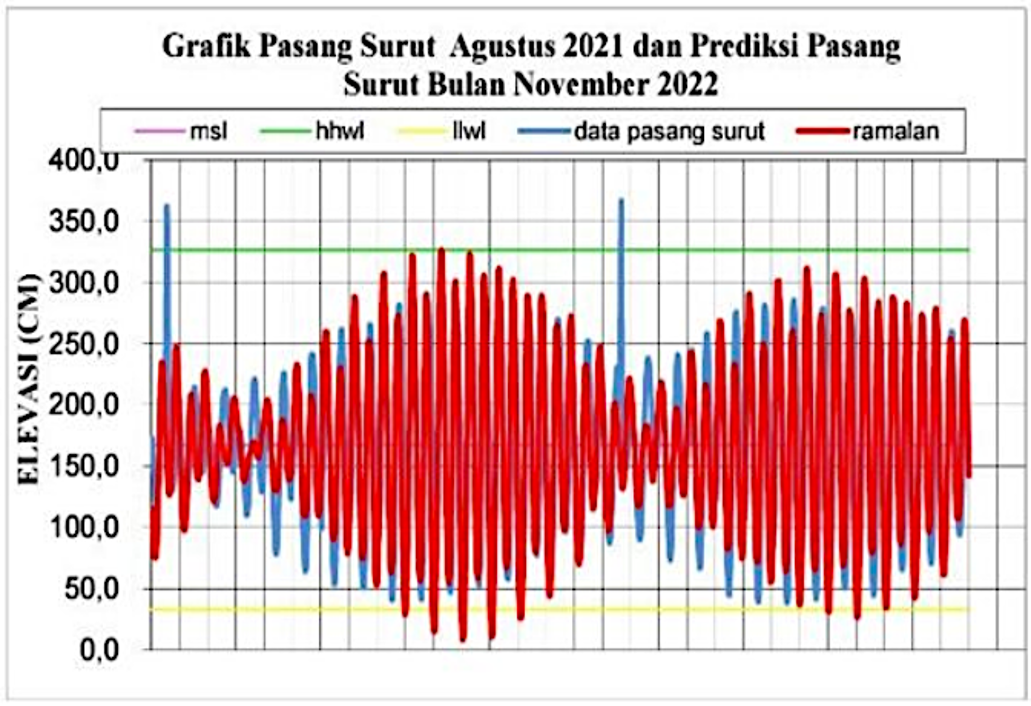
[IN] Pantai Tanjung Medang di Kabupaten Kepulauan Meranti mengalami abrasi dan kerusakan akibat gelombang besar, mengancam pemukiman dan pelabuhan. Untuk mengatasinya, dibangun pemecah ombak (breakwater). Namun, seiring waktu dan kenaikan muka air laut, kinerja breakwater dinilai tidak lagi maksimal, terutama saat pasang besar. Penelitian ini bertujuan mengevaluasi kinerja breakwater eksisting dengan menganalisis karakteristik gelombang. Metode yang digunakan adalah hindcasting gelombang berdasarkan data angin 10 tahun dari BMKG Tanjung Balai Karimun untuk mendapatkan tinggi, periode, dan transformasi gelombang. Analisis dilanjutkan dengan penentuan elevasi muka air laut menggunakan metode Admiralty, serta analisis run-up dan overtopping gelombang. Hasil analisis menunjukkan bahwa gelombang dominan berasal dari arah timur laut dengan ketinggian di atas 1 m, menjadikannya gelombang destruktif. Pada kondisi muka air tertinggi (HHWL), breakwater setinggi 3 m mengalami overtopping dari berbagai arah (nilai run-up tertinggi 2,25 m dari utara), sehingga tidak sepenuhnya aman meskipun masih efektif memecah gelombang. Sementara itu, breakwater setinggi 1,6 m sudah tidak efektif dalam mereduksi energi gelombang yang datang.
[EN] Tanjung Medang Beach in Meranti Islands Regency has experienced abrasion and damage from large waves, threatening settlements and the local port. A breakwater was built to mitigate this issue. However, over time, due to changing natural conditions and rising sea levels, its performance is considered suboptimal, especially during high tides. This study evaluates the existing breakwater's performance by analyzing wave characteristics. The method involves wave hindcasting based on 10 years of wind data from BMKG Tanjung Balai Karimun to determine wave height, period, and transformation. The analysis is supplemented by determining the sea level elevation using the Admiralty method, followed by a run-up and overtopping analysis. The results indicate that the dominant waves come from the northeast with heights exceeding 1 m, classifying them as destructive waves. At the highest water level (HHWL), the 3 m high breakwater experiences overtopping from various directions (with the highest run-up value of 2.25 m from the north), rendering it not entirely safe, although it remains effective at breaking incoming waves. Meanwhile, the 1.6 m high breakwater is no longer effective in reducing wave energy.
Downloads
References
[1] B. Triatmodjo, Teknik Pantai. Yogyakarta : Beta Offset, 1999.
[2] A. Suryani, “PENGARUH PEMECAH GELOMBANG AMBANG RENDAH (PEGAR) BERONGGA TERHADAP KARAKTERISTIK KECEPATAN PARTIKEL AIR,” UNRAM: Fakultas Teknik, 2017.
[3] Setiyawan, A. Rusdin, and N. Adnyani, “ANALISIS PERAMALAN KETINGGIAN GELOMBANG LAUT DENGAN PERIODE ULANG MENGGUNAKAN METODE DISTRIBUSI WEIBULL (STUDI KASUS PANTAI LEMBASADA KABUPATEN DONGGALA),” Jurnal Teknik Sipil dan Infrastruktur, vol. 5, p. 38, 2015.
[4] N. S. Lucky Wahana Agung, “Evaluasi Pemecah Gelombang (Breakwater) Pada Pelabuhan Perikanan,” Jurnal Rekayasa Infrastruktur Hexagon, pp. 25–34, 2017.
[5] S. Kramadibrata, Perencanaan Pelabuhan. Bandung: ITB, 2002.
[6] CERC, “Shore Protection Manual,” Washington, 1984.
[7] B. Triatmodjo, Perencanaan Bangunan Pantai. Yogyakarta : Beta Offset, 2003.
[8] Kementerian Pekerjaan Umum dan Perumahan Rakyat, Surat Edaran Menteri Pekerjaan Umum dan Perumahan Rakyat No. 07/SE/M/2010 tentang Pedoman Pelaksanaan Konstruksi Bangunan Pengaman Pantai, adaptasi dari Coastal engineering manual part VI chapter 2, “Types of functions of Coastal Structure.” Jakarta: Kementerian Pekerjaan Umum dan Perumahan Rakyat.
[9] S. K. Dauhan, H. Tawas, H. Tangkudung, and J. D. Mamoto, “ANALISIS KARAKTERISTIK GELOMBANG PECAH TERHADAP PERUBAHAN GARIS PANTAI DI ATEP OKI,” Jurnal Sipil Statik, vol. 1, no. 12, pp. 784–796, 2013.
[10] R. A. Indarto, “Analisis Transformasi Gelombang Pada Breakwater PLTU Karangkandri Cilacap,” Jurnal Teodolita, pp. 19–30, 2020.
[11] Stasiun Meteorologi Raja Haji Abdullah Tanjung Balai Karimun, “Data Kecepatan dan Arah Angin Maksimum Harian,” 2022.
[12] General Bathymetric Chart of the Oceans, “Data Kedalaman Laut Tanjung Medang,” 2022.
[13] Pusat Hidro-Oseanografi TNI Angkatan Laut, Data Pasang Surut. 2022.
Downloads
Published
How to Cite
Issue
Section
License
Copyright (c) 2023 Fauzan Azima, Harmiyati, Firdaus Agus, Muchammad Zaenal Muttaqin

This work is licensed under a Creative Commons Attribution-ShareAlike 4.0 International License.

This work is licensed under a Creative Commons Attribution-ShareAlike 4.0 International License.
Copyright. This is an open access article which means that all content is freely available without charge to the user or his/her institution. Jurnal Saintis allows the author(s) to hold the copyright without restriction. The copyright in the text of individual articles (including research articles, opinion articles, and abstracts) is the property of their respective authors distributed under the terms of the Creative Commons Attribution-ShareAlike 4.0 International License which permits unrestricted use, distribution, and reproduction in any medium. Users are allowed to read, download, copy, distribute, search, or link to full-text articles in this journal without asking by giving appropriate credit, provide a link to the license, and indicate if changes were made.