Pengaruh Penggunaan Polyurethane Terhadap Sifat Fisik dan Mekanik Beton Perkerasan Kaku
The Utilization of Polyurethane Plastic Waste on the Physical and MechanicalProperties of Rigid Pavement Concrete
DOI:
https://doi.org/10.25299/saintis.2025.vol25(02).18820Keywords:
beton, kuat tekan, kuat tarik lentur, perkerasan kaku, polyurethaneAbstract
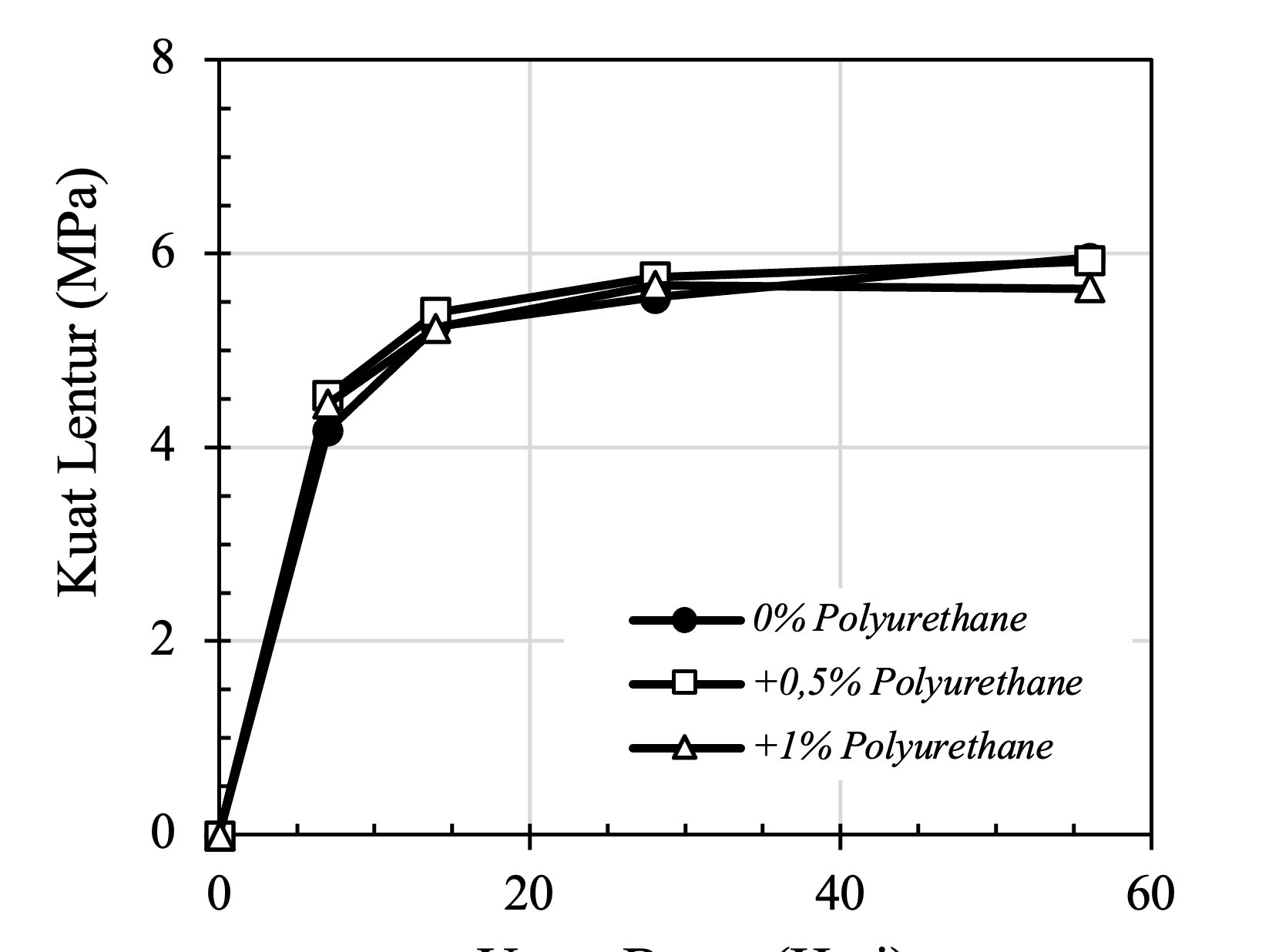
[IN] Penelitian ini mencoba memanfaatkan limbah plastik polyurethane sebagai bahan tambah pada campuran beton. Hal ini dalam upayamenambah khazanah alternatif pemanfaatan limbah plastik dalam rangka mengurangi limbah. Tujuan penelitian ini untuk mengetahuipengaruh penambahan polyurethane terhadap sifat fisik dan mekanik beton mutu rencana fc’ 36 MPa. Penelitian dilakukan melaluieksperimen di laboratorium. Sampel beton dibuat dengan variasi penambahan polyurethane 0%, 0,5% dan 1% terhadap berat campuranbeton normal. Selanjutnya campuran tersebut diuji workabilitas dan dibuat benda uji silinder dan balok beton. Benda uji dilakukan ujikuat tekan dan kuat tarik lentur pada umur 7, 14, 28 dan 56 hari. Hasil penelitian menunjukkan bahwa penambahan polyurethane tidakmemberikan pengaruh terhadap workabilitas beton. Berat isi beton rerata pada umur 28 hari berkisar antara 24,27 kN/m3 sampai 24,45kN/m3 dan berat isi beton berdasarkan benda uji balok sedikit lebih besar dibanding dari benda uji silinder. Penambahan polyurethanemenurunkan kuat tekan beton secara tidak signifikan dan masih 113% di atas kuat tekan rencana. Adapun kuat tarik lentur beton,penambahan polyurethane meningkatkan kuat tarik lentur beton cukup signifikan mencapai 26% pada penambahan 1% polyurethane dan28% pada penambahan 0,5% polyurethane. Persentase optimum polyurethane terhadap campuran beton dalam penelitian ini adalah 0,5%.
[EN] This study tries to utilize polyurethane plastic waste as an additive in concrete mixtures. This is in an effort to add to the treasure ofalternative use of plastic waste to reduce waste. The aims of this study is to determine the effect of the addition of polyurethane on the physicaland mechanical properties of concrete for the design quality of the fc' 36 MPa. The research was conducted through experiments in thelaboratory. Concrete samples were made with variations in the addition of 0%, 0.5% and 1% polyurethane to the weight of normal concretemixture. The mixture was tested for workability and made a test piece for concrete cylinders and concrete blocks. The test pieces were testedfor compressive strength and flexural strength at the age of 7, 14, 28 and 56 days. The results showed that the addition of polyurethane did notaffect the workability of concrete. The average weight of concrete content at 28 days of age ranges from 24.45 kN/m3 to 24.27 kN/m3 and theweight of concrete content based on the block test piece is slightly larger than that of the cylinder test piece. The addition of polyurethanedecreases the compressive strength of concrete insignificantly and is still 113% above the planned compressive strength. As for the flexuralstrength of concrete, the addition of polyurethane significantly increases the flexural strength of concrete reaching 26% at the addition of 1%polyurethane and 28% at the addition of 0.5% polyurethane. The optimum percentage of polyurethane to concrete mixture in this study was 0.5%.
Downloads
References
[1] H. K. Hossain, G. W. Liu, and Y. W. Yong. Experimental study to investigate mechanical properties of new material polyurethane-cement composite (PUC). Construction and Building Materials, vol. 50, pp. 200–208, 2014.
[2] O. Coppola, G. Magliulo, and E. Di Maio. Mechanical characterization of a polyurethane-cement hybrid foam in compression, tension, and shear. Journal of Materials in Civil Engineering, vol. 29, no. 2, 2017.
[3] K. Zhang dan Q. Sun. Experimental Study of Reinforced Concrete T-Beams Strengthened with a Composite of Prestressed Steel Wire Ropes Embedded in Polyurethane Cement (PSWR–PUC). International Journal of Civil Engineering, Volume 16, pages 1109–1123. 2018. https://doi.org/10.1016/j.jobe.2017.11.008
[4] Romanides et al., “SNI 03-4431-1997,” ICASSP, vol. 21, no. 3, pp. 12–42, 1997, [Online]. Available: http://downloads.esri.com/archydro/archydrooc/Overview of Arc Hydro terrainpreprocessingworkflows.pdf%0Ahttps:/ doi.org/10.1016/j.jhydrol.2017.11.003%0Ahttp //sites.tufts.edu/gis/files/2013/11/Watershed and-Drainage-Delineation-by-Pour Point.pdf%0Awww
[5] J. O. Simanjuntak, T. E. Saragi, R. A. Sidabutar, H. Pasaribu, and R. P. Simbolon, “Beton Bermutu Dan Ramah Lingkungan Dengan Memanfaatkan Limbah Abu Ban Bekas,” vol. 2, no. 2, pp. 141–149, 2021.
[6] “Beton Mapei.” [Online]. Available: https://www.mapei.com/id/en/news-and-events/event-detail/2022/09/01/inovasi-mapei-hadirkan-perkuatan-struktur-dengan-material-komposit
[7] D. Gunaran and A. Makmur, “Pengaruh Penambahan Polyurethane Terhadap Stabilitas Campuran Beraspal Berpori,” J. HPJI, vol. 2, no. 2, pp. 91–98, 2016.
[8] P. R. Candra, H. Siswanto, and B. Rahardjo, “Karakteristik Marshall Campuran Aspal Porus dengan Penambahan Polyurethane,” Media Tek. Sipil, vol. 19, no. 1, pp. 11–16, 2021, [Online]. Available: https://doi.org/10.22219/jmts.v19i1.14681
[9] A. Junianto, R. M. R. M. Ramadhan, J. P. Utari, Kusdiyono, D.A. Pawiro dan Junaidi, "Kajian Perbaikan Struktur Perkerasan Kaku Menggunakan Metode Pressure Grouting Dengan Material Polyurethane dan Epoxy (Studi Kasus: Ruas Jalan Patriot–Perintis Kemerdekaan Kota Pekalongan", Wahana Tek. Sipil, 24 (1) 2019, [Online]. Available: https://jurnal.polines.ac.id/index.php/wahana/article/view/1604
[10] J. Lei, F. Feng, S. Xu, W. Wen, and X. He, “Study on Mechanical Properties of Modified Polyurethane Concrete at Different Temperatures,” Appl. Sci., vol. 12, no. 6, 2022, doi: 10.3390/app12063184.
[11] J. Pandya, S. Shah, and S. Dave, “Feasibility of Utilization of Industrial Polyurethane (PU) Rubber Waste in Geopolymer Concrete.,” vol. 1, pp. 285–278, 2018, doi: 10.29007/2xq2.
[12] A. U. Zhafiira, E. Purwanto, and L. Irianti, “Studi Eksperimental Pengujian Kuat Tekan, Kuat Tarik Belah dan Kuat Lentur pada Campuran Beton dengan Penambahan Serat Kawat Bendrat Berkait”, JRSDD, vol. 5, no. 4, Jun. 2017.
[13] A.E. Martinelli, D.M.A. Mello, F.M. Lima, U.T. Bzerra, E.P. Marinho, D.M. Henrique. Addition of Polyurethane to Portland Cement, Materials Science Forum Vols. 498-499 (2005) pp 401-406, doi:10.4028/www.scientific.net/MSF.498-499.401.
[14] K.H. Haleem, G.W. Liu dan W.Y. Yu. Experimental study to investigate mechanical properties of new material polyurethane–cement composite (PUC). Construction Building Materials, 50 (15): 200–208. 2014. doi:10.1016/j.conbuildmat.2013.09.035.
[15] H. Gao dan Q. Sun. Study on Fatigue Testand Life Prediction of Polyurethane Cement Composite (PUC) under High or Low Temperature Conditions, Advances in Materials Science and Engineering, Volume 2020, Article ID 2398064, 14 pages https://doi.org/10.1155/2020/2398064
[16] D.K. Chattopadhyay and K. V. S. N. Raju. Structural engineering of polyurethane coatings for high performance applications. Progress in Polymer Science, vol. 32, no. 3, pp. 352–418, 2007.
[17] I.B. da Silva, A.E. Martinelli, W.R.M. de Souza, J.C. de Oliveira Freitas and M.A.F. Rodrigues. Dilatometric behavior and crystallographic characterization of Portland-polyurethane composites for oil well high-temperature cementing applications. Journal of Petroleum Science and Engineering, vol. 169, pp. 553–559, 2018.
[18] B. S. N. SNI 4431, “SNI 4431-2011 Cara Uji Kuat Lentur Beton Normal dengan Dua Titik Pembebanan,” Badan Standar Nas. Indones., pp. 1–16, 2011.
[19] B. S. Nasional, “Sni 7656:2012,” Tata Cara Pemilihan Campuran untuk Bet. Norm. Bet. Berat dan Bet. Massa, 2012.
[20] S. N. I. A. C136:2012, “SNI ASTM C136:2012. Metode uji untuk analisis saringan agregat halus dan agregat kasar,” Badan Stand. Nas., pp. 1–24, 2012.
[21] D. Cahyadi, Lasino, A. Amir Husein, W. Santoso, and Sudaryanto, “Pedoman Tata Cara Penentuan Campuran Beton Normal Dengan Semen OPC PPC dan PCC,” Pupr. pp. 1–36, 2016.
Downloads
Published
How to Cite
Issue
Section
License
Copyright (c) 2025 Anas Puri, Hengky Harianto, Elizar, Mohd Syahminan

This work is licensed under a Creative Commons Attribution-ShareAlike 4.0 International License.

This work is licensed under a Creative Commons Attribution-ShareAlike 4.0 International License.
Copyright. This is an open access article which means that all content is freely available without charge to the user or his/her institution. Jurnal Saintis allows the author(s) to hold the copyright without restriction. The copyright in the text of individual articles (including research articles, opinion articles, and abstracts) is the property of their respective authors distributed under the terms of the Creative Commons Attribution-ShareAlike 4.0 International License which permits unrestricted use, distribution, and reproduction in any medium. Users are allowed to read, download, copy, distribute, search, or link to full-text articles in this journal without asking by giving appropriate credit, provide a link to the license, and indicate if changes were made.