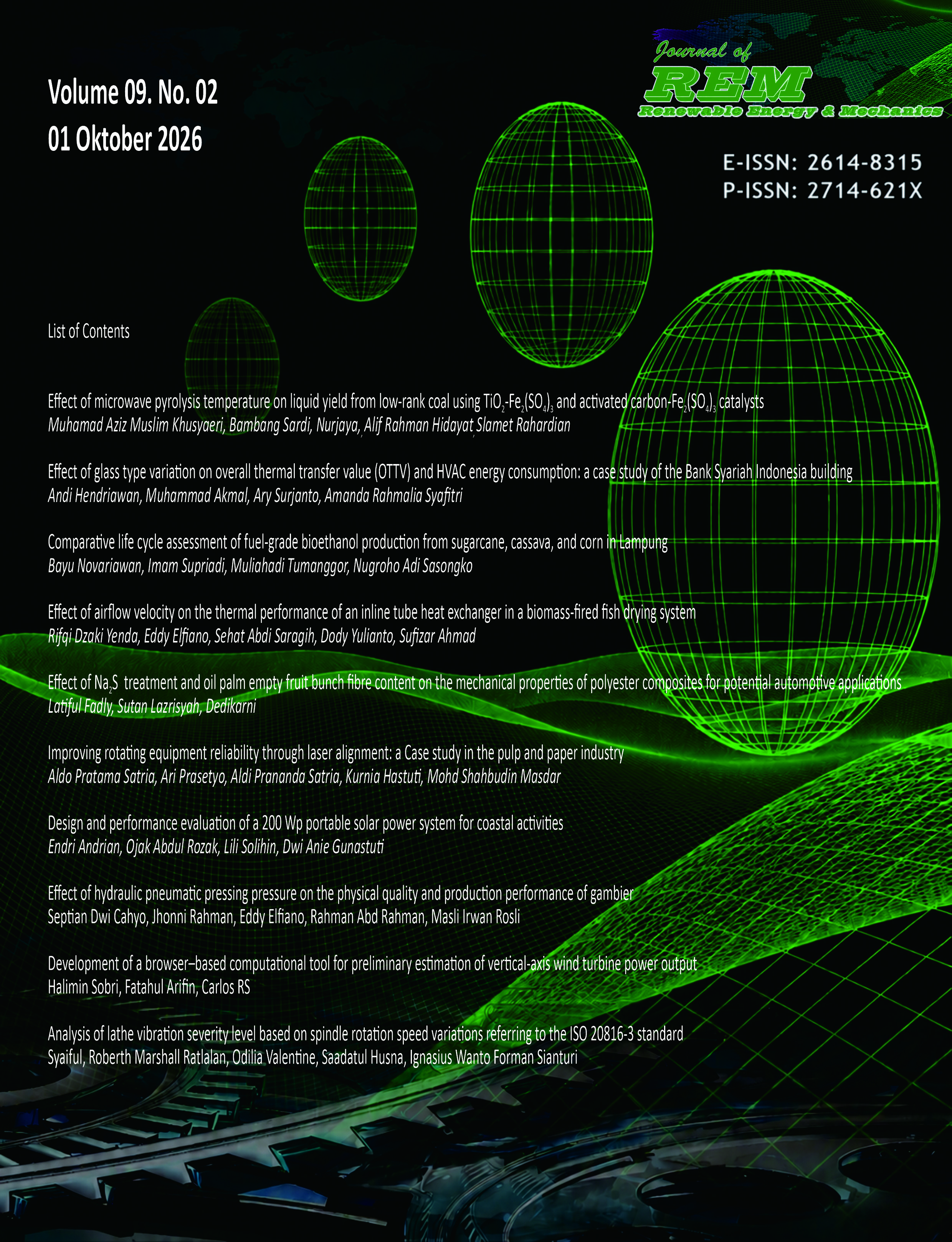
Effect of Na2S treatment and oil palm empty fruit bunch fibre content on the mechanical properties of polyester composites for potential automotive applications
DOI:
https://doi.org/10.25299/rem.2026.29195Abstract
Oil palm empty fruit bunch (OPEFB) is an abundant lignocellulosic residue with potential as reinforcement for polymer composites. This study evaluates the effect of OPEFB fibre content and sodium sulfide (Na₂S) treatment on the mechanical behaviour of polyester-based composites for potential automotive applications. OPEFB fibres were treated with 4 wt.% NaOH combined with Na₂S concentrations of 0, 2, 3, 4, and 6%, and composites were prepared at nominal resin: fibre compositions of 100:0, 70:30, and 50:50. Tensile properties were evaluated according to ASTM D638 Type I, while impact behaviour was assessed using a pendulum impact test. Increasing Na₂S concentration generally enhanced tensile strength and elastic modulus. The highest tensile strength (12.81 MPa) and elastic modulus (391.62 MPa) were obtained for the 70:30 composite treated with 6% Na₂S. The 50:50 composite also showed improved tensile strength, reaching 12.23 MPa at 6% Na₂S, although its performance remained slightly below that of the 70:30 composition. Elongation at break exhibited a non-monotonic response, indicating a strength-stiffness-ductility trade-off. These findings demonstrate that Na₂S-assisted alkaline treatment can improve the mechanical response of OPEFB/polyester composites; however, further statistical validation, interfacial characterisation, and quantitative benchmarking are required before suitability for automotive bumper components can be established.
Downloads
Downloads
Published
How to Cite
Issue
Section
Accepted 2026-09-29
Published 2026-10-01