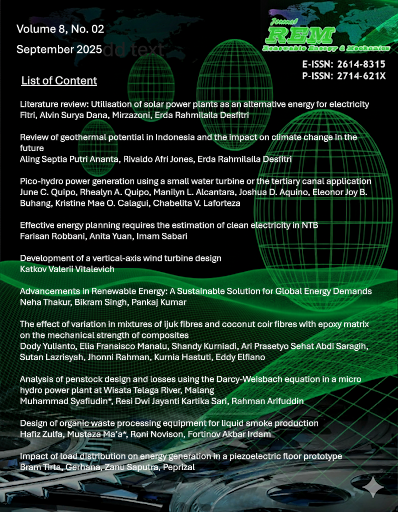
EFFECTIVE ENERGY PLANNING REQUIRES THE ESTIMATION OF CLEAN ELECTRICITY IN NTB
Keywords:
Renewable Energy, Energy Transition, Energy Planning, LEAPAbstract
Nusa Tenggara Barat (NTB) is an Indonesian province with a Regional Energy General Plan (RUED) and the Mandalika Special Economic Zone (KEK), both of which have contributed to rising electricity demand across households, businesses, industries, and public services. Despite its vast renewable energy potential, NTB’s electricity supply remains largely dependent on fossil fuels. This study employs the Low Emission Analysis Platform (LEAP) to project energy demand and supply under three scenarios: Business as Usual (BAU), RUED, and Renewable Energy (RE), with projections extending to 2050. The analysis shows that under BAU, fossil fuel dependence continues, whereas the RUED pathway accelerates renewable energy adoption and reduces emissions substantially. The RE scenario demonstrates the feasibility of eliminating fossil fuel use, achieving near-total decarbonization, and significantly enhancing energy security. These findings underscore the crucial role of renewable energy in facilitating a sustainable and resilient energy transition in NTB.
Downloads
Downloads
Published
How to Cite
Issue
Section
Accepted 2025-09-21
Published 2025-09-30