
GIS-Based Zoning for Integrating Geosite Inventory with Spatial Planning: Evidence from Meratus Geopark, Indonesia
DOI:
https://doi.org/10.25299/jgeet.2026.11.3.28927Keywords:
geo-bio-cultural landscape, territorial governance, spatial policy articulation, heritage landscape management, route-based analysisAbstract
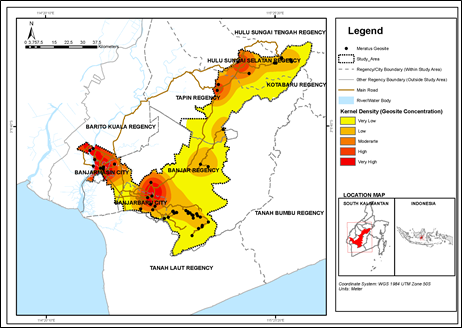
Geopark planning often begins with geosite inventories, yet translating these inventories into spatial planning interpretations remains limited. This study develops a GIS-based zoning interpretation of Meratus Geopark, South Kalimantan, Indonesia, by examining how official geosite distribution, development-potential density, accessibility, formal spatial planning categories, and field-survey evidence jointly shape geopark management implications. Its principal contribution is the development of a reproducible GIS framework that transforms official geosite inventories into analytical zoning to support spatial planning decisions. The analysis used 54 official geosites and combined weighted kernel density estimation, accessibility analysis, spatial plan overlay, and sensitivity–suitability assessment within a GIS framework, with field observations used to validate representative zoning conditions. The results show that Meratus Geopark is spatially differentiated across four routes. The weighted KDE, based on 54 official geosites and 3,647 selected toponymy points, produced a statistically clustered pattern, with a nearest-neighbor index of 0.184, z-score of -11.478, and p-value < 0.001. Accessibility also varies strongly, from the highly accessible Western Route at 8.2 km from Tugu Nol Banjarmasin to the peripheral Northern Route at 121.1 km. The integrated analysis produced five proposed zoning categories: core zone, buffer zone, geopark corridor, limited development zone, and special management zone. The proposed workflow provides planning-relevant evidence for geopark managers and spatial planners to differentiate conservation priorities, visitor-service provision, mobility corridors, and site-specific management needs, while maintaining that the resulting zoning interpretation is analytical rather than legally binding.
Downloads
References
Adhi, Y., Dewi, I., Turisno, B., 2022. Ecological Impacts and Socio-Legal Infrastructure as an Approach to Environmental Management in Ex-Mining Land Reclamation. Int. J. Sustain. Dev. Plan.
Afkarina, K.I.I., Wardana, S., Damayanti, P., 2019. COAL MINING SECTOR CONTRIBUTION TO ENVIRONMENTAL CONDITIONS AND HUMAN DEVELOPMENT INDEX IN EAST KALIMANTAN PROVINCE. J. Environ. Sci. Sustain. Dev.
Ansori, C., Warmada, I.W., Setiawan, N.I., Yogaswara, H., 2021. Geomorphosite Assessment at North Karangsambung -Karangbolong Geopark Kebumen, as Tools of Geotourism Development. J. Geosci. Eng. Environ. Technol. 6, 164–171.
Briggs, A., Newsome, D., Dowling, R., 2022. A proposed governance model for the adoption of geoparks in Australia. Int. J. Geoheritage Park. 10, 160–172.
Brilha, J., 2016. Inventory and Quantitative Assessment of Geosites and Geodiversity Sites: a Review. Geoheritage 8, 119–134.
Cahyadi, H.S., Newsome, D., 2021. The post COVID-19 tourism dilemma for geoparks in Indonesia. Int. J. Geoheritage Park.
Cahyadi, M., Aufa, N., 2022. PUSAT INFORMASI GEOPARK MERATUS DI BANJARBARU. J. TUGAS AKHIR Mhs. LANTING.
De Castro, E., Loureiro, F., Patrocinio, F., Gomes, H., Castel-Branco, J., Cezar, L., Fernandes, M., Azevedo, P., 2022. The Estrela UNESCO Global Geopark Territorial Development Strategy: A Holistic Vision for the Twenty-First Century. Tour. Hosp. Event Manag.
Dias, A., Robina-Ramírez, R., Sánchez, M.S.-O., 2023. Territorial planning and sustainable development—case study: Protected areas in the territory of the Aspiring West Geopark, Portugal 11.
Dwipati, U., Ibrahim, M.A., Abdullah, M.T., 2025. Assessing and initiating collaborative governance for sustainable geotourism development: A case study of Maros-Pangkep Geopark in Indonesia. Edelweiss Appl. Sci. Technol. 9, 1406–1412.
El Hamidy, M., Errami, E., 2025. The geosites of Safi province (Marrakech-Safi region, Morocco): Inventory and assessment for geoconservation, geotourism, geoeducation, geoparks, and local sustainable development. Int. J. Geoheritage Park. 13, 68–91.
Farsani, N., Coelho, C., Costa, C., 2010. Geotourism and geoparks as novel strategies for socio‐economic development in rural areas. Int. J. Tour. Res. 13, 68–81.
Ferdowsi, S., Németh, K., 2025. Geoparks Management in Tourism Destinations: Integrating Development and Conservation. Sustain. Dev. 34, 1034–1056.
Ferreira, D.R., Valdati, J., 2022. Geoparks and Sustainable Development: Systematic Review. Geoheritage 15.
Frey, M.-L., 2021. Geotourism—Examining Tools for Sustainable Development. Geosciences.
Gathot Harbowo, D., Siringoringo, L.P., 2025. Locating Geodiversity Hotspots through Grid-Based Spatial Indexing: Lombok Island, Indonesia. J. Geosci. Eng. Environ. Technol. 10, 215–223.
Gupta, V., Anand, S., Wei, D., Wang, G., Tripathi, S.C., 2024. Exploring applied sustainable strategies through geoheritage and geotourism: A systematic literature review. Int. J. Geoheritage Park. 12, 660–677.
Hafidhah Nurul Haq, Rosana, M.F., Endyana, C., Nugraha, K.S.A., Alamsyah, I., 2024. Geochemistry of Igneous Rocks of Citirem Formation and Its Implications for the Tectonic Setting in Ciletuh – Palabuhanratu UNESCO Global Geopark Area. J. Geosci. Eng. Environ. Technol. 9, 58–68.
Henriques, M., Brilha, J., 2017. UNESCO Global Geoparks: a strategy towards global understanding and sustainability. Episodes 40, 346–355.
Indonesia, P.K.S., 2023. Perda Kalsel Th 2023 No 6 (1).
Iukhno, A., Knyaz, O., Sadovyy, I., Hrek, M., 2025. Comprehensive spatial development plan as basis for urban territorial planning, forecasting and land use. Actual Probl. Innov. Econ. law.
Khan, M., Chen, R., 2025. Assessing the Impact of Land Use and Land Cover Change on Environmental Parameters in Khyber Pakhtunkhwa, Pakistan: A Comprehensive Study and Future Projections. Remote Sens.
Lee, Y., Jayakumar, R., 2021. Economic impact of UNESCO Global Geoparks on local communities: Comparative analysis of three UNESCO Global Geoparks in Asia.
Lestari, F., Indrayati, I., 2022. Pengembangan Kelembagaan dan Pembiayaan Geopark di Indonesia: Tantangan dan Strategi. J. Reg. Rural Dev. Plan.
Magriaty, R., 2025. Strategi Pengembangan Pariwisata Kawasan Geopark Meratus Provinsi Kalimantan Selatan, Studi Kasus: Kecamatan Piani Kabupaten Tapin. J. Reg. Rural Dev. Plan.
Martínez-Martín, J.E., Mariñoso, P.E., Rosado-González, E., Sá, A., 2023. UNESCO Global Geoparks vs. Education: a 10-Year Bibliometric Analysis. Geoheritage 15.
Mo, J., Sun, P., Shen, D., Li, N., Zhang, J., Wang, K., 2023. Simulation Analysis of Land-Use Spatial Conflict in a Geopark Based on the GMOP–Markov–PLUS Model: A Case Study of Yimengshan Geopark, China. Land 12.
Naydenov, K., 2022. GEOPARKS AS A BASIS FOR THE INTEGRATED CONSERVATION OF ECOSYSTEMS, CULTURAL HERITAGE, AND DEVELOPMENT OF ECOTOURISM, in: SGEM International Multidisciplinary Scientific GeoConference� EXPO Proceedings.
Nikolova, V., Sinnyovsky, D., 2018. Geoparks in the legal framework of the EU countries. Tour. Manag. Perspect.
Popa, R., Popa, D.-A., Andrășanu, A., 2017. The SEA and Big-S Models for Managing Geosites as Resources for Local Communities in the Context of Rural Geoparks. Geoheritage 9, 175–186.
Qi, W., Hu, Y., Zhong, L., Hui, W., 2023. Optimising the relationship between ecological protection and human development through functional zoning. Biol. Conserv.
Quesada-Valverde, M., Quesada-Román, A., 2023. Worldwide Trends in Methods and Resources Promoting Geoconservation, Geotourism, and Geoheritage. Geosciences.
Rahmatin, L.S., Nawangsari, E.R., 2025. Analysis of Sustainable Tourism Development in the Ijen UNESCO Global Geopark Area. E-Journal Tour.
Ristiawan, R., Huijbens, E., Peters, K., 2023. Projecting Development through Tourism: Patrimonial Governance in Indonesian Geoparks. Land 12.
Sahara, R., Setiawan, B., 2022. Assessment of Geosite and Geomorphosite at South Solok Aspiring Geopark Area. J. Geosci. Eng. Environ. Technol. 7, 110–116.
Shen, F., Yang, L., Zhang, L., Guo, M.-Y., Huang, H., Zhou, C., 2022. Quantifying the direct effects of long-term dynamic land use intensity on vegetation change and its interacted effects with economic development and climate change in jiangsu, China. J. Environ. Manage. 325 Pt B, 116562.
Shi, Y., Gao, H., Tan, S., Qin, H., Tian, Z., Meng, J., Zheng, X., 2024. Pattern change and ecological risk analysis of Shilin World Geopark landscape. Front. Ecol. Evol.
Shiri, Z., Le, Q.B., Ouerghemmi, H., Rejeb, H., 2025. Landscape approaches for sustainable land systems: A critical systematic review of frameworks, governance, and socio-ecological outcomes. Landsc. Archit. Sustain. 2, 100007.
Sobhani, P., Esmaeilzadeh, H., Sadeghi, S.M.M., Marcu, M. V, 2022. Estimation of Ecotourism Carrying Capacity for Sustainable Development of Protected Areas in Iran. Int. J. Environ. Res. Public Health 19.
Štrba, Ľ., Vravcová, A., Podoláková, M., Varcholová, L., Kršák, B., 2023. Linking Geoheritage or Geosite Assessment Results with Geotourism Potential and Development: A Literature Review. Sustainability.
Sulistyadi, Y., Demolingo, R.H., Latif, B.S., Indrajaya, T., Adnyana, P.P., Wiweka, K., 2024. The Implementation of Integrated Coastal Management in the Development of Sustainability-Based Geotourism: A Case Study of Olele, Indonesia. Sustain. 16.
Syaban, A.S.N., Appiah-Opoku, S., 2024. Unveiling the Complexities of Land Use Transition in Indonesia's New Capital City IKN Nusantara: A Multidimensional Conflict Analysis. Land 13.
Meratus Geopark, 2023. Meratus Geopark. Indonesian Geoparks Network.
Utama, H.W., Heriberta, H., Adriadi, A., Emilia, 2025. Geodiversity on the Great Sumatran Fault on Sungai Penuh Aspiring for the Geopark Designation, Jambi, Indonesia. J. Geosci. Eng. Environ. Technol. 10, 376–387.
Varriale, R., Genovese, L., Aldighieri, B., 2022. "Diffused Geoparks": Territorial Integration as Solution for a Shared Sustainable Growth Based on Geotourism in Italy, Japan and Tunisia. Heritage 5, 2083–2105.
Wibisono, R.R.S.F., Mahreda, E.S., Biyatmoko, D., Hafiziannor, H., 2023. Analisis Kesesuaian Rtrw Pada Bidang Pertambangan Berdasarkan Rtrwp Kalimantan Selatan Dan Rtrwk Di Kabupaten Tapin. EnviroScienteae 19, 112.
Yanbo, Q., Shilei, W., Yaya, T., Guanghui, J., Tao, Z., Liang, M., 2023. Territorial spatial planning for regional high-quality development – An analytical framework for the identification, mediation and transmission of potential land utilization conflicts in the Yellow River Delta. Land use policy.
Zhuang, A., Stoffelen, A., Meijles, E., Groote, P., 2024. The complex governance of protected areas: Insights from geoheritage and geopark management in China. Environ. Policy Gov. 34, 679–690.
Downloads
Published
Issue
Section
License
Copyright (c) 2026 Journal of Geoscience, Engineering, Environment, and Technology

This work is licensed under a Creative Commons Attribution-ShareAlike 4.0 International License.
Copyright @2019. This is an open-access article distributed under the terms of the Creative Commons Attribution-ShareAlike 4.0 International License which permits unrestricted use, distribution, and reproduction in any medium. Copyrights of all materials published in JGEET are freely available without charge to users or / institution. Users are allowed to read, download, copy, distribute, search, or link to full-text articles in this journal without asking by giving appropriate credit, provide a link to the license, and indicate if changes were made. All of the remix, transform, or build upon the material must distribute the contributions under the same license as the original.


