
Identification of Natural Hydrogen Sources from Geochemical Study in Tanjung Api Area, Central Sulawesi, Indonesia: Analysis from Open Dataset and Future Prospects
DOI:
https://doi.org/10.25299/jgeet.2026.11.3.27841Keywords:
hydrogen, H2, CH4, Geochemical, Ampana Basin, SulawesiAbstract
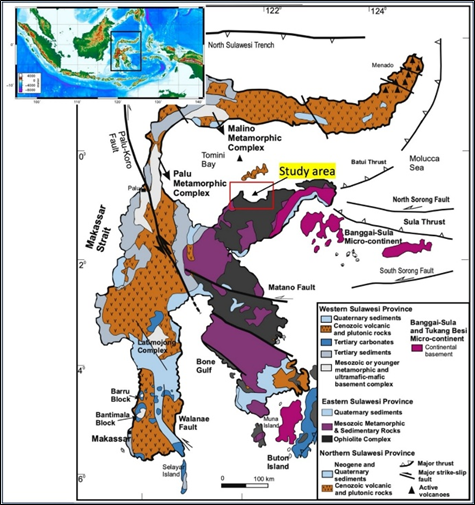
In the effort to develop environmentally friendly energy, natural H2 plays a major role due to its large source originating from the Earth's mantle. Therefore, studies on the analysis of the origin of H2 are crucial. The study in this paper aims to provide additional analysis on the origin of H2 in gas samples from the Tanjung Api area, Ampana Basin, Central Sulawesi, Indonesia. This study discusses geochemical analysis and its correlation with the source of H2. Laboratory tests of gases such as H2, CH4 and δ13C1 isotopes were used to predict the origin of H2. The results of these laboratory tests were compared with results from various H2 source locations from around the world to support and strengthen predictions regarding H2 sources in this study area. The results of this study show an H2 concentration value of 35%, δ13C1 value of -15.2 ‰ and ln(CH4/H2) with a value of -0.0901 correlated with the type of abiogenic gas that is very likely derived from serpentinization reactions in ultramafic rocks in the East Sulawesi Ophiolite (ESO) system. According to the result of this study, future studies are expected to map locations where H2 gas accumulates in reservoir rocks in the Ampana Basin. This can be achieved through more comprehensive geophysical (e.g. seismic, magnetic, and/or gravity) and geological studies. Through this study, it is expected that it can contribute to further research and development of natural H2 energy in Indonesia.
Downloads
References
Advokaat, E.L. 2015. Neogene Extension and Exhumation in NW Sulawesi. PhD Thesis. University of London.
Advokaat, E.L., Hall, R., White, L.T., Watkinson, I.M., Rudyawan, A. and BouDagher-Fadel, M.K. 2017. Miocene to recent extension in NW Sulawesi, Indonesia', Journal of Asian Earth Sciences, 147, pp. 378–401.
Babushkina, M.S., Ugolkov, V.L., Marin, Y.B., Nikitina, L.P. and Goncharov, A.G. 2018. Hydrogen and carbon groups in the structures of rock-forming minerals of rocks of the lithospheric mantle: FTIR and STA+QMS data, Doklady Earth Sciences, 479(2), pp. 456–459.
Chakraborty, D. and Mallick, S. 2026. Attribute-guided prestack seismic waveform inversion: Methodology, applications, and feasibility to characterize underground reservoirs for potential hydrogen storage, Eng, 7(1), p. 45.
Echavez, R.A., Hagemann, B., Ganzer, L. and Hincapie, R.E. 2025. The behavior and migration of natural hydrogen in the subsurface: A comprehensive review, Proceedings of the SPE Europe Energy Conference and Exhibition.
Epelle, E.I., Obande, W., Udourioh, G.A., Afolabi, I.C., Desongu, K.S., Orivri, U. et al. 2022. Perspectives and prospects of underground hydrogen storage and natural hydrogen, Sustainable Energy & Fuels, 6(14), pp. 3324–3343.
Fakhruddin, R. and Kurniadi, D. 2019. Age and paleobathymetry of Salodik Group in Poh Pagimana Section, East Arm of Sulawesi, Journal of Geoscience, Engineering, Environment, and Technology, 4(1), pp. 30–39.
Faturrakhman, M.L., Sanjaya, I., Jamal, J., Saputro, D.H. and Setiawan, R. 2025. Tectonic geomorphology analysis in natural hydrogen exploration: A case study from Tanjung Api, Sulawesi, Riset Geologi dan Pertambangan, 35(1), pp. 37–48.
Handoyo, H., 2024. Kontribusi geofisika dalam eksplorasi hidrogen geologis (geologic hydrogen) di bawah permukaan. GeoScienceEd J. 6(1), pp. 117–128.
Holm, N.G., Oze, C., Mousis, O., Waite, J.H. and Guilbert-Lepoutre, A. 2015. Serpentinization and the formation of H₂ and CH₄ on celestial bodies, Astrobiology, 15(7), pp. 587–600.
Husein, S., Novian, M.I. and Barianto, D.H. 2014. Geological structures and tectonic reconstruction of Luwuk, East Sulawesi, Proceedings of the 38th Indonesian Petroleum Association Annual Convention.
Jackson, O., Lawrence, S.R., Hutchinson, I.P., Stocks, A.E., Barnicoat, A.C. and Powney, M. 2024. Natural hydrogen: Sources, systems and exploration plays, Geoenergy, 2(1), geoenergy2024-002.
Klein, F., Tarnas, J.D. and Bach, W. 2020. Abiotic sources of molecular hydrogen on Earth, Elements, 16(1), pp. 19–24.
Li, Y. and Zhang, M. 2025. Geologic hydrogen exploration by imaging key hydrogen system components using multiple geophysical methods, Journal of Geophysics and Engineering, 22(3), pp. 952–961.
Lin, M., Wang, D. and Jiang, S. 2026. The evolution, key challenges, and future prospects of volumetric stimulation theory and engineering technology for unconventional oil and gas, Advances in Resources Research, 6(1), pp. 432–459.
Liu, Q., Wu, X., Wang, X., Jin, Z., Zhu, D., Meng, Q. et al. 2019. Carbon and hydrogen isotopes of methane, ethane, and propane: A review of genetic identification of natural gas, Earth-Science Reviews, 190, pp. 247–272.
Liu, Q., Wu, X., Huang, X., Zhu, D., Meng, Q., Zhu, D. et al. 2024. Integrated geochemical identification of natural hydrogen sources, Science Bulletin, 69(19), pp. 2993–2996.
Lucky, N.J., Hossain, S., Bhuiyan, M.A.H., Kabir, S.M. and Joy, M.F.R. 2025. Reservoir characterization and volumetric re-estimation of the Kailashtila Gas Field through integrated petrophysical and seismic interpretation, Discover Geoscience, 3(1), pp. 1–17.
Maulana, A., Christy, A.G. and Ellis, D.J. 2015. Petrology, geochemistry and tectonic significance of serpentinized ultramafic rocks from the South Arm of Sulawesi, Indonesia, Geochemistry, 75(1), pp. 73–87.
Nugraha, A.M.S., Hall, R. and BouDagher-Fadel, M. 2022. The Celebes Molasse: A revised Neogene stratigraphy for Sulawesi, Indonesia, Journal of Asian Earth Sciences, 228, 105140.
Sanjaya, I., Fatturakhman, M.L., Arifin, A.S., Maryanto, S. and Kim, H.S. 2024. Evaluating the natural hydrogen system in Ampana Basin, Central Sulawesi: An implication for natural hydrogen exploration in Indonesia, Jurnal Geologi dan Sumberdaya Mineral, 25(3), pp. 135–149.
Saragih, R.Y., Haryanto, I., Sukiyah, E., Ilmi, N.N., Sunardi, E., 2018. The sinistral strike-slip fault as Ampana Basin controller in Central Sulawesi. J. Geol. Sci. Appl. Geol. 4(2).
Satyana, A.H. 2024. Exploring Natural Hydrogen and Abiotic Methane in Indonesia: Case and Idea from Tanjung Api Gas Seeps, East Arm of Sulawesi—Building a Geologic Hydrogen System in a Collision Zone.
Su, Y., Wu, S., Sun, J., Wu, X., Huang, Y., Chen, J. et al. 2025. Natural hydrogen exploration by joint sparse inversion of geophysical measurements and integrated geological interpretation, International Journal of Hydrogen Energy, 173, 151040.
van Gorsel, J.T. and Subroto, E.A. 2022. Abiogenic gas seepage from serpentinite at Tanjung Api, Tomini Bay, East Sulawesi, Berita Sedimentologi, 48(1), pp. 67–78.
van Leeuwen, T.M., Susanto, E.S., Maryanto, S., Hadiwisastra, S., Sudijono, M. and Prihardjo. 2010. Tectonostratigraphic evolution of Cenozoic marginal basin and continental margin successions in the Bone Mountains, Southwest Sulawesi, Indonesia, Journal of Asian Earth Sciences, 38, pp. 233–254.
Wang, C., Tao, R., Walters, J.B., Ren, T., Nan, J. and Zhang, L. 2023. Deciphering the origin of abiotic organic compounds on Earth: Review and future prospects, Acta Geologica Sinica (English Edition), 97(1), pp. 288–308.
Wang, L., Jin, Z., Chen, X., Su, Y. and Huang, X. 2023. The origin and occurrence of natural hydrogen, Energies, 16(5), 2400.
Zhang, M. and Li, Y. 2024. The role of geophysics in geologic hydrogen resources, Journal of Geophysics and Engineering, 21(4), pp. 1242–1253.
Zhang, Y., Qie, J., Wang, X.F., Cui, K., Fu, T., Wang, J. and Qi, Y. 2020. Mineralogical characteristics of the nickel laterite, southeast ophiolite belt, Sulawesi Island, Indonesia, Mining, Metallurgy & Exploration, 37(1), pp. 79–91.
Downloads
Published
Issue
Section
License
Copyright (c) 2026 Journal of Geoscience, Engineering, Environment, and Technology

This work is licensed under a Creative Commons Attribution-ShareAlike 4.0 International License.
Copyright @2019. This is an open-access article distributed under the terms of the Creative Commons Attribution-ShareAlike 4.0 International License which permits unrestricted use, distribution, and reproduction in any medium. Copyrights of all materials published in JGEET are freely available without charge to users or / institution. Users are allowed to read, download, copy, distribute, search, or link to full-text articles in this journal without asking by giving appropriate credit, provide a link to the license, and indicate if changes were made. All of the remix, transform, or build upon the material must distribute the contributions under the same license as the original.


