Lithological Control on Variations in Total Dissolved Solids (TDS) and pH of Auya River Water, Obano Area, Paniai Regency , Central Papua
DOI:
https://doi.org/10.25299/jgeet.2026.11.1.27493Keywords:
lithology, TDS, Ph, river water quality, Hydrogeochemistry, Auya RiverAbstract
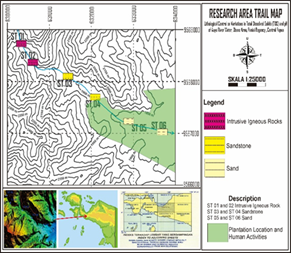
This study focuses on the study of the influence of lithology and the level of rock weathering on the water quality of the Auya River located in Obano District, Paniai Regency, Central Papua, using Total Dissolved Solids (TDS) and pH as the main indicators. The approach applied is a quantitative descriptive method, which was carried out through field surveys at six observation points, direct measurement of water quality parameters, and statistical analysis including descriptive statistics, Pearson correlation, and linear regression. The results of the study indicate an increasing trend in TDS and pH values from upstream to downstream, which is related to changes in lithology from intrusive igneous rocks to sedimentary rocks, accompanied by an increase in weathering intensity. The correlation test shows a very strong relationship between TDS and pH (r = 0.975), as well as a significant relationship between water quality parameters with lithology and weathering levels. The results of the regression analysis show that lithology contributes to TDS variations by (84.1%), while the level of weathering affects pH variations by (71.4%). These findings confirm that geological factors play a dominant role in controlling the hydrogeochemical characteristics of river water through the process of mineral dissolution and ion release. Furthermore, the presence of sulfide minerals such as pyrite contributes to increased dissolved ions through natural oxidation processes. Furthermore, anthropogenic activities also contribute to variations in water quality. TDS (17–63 mg/L) and pH (6.6–7.9) indicate that the Auya River water quality remains within clean water quality standards. This study emphasizes the importance of geological aspects as a basis for water quality management in areas with high geological complexity.
Downloads
References
Ayu, D., Mirino, T., & Alfius, B. (2024). Analysis of water quality parameters of the Kampung Salak River, Sorong City, Southwest Papua. Casuarina: Journal of Environmental Engineering, 1 (2), 13–16.
Ayuningrum, VR, Yushardi, Y., Nurdin, EA, Astutik, S., & Ikhsan, FA (2023). Mapping the distribution of irrigation river water quality on agricultural land on the karst slopes of Mount Sadeng, Puger District, Jember Regency. JPIG (Journal of Geography Education and Science).
Basharat, U., Zhang, W., Abbasi, A., Mahroof, S., Han, C., Khan, S.H., & Li, S. (2025). Integrated assessment of groundwater hydrogeochemistry and quality using multivariate statistical analysis, self-organizing maps, and water quality indices in District Bagh, AJK, Pakistan. Ecotoxicology and Environmental Safety.
Duan, X., et al. (2023). Hydrogeochemical characteristics and water quality assessment in karst groundwater systems. Water.
Gaur, N., Sarkar, A., Dutta, D., Gogoi, B. J., Dubey, R., & Dwivedi, S. K. (2022). Evaluation of water quality index and geochemical characteristics of surface water from Tawang, India. Scientific Reports, 12, 11698.
Hartanto, FV, Putranto, TT, & Setiawan, T. (2023). Analysis of the influence of lithology distribution on hydrogeochemistry in the unconfined aquifer of the Jakarta Groundwater Basin. Journal of Geology and Mineral Resources.
Iriyanto, S., Alfons, AB, & Daawia, D. (2022). Water quality status of dug wells and its control in the PIR2 Arso settlement, Keerom Regency. Dinamis: Journal of Civil and Environmental Engineering.
Islam, M. Z., & Mostafa, M. G. (2024). Assessments of hydrogeochemical characteristics, water quality, and health risks of groundwater of Chapai-Nawabganj District of Bangladesh. H2Open Journal.
Irwan, M. (2017). Physical-chemical conditions of rivers in Sawaibu Bay, Manokwari, West Papua. Indopacific Journal of Aquatic Resources.
Ministry of Health of the Republic of Indonesia. (2010). Regulation of the Minister of Health of the Republic of Indonesia Number 492/Menkes/Per/IV/2010 concerning drinking water quality requirements. Ministry of Health of the Republic of Indonesia.
Ministry of Health of the Republic of Indonesia. (2023). Regulation of the Minister of Health of the Republic of Indonesia Number 2 of 2023, regulations concerning the implementation of Government Regulation Number 66 of 2014 concerning environmental health. Ministry of Health of the Republic of Indonesia.
Masitoh, F., & Yuniarti, KNA (2026). Status of heavy metal contamination in the Metro River around the Talangagung final waste disposal site (TPAS), Malang Regency. Journal of Environmental Sciences, 23.
Government of the Republic of Indonesia. (2021). Government Regulation of the Republic of Indonesia Number 22 of 2021 concerning the implementation of environmental protection and management. Government of the Republic of Indonesia.
Pohan, DAS, Budiyono, B., & Syafrudin, S. (2017). River water quality analysis to determine the designation of environmental review. Journal of Environmental Science, 14 (2).
Rumabar, AMF, & Gaspersz, RS (2024). Determination of water quality status of the Dosay River, Jayapura Regency using the pollution index method. Wahana Pendidikan Scientific Journal, 10 (4).
Tuska, RT, Gae, DK, Devindra, R., Hidayat, I., Naibobe, GA, Pamungkas, RG, Anggara, F., & Rizqi, AHF (2025). The effect of lithology variations on groundwater quality in the Semin area and its surroundings, Semin District, Gunungkidul Regency, Special Region of Yogyakarta. In Proceedings of the 20th National Seminar on Industrial and Information Technology Engineering (ReTII) (pp. 25–39). Yogyakarta National Institute of Technology.
Wacano, D. (2026). Analysis of the concentration, distribution, and potential sources of heavy metals in surface air and groundwater on the Parangtritis coast of Yogyakarta. Journal of Environmental Sciences, 23.
World Health Organization. (2017). Drinking water quality guidelines (4th ed.). WHO.
Downloads
Published
Issue
Section
License
Copyright (c) 2026 Journal of Geoscience, Engineering, Environment, and Technology

This work is licensed under a Creative Commons Attribution-ShareAlike 4.0 International License.
Copyright @2019. This is an open-access article distributed under the terms of the Creative Commons Attribution-ShareAlike 4.0 International License which permits unrestricted use, distribution, and reproduction in any medium. Copyrights of all materials published in JGEET are freely available without charge to users or / institution. Users are allowed to read, download, copy, distribute, search, or link to full-text articles in this journal without asking by giving appropriate credit, provide a link to the license, and indicate if changes were made. All of the remix, transform, or build upon the material must distribute the contributions under the same license as the original.