Screening-Level Liquefaction Susceptibility Assessment in Central West Lombok: Integrating HVSR-Derived Ground Shear Strain and Groundwater Depth
DOI:
https://doi.org/10.25299/jgeet.2026.11.3.27334Keywords:
Ground Shear Strain, Groundwater Depth, Liquefaction, MicrozonationAbstract
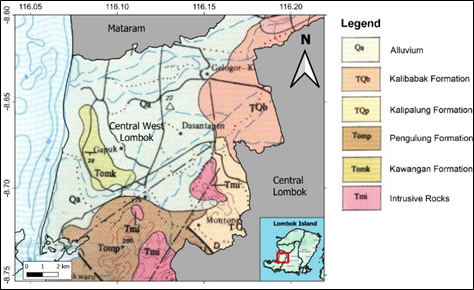
Lombok is one of the earthquake-prone areas in Indonesia that is highly exposed to secondary hazards such as liquefaction. This research presents a screening-level liquefaction susceptibility assessment for the central part of West Lombok by integrating two main controlling parameters, namely ground shear strain (GSS) derived from HVSR microtremor measurements (n = 52) as an indicator of surface soil deformability, and groundwater depth (GWD) from field observations as an indicator of soil saturation level. The Liquefaction Susceptibility Index (LSI) was calculated by combining these two parameters using an unweighted conjunctive geometric mean approach to emphasize the simultaneous occurrence of soil deformability and groundwater saturation conditions while reducing compensatory effects that may occur in additive integration methods. The idea behind this approach is that locations where both high soil deformability and shallow groundwater levels are present will be assigned higher susceptibility values, while the susceptibility values will be reduced for locations where these two prerequisites are mismatched. The integrated LSI offers a more selective zonation than the single parameter outputs: the GWD-only map identifies widespread hydrologically favorable conditions (77.24% are classified as High–Very High) as saturation-ready, and the GSS-only map is dominated by Moderate–Low deformability (73.51%). The integrated map classifies 34.79% of the study area as High, 55.40% as Moderate and 9.80% as Low, with no Very High class. High susceptibility is concentrated in the western coastal belt (Labuapi–Gerung–Lembar), which corresponds to low-lying coastal/alluvial plains underlain by Quaternary alluvium where shallow groundwater and mechanically susceptible ground are more likely to coincide. However, the proposed susceptibility model has not been validated using CPT/SPT measurements, borehole observations, or documented liquefaction inventories. Therefore, the resulting map should be interpreted as a proxy-based screening-level prioritization tool for guiding future geotechnical investigations rather than a deterministic assessment of liquefaction occurrence.
Downloads
References
Aditama, M. R., Sunan, H. L., Tri Laksono, F. A., Ramadhan, G., Iswahyudi, S., & Fadlin. (2021). Integrated Subsurface Analysis of Thickness and Density for Liquefaction Hazard: Case Study of South Cilacap Region, Indonesia. Journal of Geoscience, Engineering, Environment, and Technology, 6(1), 58–66.
Alonso-Pandavenes, O., Torrijo, F. J., & Torres, G. (2024). Analysis of the Liquefaction Potential at the Base of the San Marcos Dam (Cayambe, Ecuador)—A Validation in the Use of the Horizontal-to-Vertical Spectral Ratio. Geosciences, 14(11), 306.
Andrus, R. D., & Bwambale, B. (2021). Assessing the Effect of Aging on Soil Liquefaction Resistance (pp. 163–173).
Bao, X., Jin, Z., Cui, H., Chen, X., & Xie, X. (2019). Soil liquefaction mitigation in geotechnical engineering: An overview of recently developed methods. Soil Dynamics and Earthquake Engineering, 120, 273–291.
Buana, T. W., Hermawan, W., Rahdiana, R. N., Widyaningrum, R., Wahyudin, Hasibuan, G., Wiyono, & Sollu, W. P. (2020). Atlas Zona Kerentanan Likuefaksi Indonesia (2nd ed.). Badan Geologi Kementerian Energi dan Sumber Daya Mineral.
Chung, J.-W., & Rogers, J. D. (2013). Influence of Assumed Groundwater Depth on Mapping Liquefaction Potential. Environmental & Engineering Geoscience, 19(4), 377–389.
Civelekler, E., Afacan, K. B., & Okur, D. V. (2024). Effect of site specific soil characteristics on the nonlinear ground response analysis and comparison of the results with equivalent linear analysis. Journal of Applied Geophysics, 220, 105250.
Cox, B. R., Cheng, T., Vantassel, J. P., & Manuel, L. (2020). A statistical representation and frequency-domain window-rejection algorithm for single-station HVSR measurements. Geophysical Journal International, 221(3), 2170–2183.
Dwiyantoro, W., Fathani, T. F., & Adi, A. D. (2023). Influence of Groundwater Table Fluctuation on Liquefaction Potential Analysis Using Cyclic Stress Approach. IOP Conference Series: Earth and Environmental Science, 1184(1), 012006.
Fukushima, Y., Köse, O., Yürür, T., Volant, P., Cushing, E., & Guillande, R. (2002). Attenuation Characteristics of Peak Ground Acceleration from Fault Trace of The 1999 Kocaeli ( Turkey ) Earthquake and Comparison of Spectral Acceleration with Seismic Design Code. Journal of Seismology, 6, 379–396.
Galupino, J., & Dungca, J. (2023). Estimating Liquefaction Susceptibility Using Machine Learning Algorithms with a Case of Metro Manila, Philippines. Applied Sciences, 13(11), 6549.
Hanatha, F. D., Indriatmoko, T. W., & Qurrotu’aeni, W. S. (2023). Analysis of Soil and Rock Strength Using Vs30 Value and Ground Shear Strain Based on Microtremor Data in the Pindul Cave Area, Gunung Kidul, Yogyakarta. Jurnal Geosaintek, 9(1), 29.
Harsuko, M. R. C., Z., Z., Nugraha, A. D., Muzli, M., Sahara, D. P., Puspito, N. T., Husni, Y. M., Prabowo, B. S., & Sarjan, A. F. N. (2020). Analysis of H/V Ratio Curve to Estimate Seismic Hazard Vulnerability in Lombok Island, West Nusa Tenggara, Indonesia. Jurnal Geofisika, 18(1), 1.
Hartantyo, E., Brotopuspito, K. S., Sismanto, & Waluyo. (2014). Correlation of Shallow Groundwater Levels with The Liquefaction Occurrence Cause By May 2006 Earthquake In The South Volcanic-clastic Sediments Yogyakarta , Indonesia. International Journal of Applied Sciences, 5(1), 1–8.
Hatmoko, J. T., & Suryadharma, H. (2015). Prediction of liquefaction potential study at Bantul Regency the province of special region of Yogyakarta Indonesia. Procedia Engineering, 125, 311–316.
Hossain, A. S. M. F., Saeidi, A., Salsabili, M., Nastev, M., Suescun, J. R., & Bayati, Z. (2025). A Review of Parameters and Methods for Seismic Site Response. Geosciences, 15(4), 128.
Hu, J., Tan, Y., & Zou, W. (2021). Key factors influencing earthquake-induced liquefaction and their direct and mediation effects. PLOS ONE, 16(2), e0246387.
Hutchings, S. J., & Mooney, W. D. (2021). The Seismicity of Indonesia and Tectonic Implications. Geochemistry, Geophysics, Geosystems, 22(9), 1–42.
Ilham, I., & Sani, M. A. (2025). Microtremor based seismic vulnerability assessment of UIN mataram campus II, Lombok. Compton: Jurnal Ilmiah Pendidikan Fisika, 12(1), 106–120.
Ilham, Prabowo, U. N., & Sismanto. (2021). Mapping the Potential Liquefaction Area in Yogyakarta City Based on Ground Shear Strain Data. Jurnal Fisika Dan Aplikasinya, 17(3), 74–78.
Ina, S., Yuliyanto, G., & Irham, M. N. (2020). Calculating ground shear strain (GSS) of microtremor data using graphical user interface python programming. Journal of Physics: Conference Series, 1524(1), 012015.
Irsyam, M., Widiyantoro, S., Natawidjaja, D. H., Meilano, I., Rudyanto, A., Hidayati, S., Triyoso, W., Hanifa, N. R., Djarwadi, D., Faizal, L., & Sunarjito. (2017). Peta Sumber dan Bahaya Gempa Indonesia Tahun 2017. Badan Penelitian dan Pengembangan Kementerian Dalam Negeri Republik Indonesia.
Ishihara, K. (1996). Soil Behaviour in Earthquake Geotechnics. Clarendon Press.
Jalil, A., Fathani, T. F., Satyarno, I., & Wilopo, W. (2021). Liquefaction in Palu: the cause of massive mudflows. Geoenvironmental Disasters, 8(1), 21.
Konno, K., & Ohmachi, T. (1998). Ground-motion characteristics estimated from spectral ratio between horizontal and vertical components of microtremor. Bulletin of the Seismological Society of America, 88(1), 228–241.
Kurniawan, C. W., Yatini, Y., & Pramono, S. (2023). Application of Ground Shear Strain (GSS) for Mapping Liquefaction Potential in Palu, Central Sulawesi, Indonesia. International Journal of Scientific and Research Publications, 13(2), 64–71.
Kusuma, W. H., & Sanny, T. A. (2022). Analysis of Ground Shear Strain (GSS) In Mapping, Liquefaction Vulnerability Potential Using HVSR (Horizontal To Vertical Spectral Ratio) Method. Case Study: Sepaku Subdistrict, North Penajam Paser Regency, East Kalimantan. IOP Conference Series: Earth and Environmental Science, 1031(1), 012027.
Li, Y., Wang, R., Ma, H., & Zhang, J.-M. (2025). Rising groundwater table due to restoration projects amplifies earthquake induced liquefaction risk in Beijing. Nature Communications, 16(1), 1466.
Loviknes, K., Cotton, F., & Weatherill, G. (2024). Exploring inferred geomorphological sediment thickness as a new site proxy to predict ground-shaking amplification at regional scale: application to Europe and eastern Türkiye. Natural Hazards and Earth System Sciences, 24(4), 1223–1247.
Malawani, M. N., Hadmoko, D. S., Lavigne, F., Agniy, R. F., Hayat, D. M., Astabella, R. D., Laksono, A., Syamsuddin, S., & Mutaqin, B. W. (2024). Review on the Impacts of the Samalas Eruption (1257 CE) to the Hydrogeological Conditions of Mataram, Lombok, Indonesia. Indonesian Journal on Geoscience, 11(3), 339–348.
Manan, A., Puspitafuri, C., Chahyani, R., Irawati, & Pertiwi, I. I. (2023). Identification Of Shear Strain On The Surface Ground Of Wangi-Wangi Island, Southeast Sulawesi, Indonesia, Using Nakamura’s Technique and The Possibility Of Its Impacts. Journal of Geoscience, Engineering, Environment, and Technology, 8(4), 275–280.
Mangga, S. A., Atmawinata, S., Hermanto, B., Setyogroho, B., & Amin, T. C. (1994). Peta Geologi Lembar Lombok, Nusa Tenggara Barat.
Manoharan, S. G., & Ganapathy, G. P. (2023). GIS based urban social vulnerability assessment for liquefaction susceptible areas: a case study for greater Chennai, India. Geoenvironmental Disasters, 10(1), 1.
Mantap, B., P., M. W., & Parwito. (2025). Analysis of Soil Stability and Foundation Bearing Capacity in Infrastructure Development in Earthquake-Prone Areas. Journal of Engineering and Applied Technology, 1(2), 22–29.
Marjiyono, M. (2016). Potensi Penguatan Gelombang Gempabumi oleh Sedimen Permukaan Kota Mataram, Nusa Tenggara Barat. Jurnal Lingkungan Dan Bencana Geologi, 7(3), 135–144.
Melati, M. D., Athayde, G. B., Fan, F. M., Garcia, L. H., & de Vasconcelos Muller Athayde, C. (2023). Monitoring groundwater storage in a fractured volcanic aquifer system. Environmental Monitoring and Assessment, 195(3), 385.
Meng, S. bo, Zhao, J. wei, Liu, Z. xian, & Jin, W. (2022). Prediction and Modeling for Local Site Amplification Effect of Ground Motion: Exploring Optimized Machine Learning Approaches. Pure and Applied Geophysics, 8(2), 1592–1621.
Mulyana, G. D., Antosia, R. M., & Nathania, E. Y. (2026). Soft Layer Identification in Kedamaian District Using the HVSR-Derived Shear Wave Velocity Distribution. Journal of Geoscience, Engineering, Environment, and Technology, 11(1), 129–139.
Mustafa, R., Prasad Singh, A., & Ghani, S. (2025). Liquefaction assessment of soil based on SPT and CPT data using novel machine learning techniques: a practical solution. Modeling Earth Systems and Environment, 11(3), 218.
Nakamura, Y. (1997). Seismic Vulnerability Indices For Ground and Structures Using Microtremor. World Congress on Railway Research, 1, 1–7.
Nakamura, Y. (2008). On the H/V Spectrum. The 14th World Conference on Earthquake Engineering, 1–10.
Nakamura, Y. (2019). What is the Nakamura method? Seismological Research Letters, 90(4), 1437–1443.
Pebrianto, F., & Hidayat, A. A. N. (2018). Ini Data Lengkap Kerusakan Gempa Lombok Versi BNPB.
Pemerintah NTB. (2024). Peraturan Daerah (Perda) Provinsi Nusa Tenggara Barat Nomor 5 Tahun 2024 tentang Rencana Tata Ruang Wilayah Provinsi Nusa Tenggara Barat Tahun 2024-2044. Jaringan Dokumentasi Dan Informasi Produk Hukum.
Prabowo, U. N., Ferdiyan, A., & Amalia, A. F. (2021). The Soft Layer Thickness Estimation using Microtremor Measurement to Identify Landside Potential in Watukumpul, Central Java, Indonesia. Journal of Geoscience, Engineering, Environment, and Technology, 6(1), 16–23.
Rachmat, H., Rosana, M. F., Wirakusumah, A. D., & Jabbar, G. A. (2016). Petrogenesis of Rinjani Post-1257-Caldera-Forming-Eruption Lava Flows. Indonesian Journal on Geoscience, 3(2), 107–126.
Refrizon, Fadli, D. I., Sumanjaya, E., Maulidiyah, A., Hardianza, M., & Hardiansyah, D. (2025). Seismic microzonation in Bengkulu City, Indonesia: insights for resilient planning after 2000 Mw 7.9 and 2007 Mw 8.4 earthquakes. Bulletin of Earthquake Engineering, 23(8), 3085–3107.
Saputri, D., & Pujiastuti, D. (2020). Analisis Kecocokan Nilai Percepatan Tanah Pulau Lombok Berdasarkan Perhitungan Empiris dengan Data Percepatan Tanah dari Akselerograf di Stasiun Mataram. Jurnal Fisika Unand, 9(1), 79–84.
Sarah, D., & Soebowo, E. (2013). Liquefaction Due to the 2006 Yogyakarta Earthquake : Field Occurrence and Geotechnical Analysis. Procedia Earth and Planetary Science, 6, 383–389.
Sasmi, A. T., Nugraha, A. D., Muzli, M., Widiyantoro, S., Zulfakriza, Z., Wei, S., Sahara, D. P., Riyanto, A., Puspito, N. T., Priyono, A., Greenfield, T., Afif, H., Supendi, P., Daryono, D., Ardianto, A., Syahbana, D. K., Husni, Y. M., Prabowo, B. S., & Narotama Sarjan, A. F. (2020). Hypocenter and Magnitude Analysis of Aftershocks of the 2018 Lombok, Indonesia, Earthquakes Using Local Seismographic Networks. Seismological Research Letters, 91(4), 2152–2162.
Simandjuntak, T. O. (2014). Tektonika (S. Tjokrosapoetro, Ed.). Pusat Survei Geologi Bandung.
Soebowo, E., Tohari, A., & Sarah, D. (2007). Studi Potensi Likuifaksi di Daerah Zona Patahan Opak Patalan - Bantul, Jogjakarta. Proseding Seminar Geoteknologi Kontribusi Ilmu Kebumian Dalam Pembangunan Berkelanjutan.
Sudrajat, Y., Arisbaya, I., Handayani, L., Gaol, K. L., Mukti, M. M., Sugiarto, B., Syamsuddin, Mutaqin, B. W., Virmoux, C., & Lavigne, F. (2026). Electrical resistivity tomography for geohazard assessment in West Lombok’s alluvial plain. Geosystems and Geoenvironment, 5(2), 100487.
Supartoyo, Hidayati, S., & Omang, A. (2018). Dampak Permukaan Gempa Lombok Tanggal 5 Agustus 2018. In M. Irsyam, N. R. Hanifa, & D. Djarwadi (Eds.), Kajian Rangkaian Gempa Lombok Provinsi Nusa Tenggara Barat (Pertama, 8). Pusat Penelitian dan Pengembangan Perumahan dan Pemukiman, Badan Penelitian dan Pengembangan, Kementerian Pekerjaan Umum dan Perumahan Rakyat.
Supartoyo, Robiana, R., Natalia, M. C., & Hespiantoro, S. (2020). Dampak Gempa Lombok Tahun 2018. Geominerba, 5(1), 61–76.
Syafaat, M. B., Buana, L. A. T. A., Putra, D. P. E., & Kuncoro, D. A. (2024). Hydrogeology Conceptual Model of Meninting Dam and Its Surrounding Area, West Lombok Regency, West Nusa Tenggara, Indonesia. IOP Conference Series: Earth and Environmental Science, 1291(1), 1–8.
Syamsuddin, E., Maulana, A., Hamzah, A., & Irfan, U. R. (2024). Assessing soil vulnerability in Petobo post-liquefaction zone, Palu, Central Sulawesi: A microzonation study utilizing microtremor measurements. Journal of Degraded and Mining Lands Management, 11(3), 5805–5816.
Taruna, R. M., Septiadhi, A., Sungkono, Mase, L. Z., & Mashuri. (2024). Preliminary Assessment of Liquefaction Vulnerability using Microtremor Analysis in North Lombok. Journal of Physics: Conference Series, 2866(1), 1–6.
Towhata, I. (2008). Geotechnical Earthquake Engineering (W. Wu & R. I. Borja, Eds.). Springer.
Upomo, T. C., Chang, M., Kusumawardani, R., Prayitno, G. A., Huang, R.-C., & Fansuri, M. H. (2024). Preliminary Field Study of the Petobo Flow Slide After the 2018 Indonesia Palu Liquefaction. In Earth and Environmental Science Earth and Environmental Science (R0) (pp. 19–22).
USGS. (2018). M 6.9 - 36 km NW of Labuan Lombok, Indonesia. Earthquake Hazards Program.
van Ginkel, J., Ruigrok, E., Wentinck, R., & Herber, R. (2022). Amplification Behaviour of Compressional Waves in Unconsolidated Sediments. Frontiers in Earth Science, 10, 1–17.
Wathelet, M., Chatelain, J. L., Cornou, C., Giulio, G. Di, Guillier, B., Ohrnberger, M., & Savvaidis, A. (2020). Geopsy: A user-friendly open-source tool set for ambient vibration processing. Seismological Research Letters, 91(3), 1878–1889.
Yatini, Putra, A. K., & Paripurno, E. T. (2023). An Application of HVSR Method on Microtremor Data for Analysis of Earthquake Potential in Candipuro District, Lumajang, Indonesia. Journal of Geoscience, Engineering, Environment, and Technology, 8(4), 288–294.
Youd, T. L., Idriss, I. M., Andrus, R. D., Arango, I., Castro, G., Christian, J. T., Dobry, R., Finn, W. D. L., Harder, L. F., Hynes, M. E., Ishihara, K., Koester, J. P., Liao, S. S. C., Marcuson, W. F., Martin, G. R., Mitchell, J. K., Moriwaki, Y., Power, M. S., Robertson, P. K., … Stokoe, K. H. (2001). Liquefaction Resistance of Soils: Summary Report from the 1996 NCEER and 1998 NCEER/NSF Workshops on Evaluation of Liquefaction Resistance of Soils. Journal of Geotechnical and Geoenvironmental Engineering, 127(10), 817–833.
Zhang, X., Jiao, J. J., & Guo, W. (2022). How Does Topography Control Topography‐Driven Groundwater Flow? Geophysical Research Letters, 49(20).
Zumpano, V., Pisano, L., Filice, F., Ugenti, A., de Lucia, D., Wasowski, J., Santaloia, F., & Lollino, P. (2022). Regional-Scale Seismic Liquefaction Susceptibility Mapping via an Empirical Approach Validated by Site-Specific Analyses. Geosciences, 12(5), 215.
Downloads
Published
Issue
Section
License
Copyright (c) 2026 Journal of Geoscience, Engineering, Environment, and Technology

This work is licensed under a Creative Commons Attribution-ShareAlike 4.0 International License.
Copyright @2019. This is an open-access article distributed under the terms of the Creative Commons Attribution-ShareAlike 4.0 International License which permits unrestricted use, distribution, and reproduction in any medium. Copyrights of all materials published in JGEET are freely available without charge to users or / institution. Users are allowed to read, download, copy, distribute, search, or link to full-text articles in this journal without asking by giving appropriate credit, provide a link to the license, and indicate if changes were made. All of the remix, transform, or build upon the material must distribute the contributions under the same license as the original.