Water Hyacinth Phytoremediation for Reducing COD, BOD, and Pb in Leachate: An Environmental Geoscience Perspective
DOI:
https://doi.org/10.25299/jgeet.2026.11.02.26904Keywords:
Leachate, Phytoremediation, Water HyacinthAbstract
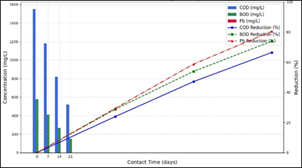
Leachate generated from landfill disposal sites poses a serious environmental threat due to its high content of organic pollutants and heavy metals. Elevated levels of chemical oxygen demand (COD), biochemical oxygen demand (BOD), and lead (Pb) may contaminate soil and surrounding water bodies if the leachate is not properly treated. Phytoremediation using water hyacinth offers an eco-friendly and low-cost alternative for leachate treatment. This study was conducted to evaluate the effectiveness of water hyacinth in reducing COD and BOD concentrations and removing Pb from leachate. An experimental method with a batch reactor system was applied, using 30 clumps of water hyacinth in each tank and contact time variations of 7, 14, and 21 days. COD, BOD, and Pb concentrations were measured before and after treatment using standard water quality analysis methods. The results showed that the 21-day contact time produced the highest removal efficiency. COD decreased from 1551.21 mg/L to 520.32 mg/L, representing a 66.44% reduction, while BOD decreased from 576.34 mg/L to 150.62 mg/L, equivalent to a 73.88% reduction. Pb concentration also decreased from 0.92 mg/L to 0.18 mg/L, with a removal efficiency of 80.43%. These reductions are attributed not only to the physiological activity of water hyacinth but also to the interactions among hydrological conditions, root zone architecture, and rhizosphere-mediated microbial communities, which collectively facilitate biodegradation, assimilation, and bioaccumulation of pollutants. Overall, the study highlights the critical role of integrating environmental geoscience principles with phytoremediation to optimize leachate treatment. Understanding the geochemical characteristics of leachate, subsurface hydrodynamics, and plant-microbe interactions provides a scientific basis for designing sustainable, low-cost, and efficient treatment systems. The findings indicate that water hyacinth can serve as a practical and geoscience-informed solution for mitigating organic and heavy metal pollution from landfill leachate, with 21 days identified as the optimum contact time.
Downloads
References
Adi, S., Frezy Ukhuah, I., Husnul, K., Dewandra, B., 2020. Geophysical Survey on Open Dumping Landfill for Monitoring Spread of Leachate: A Case Study in Pekanbaru, Riau, Indonesia. JGEET (Journal of Geoscience, Engineering, Environment, and Technology). 5, 105-107.
Amira, A., Utomo, K.P., Pramadita, S., 2022. Efektivitas Penurunan BOD Dan TSS Menggunakan Media Filter Serabut Kelapa Dan Serbuk Serabut Kelapa. J. Rekayasa Lingkung. Trop. 3, 1–7.
Aoust, P.M.D., Szulc, P.J., Houweling, D., 2026. Evaluating Hydrogen Sulfide Removal from Municipal Landfill Leachate using a Venturi Stripping System. Waste Manag. 211, 115288.
Apriyani, N., Lesmana, R.Y., 2020. Pengaruh Air Lindi Terhadap pH Dan Zat Organik Pada Air Tanah Di Tempat Penampungan Sementara Kelurahan Pahandut Kota Palangkaraya. J. Mns. dan Lingkung. 25, 60–65.
Auchterlonie, J., Eden, C., Sheridan, C., 2021. The Phytoremediation Potential of Water Hyacinth : A Case Study From Hartbeespoort Dam , South Africa. South African J. Chem. Eng. 37, 31–36.
Claquin, P., Mussio, I., Navon, M., Rusig, A., 2025. Sargassum Leachate Initially Inhibits then Stimulates Phytoplankton Growth in Coral Reef Waters Am. J. Exp. Mar. Bio. Ecol. 593, 152146.
Eden, W.T., Salshabila, C., Rakainsa, S.K., Mursiti, S., 2024. Identifikasi Senyawa Aktif Eceng Gondok (Eichhornia crassipes (Mart.) Solms) Sebagai Inhibitor Tirosinase. JPSCR J. Pharm. Sci. Clin. Res. 9, 301–312.
Ekha, Y., Annete Ratnagreha, N., Andi, S., 2021. Evaluation of Groundwater Quality Status Around Gunung Tugel Landfill In Kedungrandu Village, Patikraja District, Banyumas Regency, Central Java, Indonesia. JGEET (Journal of Geoscience, Engineering, Environment, and Technology). 6, 42-50.
Elvania, N.C., 2025. Efektivitas Media Filtrasi Pasir, Zeolit, Dan Karbon Aktif Dalam Mengurangi Pencemar Pada Air Lindi. CHEMVIRO J. Kim. dan Ilmu Lingkung. 3, 245–250.
Elvania, N.C., 2022. Analysis Of The Leachate Quality And Its Potential Distribution In The Banjarsari Landfill Environment , Bojonegoro Regency. J. Pendidikan Sains, 10, 25–31.
Elvania, N.C., Anggara, O.C., Khairiyyah, N.N., 2025. Effectiveness Of Using Activated Carbon To Reduce Pollutants In Leachate. Anal. Anal. Environ. Chem. 10, 25–36.
Fery, E., Emi, S., Johanes, H., Adjat,S., 2020. The Permeability of Granite Weathering Soil in Tanjungpinang, Bintan Island, Indonesia. JGEET (Journal of Geoscience, Engineering, Environment, and Technology). 5, 129-135.
Ihtiar, A., Ulfah, M., Kaswinarni, F., 2024. Effectiveness Of Water As Phytoremediation Agent BOD and COD Leachate. J. Environ. Sci. Educ. 4, 92–108.
Megagupita, S., Marendra, P., Widiatmono, B.R., Sari, E., 2024. Perbandingan Efektivitas Fitoremediasi Dalam Mereduksi BOD dan COD (Studi Kasus : Industri Batik Alam , Pasuruan). J. Sumberd. Alam Dan Lingkung. 11, 20–29.
Miguel, E.G.S., Guerrero, J.L., 2026. Temporal Trends of Pollution in an Estuary Affected by Phosphogypsum Leachates and Acid Mine Drainage : Waste Management Implications. Mar. Pollut. Bull. 223, 118996.
Oktavia, L., 2020. Fitoteknologi Pengolahan Limbah Cair Depo Pemasaran Ikan (DPI) Kabupaten Sidoarjo Menggunakan Eceng Gondok (Eichhornia crassipes) Dan Kangkung Air (Ipomoea aquatic). J. Res. Technol. 06, 227–236.
Priscillia, E., Taiwo, A., Emmanuel Emeka, U., Naeem, A., Oke Israel, O., 2019. Assessment of the Leachate Contamination Level of Groundwater Resource at a Dumpsite, In Minna, North Central, Nigeria Using Resistivity Method. JGEET (Journal of Geoscience, Engineering, Environment, and Technology), 4, 116-127.
Purwaningrum, S.I., Syarifuddin, H., Nizori, A., Wibowo, G., 2023. Wastewater Treatment Plant Design for Batik Wastewater with Off-Site System Method in Ulu Gedong Sub-District, Jambi City. J. Presipitasi 20, 153–164.
Puspitaningsari, A., Joegijantoro, R., Yuniastuti, T., 2024. Analisis Kualitas Air Lindi Di TPA Lempeni Kabupaten Lumajang. Media Husada J. Environ. Heal. 4, 25–33.
Rahayu, E., Hasri, Pratiwi, D.E., 2023. Studi Adsorpsi Logam Cd (II) Dan Pb (II) Menggunakan Adsorben Rumput Gajah (Pennistum Purpureum). Anal. Anal. Environ. Chem. 8, 56–67.
Rahmi, R., Sajidah, 2017. Pemanfaatan Adsorben Alami (Biosorben) Untuk Mengurangi Kadar Timbal (Pb) dalam Limbah Cair. Pros. Semin. Nas. Biot. 7, 271–279.
Rezagama, A., Purwono, P., Hadiwidodo, M., Yustika, M., Prabowo, Z.N., 2017. Pengolahan Air Lindi TPA Jatibarang Menggunakan Fenton (H2O2 – Fe). J. Presipitasi Media Komun. dan Pengemb. Tek. Lingkung. 14, 30–36.
Sangkham, S., Pitakpong, A., Kumar, R., 2025. Advanced Approaches to Microplastic Removal in Landfill Leachate : Advanced Oxidation Processes ( AOPs ), Biodegradation , and Membrane Filtration. Case Stud. Chem. Environ. Eng. 11, 101056.
Siswoyo, E., 2023. Penyerapan Logam Berat Timbal (Pb) Air Lindi Tempat Pemrosesan Akhir (TPA) Oleh Eceng Gondok (Eichhornia crassipes) Dalam Sistem Constructed Wetland. AJIE - Asian J. Innov. Entrep. 07, 76–81.
Skrubbeltrang, E., Almeda, R., Gissel, T., 2024. Tire Particles and Their Leachates Reduce the Filtration Rate of the Mussel Mytilus Edulis. Mar. Environ. Res. 195, 106348.
Sudheer Kumar, Y., Hari Krishna, P., Srinivas, P., 2018. A Study On Influence Of Real Municipal Solid Waste Leachate On Properties Of Soils In Warangal, India. JGEET (Journal of Geoscience, Engineering, Environment, and Technology). 3, 25-29.
Syahdo, D., Khair, A., Haris, A., 2025. Pengaruh Jenis Pasir Terhadap Kadar BOD Dan COD Pada Air Lindi Di Kecamatan Pulau Sebuku Kabupaten Kotabaru. J. Penelit. Multidisiplin Bangsa 1, 1970–1983;
Tshikovhi, N.A., Mudzanani, K., Phadi, T., Masindi, V., Foteinis, S., 2025. Valorization of Invasive Water Hyacinth for Nutrients Removal from Eutrophic Waterbodies and Biochar Production. Desalin. Water Treat. 324, 101527.
Vidiyanti, S., Jhon, C., Simamora, K., Utomo, P., 2025. Penyisihan BOD, COD, Dan Amonia pada Lindi Menggunakan Spons dan Sumbu Kompor Sebagai Media Biofilter. J. Ilmu Lingkung. 23, 1316–1322.
Wdowczyk, A., Szyma, A., 2024. Application of Selected Indicators to Assess Contamination of Municipal Landfill Leachate and its Impact on Groundwater. Water Resour. Ind. 32, 100265.
Wijaya, R.A., Utomo, B., Soeryodarundio, K., 2022. Produksi Bersih Melalui Pemanfaatan Kembali Air Limbah Pada Home Industry Tahu Menggunakan Slow Sand Filter. J. Matriks Tek. Sipil 10, 281–291.
Yang, H., Tan, T., Ren, G., Liu, Y., Liu, Z., Xia, S., Wu, Z., 2025. The Dual Nature of Water Hyacinth (Pontederia crassipes) : Environmental Threats and Sustainable Solutions. Water Biol. Secur. 4, 100359.
Yin, J., Zhu, T., Li, X., Wang, F., Xu, G., 2025. Phytoremediation of Microplastics by Water Hyacinth. Environ. Sci. Ecotechnology 24, 100540.
Downloads
Published
Issue
Section
License
Copyright (c) 2026 Journal of Geoscience, Engineering, Environment, and Technology

This work is licensed under a Creative Commons Attribution-ShareAlike 4.0 International License.
Copyright @2019. This is an open-access article distributed under the terms of the Creative Commons Attribution-ShareAlike 4.0 International License which permits unrestricted use, distribution, and reproduction in any medium. Copyrights of all materials published in JGEET are freely available without charge to users or / institution. Users are allowed to read, download, copy, distribute, search, or link to full-text articles in this journal without asking by giving appropriate credit, provide a link to the license, and indicate if changes were made. All of the remix, transform, or build upon the material must distribute the contributions under the same license as the original.