
Application of the Saturation Water Gradient (SWGRAD) Method to Well-Log Analysis for Gas-Bearing Zone Identification and Perforation Interval Recommendation in the Poseidon Field, Browse Basin, Western Australia
DOI:
https://doi.org/10.25299/jgeet.2026.11.3.25775Keywords:
SWGRAD, water saturation, formation-water salinity, gas reservoir, Plover Formation, Browse Basin, well-log analysisAbstract
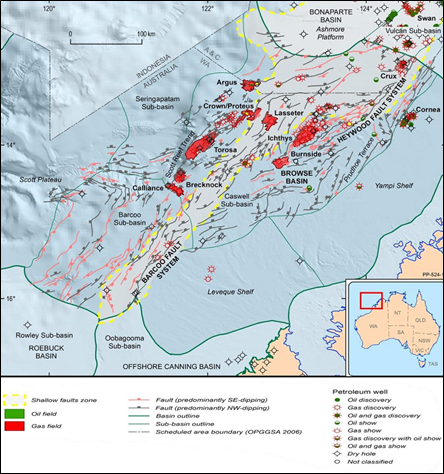
Accurate identification of gas-bearing intervals in heterogeneous sandstone reservoirs remains challenging when formation-water salinity is poorly constrained. This study evaluates the applicability of the Saturation Water Gradient (SWGRAD) method for identifying potential gas-bearing intervals in the Plover Formation of the Poseidon Field, Browse Basin, Western Australia. Well-log, mudlog, well-report, and available DST/MDT data from five wells, namely Torosa-1, Kronos-1, Boreas-1, Poseidon-1, and Poseidon-2, were analyzed. Gamma Ray, neutron–density porosity, and resistivity logs were integrated to characterize reservoir intervals prior to SWGRAD analysis. Water saturation was calculated using Archie’s equation for formation-water salinities ranging from 1 to 25 kppm, and SWGRAD was determined from the slope of the least-squares linear regression between water saturation and salinity at each depth sample. The resulting SWGRAD profiles were interpreted using well-specific cutoff criteria and evaluated against available DST/MDT and production-test evidence. The results indicate that well-specific SWGRAD cutoffs ranging from ≤0.00002 to ≤0.000045 provide a more appropriate discrimination criterion than a universal threshold. Independent validation is strongest in Boreas-1, where SWGRAD intervals overlap approximately 61 m of the 70 m DST interval, corresponding to approximately 87.1% agreement, and in Kronos-1, where the interpreted intervals correspond to reported gas-show and production-test evidence. In Poseidon-2, the identified low-SWGRAD intervals are considered prospective rather than independently validated because the available DST results were inconclusive. For Poseidon-1, where direct well-test evidence is unavailable, the ≤0.00002 criterion was adopted as a working cutoff based on comparison with Boreas-1 and was used to identify prospective intervals and recommend perforation targets. The results demonstrate that SWGRAD can provide a quantitative supporting indicator for gas-zone screening under uncertain formation-water salinity, but its interpretation requires well-specific calibration and integration with conventional petrophysical, geological, and independent well-test information.
Downloads
References
Anwar, T. and Hidayat, H.K. (2018) ‘Water Saturation Gradient (SWGRAD) as a new mathematical solution for hydrocarbon identification in the oil and gas field with high uncertainty on water salinity’, Proceedings of the Indonesian Petroleum Association, 42nd Annual Convention, IPA18-88-G.
Archie, G.E. (1942) ‘The electrical resistivity log as an aid in determining some reservoir characteristics’, Transactions of the American Institute of Mining and Metallurgical Engineers, 146, pp. 54–62.
Asquith, G.B. and Krygowski, D. (2004) Basic Well Log Analysis. 2nd edn. Tulsa, OK: American Association of Petroleum Geologists.
Awolayo, A., Ashqar, A., Uchida, M., Salahuddin, A.A. and Olayiwola, S.O. (2017) ‘A cohesive approach at estimating water saturation in a low-resistivity pay carbonate reservoir and its validation’, Journal of Petroleum Exploration and Production Technology, 7, pp. 637–657.
Blevin, J.E., Boreham, C.J., Summons, R.E., Struckmeyer, H.I.M. and Loutit, T.S. (1998a) ‘An effective Lower Cretaceous petroleum system on the North West Shelf: evidence from the Browse Basin’, in Purcell, P.G. and Purcell, R.R. (eds.) The Sedimentary Basins of Western Australia II: Proceedings of the Petroleum Exploration Society of Australia Symposium. Perth: Petroleum Exploration Society of Australia, pp. 397–420.
Blevin, J.E., Struckmeyer, H.I.M., Cathro, D.L., Totterdell, J.M., Boreham, C.J., Romine, K.K., Loutit, T.S. and Sayers, J. (1998b) ‘Tectonostratigraphic framework and petroleum systems of the Browse Basin, North West Shelf’, in Purcell, P.G. and Purcell, R.R. (eds.) The Sedimentary Basins of Western Australia II: Proceedings of the Petroleum Exploration Society of Australia Symposium. Perth: Petroleum Exploration Society of Australia, pp. 369–395.
Boreham, C.J., Roksandic, Z., Hope, J.M., Summons, R.E., Murray, A.P., Blevin, J.E. and Struckmeyer, H.I.M. (1997) Browse Basin organic geochemistry study, North West Shelf, Australia. Volume 1: Interpretation report. AGSO Record 1997/57. Canberra: Australian Geological Survey Organisation.
Bourdet, J., Heath, C., Kempton, R., et al. (2019) ‘Adaptation of fluid inclusion techniques for investigating gas charge: examples from the Caswell Sub-basin, Browse Basin, Australia’, Geological Society, London, Special Publications, 484(1), pp. 29–50.
Brincat, M.P., Lisk, M., Kennard, J.M., Bailey, W.R. and Eadington, P.J. (2004) ‘Evaluating the oil potential of the Caswell Sub-basin: insights from fluid inclusion studies’, in Ellis, G.K., Baillie, P.W. and Munson, T.J. (eds.) Timor Sea Petroleum Geoscience. Proceedings of the Timor Sea Symposium. Darwin, Northern Territory.
Castillo Vincentelli, M.G. and Caceres Contreras, S.A. (2016) ‘Water saturation on Albian carbonates reservoirs—ancient Brazilian oil fields’, Journal of Geophysics and Engineering, 13(6), pp. 880–886.
Dewan, J.T. (1983) Essentials of Modern Open-Hole Log Interpretation. Tulsa, OK: PennWell Books.
Glover, P.W.J. (2000) Petrophysics MSc Course Notes. Aberdeen: Department of Geology and Petroleum Geology, University of Aberdeen.
Johanna, U. and Kusumah, E.P. (2023) ‘Analysis of petrophysical parameter on shaly sand reservoir by comparing conventional method and shaly sand method in Vulcan Subbasin, Northwest Australia’, Journal of Geoscience, Engineering, Environment, and Technology, 8(2-2), pp. 35–41.
Jumaah, H.A. (2021) ‘Modified Archie’s parameters for estimating water saturation for carbonate reservoir in north of Iraq’, Journal of Petroleum Exploration and Production Technology, 11, pp. 3689–3697.
Kamel, M.H. and Mabrouk, W.M. (2002) ‘An equation for estimating water saturation in clean formations utilizing resistivity and sonic logs: theory and application’, Journal of Petroleum Science and Engineering, 36(3–4), pp. 159–168.
Ogbamikhumi, A. and Ighodalo, J.E. (2021) ‘Hydrocarbon prospectivity in the undrilled area of AIMA Field in the Niger Delta Basin, Nigeria’, Journal of Geoscience, Engineering, Environment, and Technology, 6(1), pp. 34–41.
Palu, T.J., Hall, L., Edwards, D., Grosjean, E., Rollet, N., Boreham, C., Buckler, T., Higgins, K., Nguyen, D. and Khider, K. (2017) ‘Source rocks and hydrocarbon fluids of the Browse Basin’, in AAPG/SEG International Conference and Exhibition 2017, London, UK, pp. 15–18.
Pardede, R.P., Alfatih, Z.Z.P., Saputra, M.F., Sigalingging, A.S. and Winardhi, S. (2025) ‘Mapping reservoir characteristics with petrophysical properties using pseudo elastic impedance (PEI) and seismic inversion in Poseidon Field, Browse Basin’, Proceedings of the Indonesian Petroleum Association, 49th Annual Convention, IPA25-SG-464, pp. 1–12.
Peeters, M. and Holmes, A. (2014) ‘Review of existing shaly-sand models and introduction of a new method based on dry-clay parameters’, Petrophysics, 55(6), pp. 543–553.
Pickett, G.R. (1966) ‘A review of current techniques for determining water saturation from logs’, Journal of Petroleum Technology, 18(11), pp. 1425–1433.
Poupon, A. and Leveaux, J. (1971) ‘Evaluation of water saturations in shaly formations’, SPWLA 12th Annual Logging Symposium, paper SPWLA-1971-vXIIn4a1.
Rollet, N., Edwards, D., Grosjean, E., Palu, T., Hall, L., Totterdell, J., Boreham, C. and Murray, A. (2018) ‘Regional Jurassic sediment depositional architecture, Browse Basin: implications for petroleum systems’, ASEG Extended Abstracts, 2018(1), pp. 1–8.
Simandoux, P. (1963) ‘Dielectric measurements in porous media and application to shaly formations’, Revue de l’Institut Français du Pétrole, 18, supplementary issue, pp. 193–215.
Stephenson, A.E. and Cadman, S.J. (1994) ‘Browse Basin, Northwest Australia: the evolution, palaeogeography and petroleum potential of a passive continental margin’, Palaeogeography, Palaeoclimatology, Palaeoecology, 111(3–4), pp. 337–366.
Struckmeyer, H.I.M., Blevin, J.E., Sayers, J., Totterdell, J.M., Baxter, K. and Cathro, D.L. (1998) ‘Structural evolution of the Browse Basin, North West Shelf: new concepts from deep-seismic data’, in Purcell, P.G. and Purcell, R.R. (eds.) The Sedimentary Basins of Western Australia II: Proceedings of the Petroleum Exploration Society of Australia Symposium. Perth: Petroleum Exploration Society of Australia, pp. 345–367.
Symonds, P.A., Collins, C.D.N. and Bradshaw, J. (1994) ‘Deep structure of the Browse Basin: implications for basin development and petroleum exploration’, in Purcell, P.G. and Purcell, R.R. (eds.) The Sedimentary Basins of Western Australia: Proceedings of the Petroleum Exploration Society of Australia
Symposium. Perth: Petroleum Exploration Society of Australia, pp. 315–331.
Tiab, D. and Donaldson, E.C. (2004) Petrophysics: Theory and Practice of Measuring Reservoir Rock and Fluid Transport Properties. 2nd edn. Oxford: Elsevier.
Tovaglieri, F. and George, A.D. (2014) ‘Stratigraphic architecture of an Early–Middle Jurassic tidally influenced deltaic system (Plover Formation), Browse Basin, Australian North West Shelf’, Marine and Petroleum Geology, 49, pp. 59–83.
Waxman, M.H. and Smits, L.J.M. (1968) ‘Electrical conductivities in oil-bearing shaly sands’, Society of Petroleum Engineers Journal, 8(2), pp. 107–122.
Waxman, M.H. and Thomas, E.C. (1974) ‘Electrical conductivities in shaly sands—I. The relation between hydrocarbon saturation and resistivity index; II. The temperature coefficient of electrical conductivity’, Journal of Petroleum Technology, 26(2), pp. 213–225.
Yahia, M., Szabó, I., Badawi, M., Radwan, A.A., Kiss, K., Leila, M. and Szabó, N.P. (2025) ‘Integrated petrophysical and seal characterization of the heterogeneous Jurassic Plover Formation for CO₂ storage assessment in Northwest Australia’, Scientific Reports, 15, article 35416.
Downloads
Published
Issue
Section
License
Copyright (c) 2026 Journal of Geoscience, Engineering, Environment, and Technology

This work is licensed under a Creative Commons Attribution-ShareAlike 4.0 International License.
Copyright @2019. This is an open-access article distributed under the terms of the Creative Commons Attribution-ShareAlike 4.0 International License which permits unrestricted use, distribution, and reproduction in any medium. Copyrights of all materials published in JGEET are freely available without charge to users or / institution. Users are allowed to read, download, copy, distribute, search, or link to full-text articles in this journal without asking by giving appropriate credit, provide a link to the license, and indicate if changes were made. All of the remix, transform, or build upon the material must distribute the contributions under the same license as the original.


