Analysis Of Co2 Storage in A Saline Aquifer Using A Fully Implicit Integrated Network Modeling Approach in the 'AZ' Field
DOI:
https://doi.org/10.25299/jgeet.2025.10.4.25106Keywords:
Deep Saline Aquifer, Carbon Capture And Storage (CCS), Trapping Mechanism, Storativity, Integrated Network ModelingAbstract
The increasing carbon dioxide (CO2) emissions from industrial and energy activities have driven the development of Carbon Capture and Storage (CCS) technology as a key solution for climate change mitigation. Among various geological storage options, saline aquifers offer significant advantages due to their large storage capacity, wide distribution, independence from hydrocarbon value, and stable geological and geochemical conditions. The “AZ” Field, located near a power plant emitting 2.2 million tons of CO2 annually, was selected as the study site for CO2 storage.
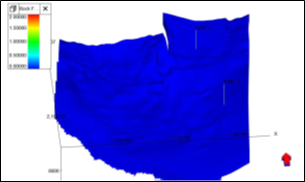
This study aims to analyze the trapping mechanisms and optimize the CO2 storage capacity (storativity) using a fully implicit integrated modeling approach. The methodology involves building a static and dynamic model of the Johansen Formation saline aquifer, and integrating well and surface facility models using the well designer and network designer features in tNavigator. A 140-year simulation was conducted, comprising 40 years of injection and 100 years of post-injection period.
Simulation results show that the “AZ” Field can store up to 83.9 Mt of CO2, predominantly through solubility/residual trapping mechanisms, in addition to structural trapping. No leakage was observed to the surface, indicating that caprock integrity remained intact throughout the simulation period. The fully implicit integrated modeling approach effectively captured the dynamic interactions between the reservoir, wells, and surface facilities, supporting the feasibility of the “AZ” Field as a safe and sustainable CO2 storage site.
Downloads
References
Ajayi, T., Gomes, J.S., Bera, A., 2019. A review of CO2 storage in geological formations emphasizing modeling, monitoring and capacity estimation approaches. Pet. Sci. 16, 1028–1063.
Bachu, S., Bonijoly, D., Bradshaw, J., Burruss, R., Holloway, S., Christensen, N.P., Mathiassen, O.M., 2007. CO2 storage capacity estimation: Methodology and gaps. Int. J. Greenh. Gas Control 1, 430–443.
Bai, M., Zhang, Z., Fu, X., 2016. A review on well integrity issues for CO2 geological storage and enhanced gas recovery. Renew. Sustain. Energy Rev. 59, 920–926.
Bakhshian, S., Bump, A.P., Pandey, S., Ni, H., Hovorka, S.D., 2023. Assessing the potential of composite confining systems for secure and long-term CO2 retention in geosequestration. Sci. Rep. 13, 1–14.
Benson, S.M., Orr, F.M., 2008. Carbon Dioxide Capture and Storage. MRS Bull. 33, 303–305.
Bergmo, P.E.S., Grimstad, A.-A., Lindeberg, E., 2011. Simultaneous CO2 injection and water production to optimise aquifer storage capacity. Int. J. Greenh. Gas Control 5, 555–564.
Bergmo, P.S., Lindeberg, E., Riis, F., Johansen, W.T., 2009. Exploring geological storage sites for CO2 from Norwegian gas power plants: Johansen formation. Energy Procedia 1, 2945–2952.
Eigestad, G.T., Dahle, H.K., Hellevang, B., Riis, F., Johansen, W.T., Øian, E., 2009. Geological modeling and simulation of CO2 injection in the Johansen formation. Comput. Geosci. 13, 435–450.
Fawad, M., Mondol, N.H., 2019. Comparison of sealing properties of Amundsen and drake formations for potential CO2 storage in North Sea. 81st EAGE Conf. Exhib. 2019 1–5.
Gibbins, J., Chalmers, H., 2008. Carbon capture and storage. Energy Policy 36, 4317–4322.
Liang, J., Rubin, B., 2014. A Semi-Implicit Approach for Integrated Reservoir and Surface-Network Simulation. SPE Reserv. Eval. Eng. 17, 559–571.
Lipponen, J., McCulloch, S., Keeling, S., Stanley, T., Berghout, N., Berly, T., 2017. The Politics of Large-scale CCS Deployment. Energy Procedia 114, 7581–7595.
Luo, R., Wang, N., 2026. Carbon emission quota allocation for 280 Chinese cities : Integrating machine learning and DEA with regional heterogeneity. Expert Syst. Appl. 296, 129036.
Mim, R.T., Negash, B.M., Jufar, S.R., Ali, F., 2023. Minireview on CO2 Storage in Deep Saline Aquifers: Methods, Opportunities, Challenges, and Perspectives. Energy & Fuels 37, 18467–18484.
Nayak, H., Yadav, S.P., Yadav, D.K., 2020.
Picha, M.S., 2024. Carbon Capture Storage (CCS) Drilling & Completion Well Integrity Lifecycle Challenges & Mitigations, in: IADC/SPE Asia Pacific Drilling Technology Conference and Exhibition.
Punnam, P.R., Sai, V., Tatavarthi, T., Surasani, V.K., 2025. Investigation of different caprock morphologies on CO 2 leakage and solubility trapping mechanism 1–15.
Rui, Z., Zeng, L., Dindoruk, B., 2025. Challenges in the Large-Scale Deployment of CCUS. Engineering 44, 17–20.
Saadatpoor, E., Bryant, S.L., Sepehrnoori, K., 2010. New Trapping Mechanism in Carbon Sequestration. Transp. Porous Media 82, 3–17.
Song, J., Zhang, D., 2013. Comprehensive Review of Caprock-Sealing Mechanisms for Geologic Carbon Sequestration. Environ. Sci. Technol. 47, 9–22.
Stokes, S., Mckay, C., Shah, D., Hegde, G., 2024. Importance of Surface-Subsurface Integration in CCS System Design, in: SPE Energy Transition Symposium.
Sundal, A., Nystuen, J.P., Rørvik, K.-L., Dypvik, H., Aagaard, P., 2016. The Lower Jurassic Johansen Formation, northern North Sea – Depositional model and reservoir characterization for CO2 storage. Mar. Pet. Geol. 77, 1376–1401.
Yoro, K.O., Daramola, M.O., 2020. Chapter 1 - CO2 emission sources, greenhouse gases, and the global warming effect, in: Rahimpour, M.R., Farsi, M., Makarem, M.A. (Eds.), Advances in Carbon Capture. Woodhead Publishing, pp. 3–28.
Downloads
Published
Issue
Section
License
Copyright (c) 2025 Journal of Geoscience, Engineering, Environment, and Technology

This work is licensed under a Creative Commons Attribution-ShareAlike 4.0 International License.
Copyright @2019. This is an open-access article distributed under the terms of the Creative Commons Attribution-ShareAlike 4.0 International License which permits unrestricted use, distribution, and reproduction in any medium. Copyrights of all materials published in JGEET are freely available without charge to users or / institution. Users are allowed to read, download, copy, distribute, search, or link to full-text articles in this journal without asking by giving appropriate credit, provide a link to the license, and indicate if changes were made. All of the remix, transform, or build upon the material must distribute the contributions under the same license as the original.