The Effect of Limestone Variations on the Compressive Strength of Clay Soil Stabilized with Pumice Microsilica and Aluminum Hydroxide
DOI:
https://doi.org/10.25299/jgeet.2026.11.1.24976Keywords:
Soil stabilization, limestone, pumice sand, aluminum hydroxideAbstract
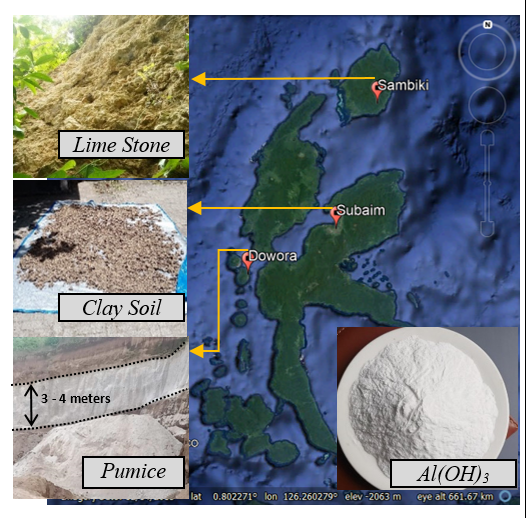
The pozzolanic reaction is a chemical interaction involving calcium hydroxide, silica, and alumina that contributes to the chemical stabilization of soil. An optimized proportion of these three components can yield greater improvements in soil strength compared to the use of a single stabilizing material. This research examines the additional effect of limestone as a calcium source on clay soil stabilized with pumice-based microsilica and hydroxide aluminate. The testing of soil properties in this research follows the American Society for Testing Materials (ASTM) guidelines. The stabilization materials used include pumice, hydroxide aluminate, and limestone. The mechanical behavior of the blend of these three minerals is determined from the findings of the unconfined compressive strength tests, using cylindrical test samples measuring 35 mm in diameter and 70 mm in height. Variations in the addition of lime used to form the mixed matrix were 2%, 4%, and 6% by weight of dry soil. Laboratory test results showed a very significant increase in unconfined compressive strength (qu) compared to natural soil or soil stabilized only with silica and alumina. The optimum value for lime addition in this mixture was 4%, which resulted in a qu value of 52.48 kg/cm².
Downloads
References
Abdulkareem, M., Havukainen, J. & Horttanainen, M., 2019. How environmentally sustainable are fibre reinforced alkali-activated concretes?. Journal of Cleaner Production, p.
Argin, G. & Uzal, B., 2022. Enhancement of pozzolanic activity of calcined clays by limestone powder addition. Construction and Building Materials, p.
Ayazhan Bazarbekova1, C.-S. S. K. A., Kim, J. R., Zhang, D. & Moon, S.-W., 2021. Potential of limestone powder to improve the stabilization of sulfate-contained saline soil. IOP Conference Series: Materials Science and Engineering
Baek, C.-S., Seo, J., Jin-Sang, C. & Kye-Hong, C., 2016. Effects of Physicochemical/Mineralogical Characteristics of Limestones and Porosity after Calcination on Desulfurization Reactivities. Journal of the Korean Ceramic Society, pp. 34-42
Barman, D. & Dash, S. K., 2022. Stabilization of expansive soils using chemical additives: A review. Journal of Rock Mechanics and Geotechnical Engineering
Bayiha, B. N. et al., 20223. Comparative study of the effects of a natural pozzolan and an artificial pozzolan on the hydraulic properties of Portland cement mortar. Global Journal of Engineering and Technology Advances, 14
Carașca, O., 2016. Soil improvement by mixing: techniques and performances. Energy Procedia , pp. 85-92.
Çimen, Ö., Saltan, M. & Keskin, S. N., 2015. Stabilization of clayey subgrade with waste pumice for road infrastructure. Science Engineering Composite Material , 22 (5, DOI : 10.1515/secm-2013-0315 ), p. 583–590.
Das, B. M., 2019. Advanced Soil Mechanics, Fifth Edition. London: CRC Press.
de Rozari, P. et al., 2021. The use of pumice amended with sand media for domestic wastewater treatment in vertical flow constructed wetlands planted with lemongrass (Cymbopogon citratus). Heliyon, 7(7,
Dodson, V., 1990. Pozzolans and the Pozzolanic Reaction in Concrete Admixture. Boston, MA: Springer.
Erdawaty, et al., 2025. A Study On Soil Bearing Capacity Strengthening Using Soil Cement On Jagebob Road With Unconfined Compression Test. Journal of Geoscience, Engineering, Environment, and Technology, 10(4,
Etim, R. K., Ekpo, D. U., Attah, I. C. & Onyelowe, K. C., 2021. Effect of micro sized quarry dust particle on the compaction and strength properties of cement stabilized lateritic soil. Cleaner Materials
Fithria, R. & Kusumastuti, D. P., 2022. The Effect of Wood Charcoal Powder and Pumice Powder on The Parameters of Shear Strength of Clay Soil. Indonesian Geotechnical Journal
Gaus, A. & Imran, 2018. Towards Eco Green Construction With Pumice Fine Aggregate Concrete. s.l., Atlantis Press.
Gaus, A., Imran, Anwar, C. & Novianti, L., 2019. Experimental Study on the Use of Pumice on the Rigid Pavement. EPI International Journal of Engineering, pp. 61-67.
Gómez, S. d. R. & F. Rojas, M., 2013. Natural pozzolans in eco-efficient concrete in Eco-efficient concrete. Cambridge: Woodhead Publishing.
Harikaran, M., Kulanthaivel, P., Gokulakannan, S. & Vinodhkumar, S., 2023. Eco-friendly soil stabilization: a combined approach using lime and waste eggshell powder.
Janz, M. &. J. S., 2002. The Function of Different Binding Agents in Deep Stabilization. s.l.:Swedish Deep Stabilization Research Centre.
Kang, I., Shin, S. & Kim, J., 2024. Optimal Limestone Content on Hydration Properties of Ordinary Portland Cement with 5% Ground Granulated Blast-Furnace Slag. Material, p.
Kimpraswil, 2002. Panduan Geoteknik 4: Pengujian tanah lunak (Pt T 09-2002-B).. Jakarta: Kimpraswil.
Liangyou, L. et al., 2016. Influence of nickel-iron slag used as admixture on cement properties. Bulletin of the Chinese ceramic society.
Mahasenan, N., Smith, S. & Humphreys, K., 2003. The Cement Industry and Global Climate ChangeCurrent and Potential Future Cement Industry CO2 Emissions. Kyoto. Japan, s.n., pp. 995-1000
McCarthy, M. J. & Dyer, T. D., 2019. Pozzolanas and Pozzolanic Materials. Lea's Chemistry of Cement and Concrete
Menéndez, E. et al., 2020. Sustainable and Durable Performance of Pozzolanic Additions to Prevent Alkali-Silica Reaction (ASR) Promoted by Aggregates with Different REaction Rates. Applied Science, doi:10.3390/app10249042, pp. 1-24.
Nugroho, S. A., Wibisono, G., Ongko, A. & Mauliza, A. Z., 2021. The Influence of High Plasticity and Expansive Clay Stabilization with Limestone on Unconfined Compression Strength. Journal of The Civil Engineering Forum, 7(2,
Nur, M. M., Kusnadi & Rauf, I., 2022. Compressive Strength Characteristics of Lightweight Concrete with Modified EPS and Pumice Sand. IJEBD, pp. 830-835.
Rashad, A. M., 2019. A short manual on natural pumice as a lightweight aggregate. Journal of Building Engineering, p.
Raveendran, N. & Vasughi, K., 2024. Synergistic effect of nano silica and metakaolin on mechanical and microstructural properties of concrete: An approach of response surface methodology. Case Studies in Construction Materials,
Siregar, F., Saputra, M. R., Gaus, A. & Rauf, I., 2024. Performance of Nickel Slag as a Stabilization Material for Soft Soil. South Asian Res J Eng Tech, 6(1), pp. 29-34.
Weise, K., Ukrainczyk, N. & Koenders, E., 2023, . Pozzolanic Reactions of Metakaolin with Calcium Hydroxide: Review on Hydrate Phase Formations and Effect of Alkali Hydroxides, Carbonates and Sulfates. Materials & Design,
Zada, U. et al., 2023. Recent advances in expansive soil stabilization using admixtures : current challenges and opportunities. Case Studies in Construction Materials
Downloads
Published
Issue
Section
License
Copyright (c) 2026 Journal of Geoscience, Engineering, Environment, and Technology

This work is licensed under a Creative Commons Attribution-ShareAlike 4.0 International License.
Copyright @2019. This is an open-access article distributed under the terms of the Creative Commons Attribution-ShareAlike 4.0 International License which permits unrestricted use, distribution, and reproduction in any medium. Copyrights of all materials published in JGEET are freely available without charge to users or / institution. Users are allowed to read, download, copy, distribute, search, or link to full-text articles in this journal without asking by giving appropriate credit, provide a link to the license, and indicate if changes were made. All of the remix, transform, or build upon the material must distribute the contributions under the same license as the original.