Architectural Element Analysis of Channel Deposits in The Cipamingkis River Section, Jatiluhur Formation
DOI:
https://doi.org/10.25299/jgeet.2026.11.1.24766Keywords:
Jatiluhur, Slope, Channel, Facies, Architectural, ElementsAbstract
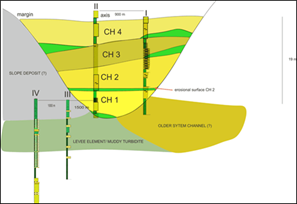
Architectural element analysis on the channel has been held with the length of the object study more than 3 kilometers in the Cipamingkis River Jatiluhur Formation. The channel deposit and association of the channel are generally influenced by the turbidity system in the slope setting. The determination of architectural elements in this study must consider the stratigraphic record, characterized by facies, facies association, internal geometry, and bounding surface. The study area has seven lithofacies and must be grouped into three facies associations. Channel elements are generally filled with coarse-grained sediment material and show amalgamation, thickened beds, and gradation of sandstone. There is fine-grained material that was found, such as siltstone, which indicates a levee element that has an older stratigraphic position than the channel element. Four-channel elements can be distinguished based on the characteristics of the constituent materials and their internal geometry. The vertical stack creates a channel complex in the study area, with channel element evolution starting from incision, and the last phase is aggradation-migration.
Downloads
References
Abdurrokhim, Ito, M., 2013. The role of slump scars in slope channel initiation: A case study from the Miocene Jatiluhur Formation in the Bogor Trough, West Java, Journal of Asian Earth Sciences 71, 68-86.
Aulia, I. & Aditiyo, R. (2021). Diagenesis study of Jatiluhur Formation at Cipamingkis River, Bogor Regency, West Java, Indonesia. Journal of Geoscience, Engineering, Environment and Technology, 6(4), pp.255–262.
Abdurrokhim, A., Adhiperdana, B. & Hendarmawan (2022). Temporal variation in sandstone composition of Miocene Jatiluhur Formation in the Bogor Trough, West Java, Indonesia. Journal of Geoscience, Engineering, Environment and Technology, 7(3), pp.132-139.
Abdurrokhim, 2014. A prograding slope-shelf succession of the middle-late Miocene Jatiluhur Formation: Sedimentology and genetic stratigraphy of mixed siliciclastic and carbonate deposits in the Logor Trough, West Java. Ph.D. Thesis, Chiba University, Japan.
Alpak, F.O., Barton, M.D., Naruk, S.J., 2013. The impact of fine-scale turbidite channel architecture on deep-water reservoir performance. Am Assoc Pet Geol Bull 97, 251–284.
Arnott, R.W.C., Hand, B.M., 1989. Bedforms, primary structures, and grain fabric in the presence of suspended sediment rain. Journal of Sedimentary Petrology, 59(6), 1062–1069.
Cantero, M.I., Cantelli, A., Pirmez, C., Balachandar, S., Mohrig, D., Hickson, T.A., Yeh, T.H., Naruse, H., Parker, G., 2012. Emplacement of massive turbidites linked to extinction of turbulence in turbidity currents. Nat Geosci 5, 42–45.
Cahyaningsih, C., Ritonga, A.L., Aldila, S. & Zulhikmah, Z. (2018). Lithofacies and depositional analysis environment of west section Kolok Nan Tuo village, Sawahlunto City, West of Sumatera. Journal of Geoscience, Engineering, Environment and Technology, 3(2), pp.128-133.
Covault, J.A., Sylvester, Z., Hubbard, S.M., Jobe, Z.R., Sech, R.P., 2016. The Stratigraphic Record of Submarine-Channel Evolution. The Sedimentary Record 14, 4–11.
Deptuck, M.E., Steffens, G.S., Barton, M., Pirmez. C., 2003. Architecture And Evolution Of Upper Fan Channel-Belts On The Niger Delta Slope And In The Arabian Sea. Marine And Petroleum Geology 20(6-8), 649-676.
Friend, P.F., 1983. Towards The Field Classification Of Alluvial Architecture Or Sequence. In: Collinson, JD, Lewin, J. (Eds.), Modern and Ancient Fluvial Systems. International Association of Sedimentologists, Special Publication 6, 345-354.
Jobe, Z.R., Lowe, D.R., Morris, W.R., 2015. Climbing-ripple successions in turbidite systems: Depositional environments, process partitioning, and stratigraphic significance. Journal of Sedimentary Research 85(7), 879-894.
Khorniawan, W.B., Jayanti, A.G.R., & Caesario, D. (2024). Quantitative Analysis of Thin Section Using Frequency Measurement (Point Counting): Case Study on Limestone of The Rajamandala Formation, Cikamuning, West Java, Indonesia. Journal of Geoscience, Engineering, Environment, and Technology, 9(3), 251–258.
Kane, I.A., Hodgson, D.M., 2011. Sedimentological criteria to differentiate submarine channel levee subenvironments: Exhumed examples from the Rosario Fm. (Upper Cretaceous) of Baja California, Mexico, and the Fort Brown Fm. (Permian), Karoo Basin, S. Africa. Mar Pet Geol 28, 807–823.
Lowe, D.R., 1982. Sediment Gravity Flows: II Depositional Models With Special Reference To The Deposits Of High-Density Turbidity Currents, SEPM: Journal of Sedimentary Research 52(1), 279-297.
Mayall, M., Jones, E., Casey, M., 2002. Turbidite channel reservoirs-Key elements in facies prediction and effective development. Marine and Petroleum Geology 1911. 111-142.
McHargue, T.R., Pyrcz, M.J. Sullivan, MD, Clark, AD, Fildani, A., Romans, B.W., Covault, J.A., Levy, M., Posamentier, H.W., Drinkwater. N.J., 2011. Architecture of turbidite channel systems on the continental slope: Patterns and predictions. Manine and Petroleum Geology 28(3), 728-743.
Miall, A.D., 1985. Architectural Element Analysis: A New Method Of Facies Analysis Applied To Fluvial Deposits. Earth-Science Reviews 22, 261-308.
Mutti, E., 1972. Turbidites of the northern Apennines: Introduction to facies analysis, International Geology Bеnеw 20(2), 125-166. International Geology Review, 20(2), 125–166.
Nurani, A., 2010. Biofacies dan biostratigrafi berdasarkan analisis foraminifera pada outcrop Sungai Cipamingkis, Kecamatan Jonggol, Kabupaten Bogor, Provinsi Jawa Barat. Undergraduate Thesis. Universitas Padjadjaran, Bandung, 106.
Schwarz, E., Arnott, R.W.C., 2007. Anatomy and evolution of a slope channel-complex set (Neoproterozoic Isaac Formation, Windermere Supergroup, southern Canadian cordillera): Implications for reservoir characterization. Journal of Sedimentary Research 77, 89–109.
Sprague, A.R., 2002. The physical stratigraphy of deep-water strata: a hierarchical approach to the analysis of genetically related elements for improved reservoir prediction. AAPG Annual Meeting Abstracts, Houston, Texas, 10-13.
Sprague, A.R., Sullivan, M.D., Campion, K.M., Jensen, G.N., Goulding, F.J., Garfield, T.R., Sickafoose, D.K., 2002. The physical stratigraphy of deep-water strata: a hierarchical approach to the analysis of genetically related stratigraphic elements for improved reservoir prediction. In: Deep-Water Reservoirs of the World, GCSSEPM Foundation 22nd Annual Research Conference, 283-313.
Sprague, A.R. et al., 2005. Integrated slope channel depositional models: the key to successful prediction of reservoir presence and quality in offshore West Africa. CIPM, 1-13.
Sari, R.A.P., Winantris, L. Fauzielly, & Ringga Jayanti, A.G. (2019). Depositional Environmental Changes of Cimanceuri Formation Based on Mollusk Fossil
Assemblages in Bayah, Banten Province. Journal of Geoscience, Engineering, Environment, and Technology, 4(2), 66-75.
Stow, D., Piper, D., 1984. Fine-Grained Sediments: Deep-Water Processes and Facies. Blackwell Scientific Publication, London. 611-646
Sudjatmiko, S. Effendi, A.C., 1998, Geological Map of the Bogor Quadrangle, Java. Geological Research and Development Centre, Bandung, Indonesia.
Sakilla Gia Mentari, Winantris, Lia Jurnaliah & Novita Iwa Anjani (2025). Depositional Environment of the Late Miocene of Lemau Formation from Bengkulu Basin Based on Palynology in Seluma, Bengkulu, Indonesia. Journal of Geoscience, Engineering, Environment, and Technology, 10(4), 549-554.
Yuskar, Y. & Choanji, T. (2017). Uniqueness deposit of sediment on floodplain resulting from lateral accretion on tropical area: study case at Kampar River, Indonesia. Journal of Geoscience, Engineering, Environment and Technology, 2(1), pp.14–19.
Yuskar, Y., Bagus Eka Putra, D. & Revanda, M. (2018). Quarternary sediment characteristics of floodplain area: study case at Kampar River, Rumbio Area and surroundings, Riau Province. Journal of Geoscience, Engineering, Environment and Technology, 3(1), pp.63–68
Downloads
Published
Issue
Section
License
Copyright (c) 2026 Journal of Geoscience, Engineering, Environment, and Technology

This work is licensed under a Creative Commons Attribution-ShareAlike 4.0 International License.
Copyright @2019. This is an open-access article distributed under the terms of the Creative Commons Attribution-ShareAlike 4.0 International License which permits unrestricted use, distribution, and reproduction in any medium. Copyrights of all materials published in JGEET are freely available without charge to users or / institution. Users are allowed to read, download, copy, distribute, search, or link to full-text articles in this journal without asking by giving appropriate credit, provide a link to the license, and indicate if changes were made. All of the remix, transform, or build upon the material must distribute the contributions under the same license as the original.