Estimation of Tsunami Arrival Time and Run-up Height Using The Cornell Multi-Grid Coupled Tsunami Model (COMCOT) at Ujung Bulu and Bira Beaches, Bulukumba Regency, Indonesia
DOI:
https://doi.org/10.25299/jgeet.2026.11.1.24759Keywords:
tsunami, COMCOT, Ujung Bulu, Bira Beach, disasterAbstract
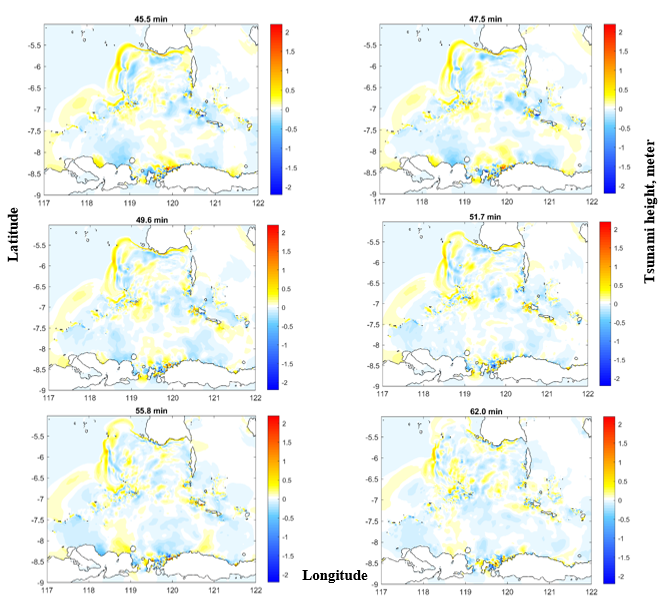
This study aims to estimate tsunami arrival times and wave heights at Ujung Bulu Beach and Bira Beach, Bulukumba Regency, using numerical simulations with the Cornell Multi-grid Coupled Tsunami Model (COMCOT). Two potential tsunamigenic earthquake scenarios were considered: the West Nusa Tenggara segment of the Flores Back-Arc Thrust (Mw 7.5) affecting Ujung Bulu District, and the eastern segment of the Selayar Fault (Mw 7.2) impacting Bira Beach in Bontobahari District.Modeling results indicate that tsunami arrival times at Ujung Bulu range from approximately 46 minutes at the coastline to 56 minutes inland, with modeled wave heights varying between 0.02 and 1.96 m. In contrast, Bira Beach experiences significantly shorter arrival times, ranging from 3 to 6 minutes, with wave heights between 0.10 and 10.00 m. The reported tsunami heights represent the maximum modeled water surface elevation above mean sea level at each location.These results highlight the near-field tsunami hazard at Bira Beach and the moderate but widespread inundation potential in Ujung Bulu District. The findings provide important implications for disaster risk reduction in Bulukumba Regency, including improvements in early warning dissemination, evacuation planning, and community preparedness. Nevertheless, the results are subject to uncertainties associated with earthquake source parameterization, bathymetric resolution, and numerical modeling assumptions.
Downloads
References
Bernard, E. N., & Titov, V. V. (2015). Evolution of tsunami warning systems and products. Philosophical Transactions of the Royal Society A: Mathematical, Physical and Engineering Sciences, 373(2053), 20140371.
BMKG. (2021). Historical tsunami database. Badan Meteorologi, Klimatologi, dan Geofisika.
BMKG. (2022). Laporan gempabumi dan peringatan dini tsunami Laut Flores 14 Desember 2021. Badan Meteorologi, Klimatologi, dan Geofisika.
BPS Bulukumba. (2023). Bulukumba in figures 2023. Badan Pusat Statistik Bulukumba.
Geospatial Information Agency of Indonesia. (2023). National digital elevation model (DEMNAS). Badan Informasi Geospasial.
Geospatial Information Agency of Indonesia. (2023). National administrative boundaries (BATNAS). Badan Informasi Geospasial.
Gusman, A. R., Tanioka, Y., Matsumoto, H., & Iwasaki, S. I. (2010). Analysis of the tsunami generated by the great 2004 Sumatra–Andaman earthquake with COMCOT. Pure and Applied Geophysics, 167, 1945–1959.
Harbitz, C. B., Løvholt, F., Pedersen, G., & Masson, D. G. (2014). Mechanisms of tsunami generation by submarine landslides: A short review. Natural Hazards and Earth System Sciences, 14(3), 571–594.
Heidarzadeh, M., Gusman, A. R., & Harada, T. (2016). Probabilistic tsunami hazard assessment for Sulawesi Island, Indonesia. Natural Hazards and Earth System Sciences, 16(7), 1573–1583.
Imamura, F., Goto, C., & Shuto, N. (1995). Numerical simulation of the 1992 Flores tsunami: Interpretation of tsunami phenomena in northeastern Flores Island and damage at Babi Island. Pure and Applied Geophysics, 144(3–4), 555–568.
Latief, H., Puspito, N. T., & Imamura, F. (2000). Tsunami catalog and zones in Indonesia. Journal of Natural Disaster Science, 22(1), 25–43.
Liu, P. L. F., Woo, S. B., & Cho, Y. S. (1998). Computer programs for tsunami propagation and inundation. Cornell University.
Løvholt, F., Pedersen, G., Harbitz, C. B., Glimsdal, S., & Kim, J. (2014). On the characteristics of landslide tsunamis. Natural Hazards and Earth System Sciences, 14(5), 1405–1430.
Monecke, K., Finger, W., Klarer, D., Kongko, W., McAdoo, B. G., Moore, A. L., & Sudrajat, S. U. (2008). A 1,000-year sediment record of tsunami recurrence in northern Sumatra. Nature, 455(7217), 1232–1234.
Newcomb, K. R., & McCann, W. R. (1987). Seismic history and seismotectonics of the Sunda Arc. Journal of Geophysical Research: Solid Earth, 92(B1), 421–439.
Pelletier, B., & Calmant, S. (2004). Geodetic observations of convergence and back-arc extension at the central New Hebrides subduction zone. Journal of Geophysical Research: Solid Earth, 109(B5).
Pusat Studi Gempa Nasional. (2017). Peta sumber dan bahaya gempa Indonesia tahun 2017. Kementerian Pekerjaan Umum dan Perumahan Rakyat.
Prasetya, G., de Lange, W. P., & Healy, T. R. (2001). The Makassar Strait tsunami of 1996: Impact on Babi Island, Flores, Indonesia. Natural Hazards, 24(3), 295–307.
Puspito, N. T., & Gunawan, E. (2005). Tsunami sources in Indonesia and their potential hazard. Journal of Disaster Research, 1(1), 15–23.
Rafliana, I., Kongko, W., & Latief, H. (2012). Community-based disaster risk reduction for tsunami early warning system in Indonesia. International Journal of Disaster Risk Reduction, 2, 72–81.
Satake, K. (1995). Linear and nonlinear computations of the 1992 Nicaragua earthquake tsunami. Pure and Applied Geophysics, 144(3–4), 455–470.
Soloviev, S. L., & Go, C. N. (1974). Catalogue of tsunamis on the western shore of the Pacific Ocean. Academy of Sciences of the USSR.
Strunz, G., et al. (2011). Tsunami risk assessment in Indonesia. Natural Hazards and Earth System Sciences, 11(1), 67–82.
Titov, V. V., & Synolakis, C. E. (1998). Numerical modeling of tidal wave runup. Journal of Waterway, Port, Coastal, and Ocean Engineering, 124(4), 157–171.
Tsuji, Y., Matsutomi, H., & Imamura, F. (1995). Damage and height distribution of the 1992 Flores Island earthquake tsunami. Pure and Applied Geophysics, 144(3–4), 481–496.
Downloads
Published
Issue
Section
License
Copyright (c) 2026 Journal of Geoscience, Engineering, Environment, and Technology

This work is licensed under a Creative Commons Attribution-ShareAlike 4.0 International License.
Copyright @2019. This is an open-access article distributed under the terms of the Creative Commons Attribution-ShareAlike 4.0 International License which permits unrestricted use, distribution, and reproduction in any medium. Copyrights of all materials published in JGEET are freely available without charge to users or / institution. Users are allowed to read, download, copy, distribute, search, or link to full-text articles in this journal without asking by giving appropriate credit, provide a link to the license, and indicate if changes were made. All of the remix, transform, or build upon the material must distribute the contributions under the same license as the original.