Integrating Hydrological Modeling and Pavement Evaluation to Analyze the Impact of Drainage Performance on Road Infrastructure
DOI:
https://doi.org/10.25299/jgeet.2025.10.4.24641Keywords:
Drainage, Pavement Condition Index, RunoffAbstract
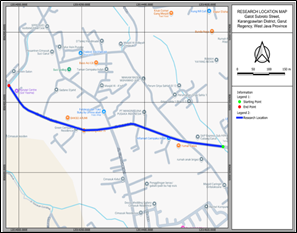
The drainage channel along Gatot Subroto Road in Karangpawitan District, Garut Regency, extends about 1,580 meters in an open rectangular form with varying cross-sectional dimensions. Reports from the Public Works and Spatial Planning Agency (UPT PUPR) indicate frequent overflow and partial malfunction, mainly due to additional inflow from residential drainage and undersized sections. These conditions contribute to recurrent flooding, disruption of community activities, and accelerated pavement deterioration. This study aims to quantify design flood discharge, assess the hydraulic capacity of the existing system, evaluate pavement condition influenced by runoff, and recommend redesigned channel dimensions using hydrological hydraulic analysis with the SWMM model. A quantitative approach was applied, integrating rainfall frequency analysis, hydraulic evaluation, and Pavement Condition Index (PCI) surveys. The results show that under a 2 year return period, most segments performed adequately, whereas at 5 and 10 year periods several sections exceeded their capacity. PCI surveys yielded an average value of 58.66, categorized as “Fair,” with critical segments falling into failure due to uncontrolled runoff. After redesign, channel performance improved substantially, with Max/Full Flow ratios consistently below 1 across all segments and return periods. The findings confirm a direct relationship between drainage performance and pavement deterioration. Integrating SWMM based modeling with PCI analysis provides a robust framework for diagnosing deficiencies and formulating technical recommendations. These results are consistent with previous studies, emphasizing that drainage adequacy and pavement condition must be addressed together to improve resilience and extend the service life of urban road infrastructure.
Downloads
References
Abegaz, R., Xu, J., Wang, F., & Huang, J. (2024). Impact of flooding events on buried infrastructures: a review. In Frontiers in Built Environment (Vol. 10). Frontiers Media SA.
Ahmed, A., Ali, S., Ahmed, A., & Khan, F. (2024). Investigating the Impact of Domestic Sewage on Asphalt Concrete Pavement Strength. Engineering, Technology and Applied Science Research, 14(2), 13617–13623.
Aprilianto, D., & Riyanto, A. (2024). Analisis Pengaruh Drainase Terhadap Kerusakan Jalan Berdasarkan Metode Pavement Condition Index dan Alternatif Solusinya.
Asdak, C. (2018). Hidrologi dan pengelolaan daerah aliran sungai (6th ed.). Yogyakarta: Gadjah Mada University Press.
ASTMD6433. (n.d.). Designation: D 6433-07 Standard Practice for Roads and Parking Lots Pavement Condition Index Surveys 1.
Feng, B., Zhang, Y., & Bourke, R. (2021). Urbanization impacts on flood risks based on urban growth data and coupled flood models. Natural Hazards, 106(1), 613–627.
Gibran, D. A., & Badriani, R. E. (2024). Analisis Kapasitas Drainase Jalan Piere Tendean Banyuwangi dengan Perangkat Lunak EPA-SWMM. Jurnal Teknik Sipil, 20(1).
Kartawijaya, S. A., Sutandi, A., & Kurniawan, V. (2021). Analisis Kapasitas Saluran Drainasedi Kecamatan Kelapa Gading (Vol. 4, Issue 2).
Naibaho, J., Alfa Lestari, M., Alfianto Akbar, S., Studi, P. S., Masyarakat, K., Kesehatan Masyarakat, F., & Widya Gama Mahakam Samarinda, U. (2024). Hubungan Pemeliharaan Drainase Terhadap Penyebab Terjadinya Banjir Pada Wilayah Kelurahan Simpang Tiga Loa Janan Ilir Kota Samarinda. In Communnity Development Journal (Vol. 5, Issue 4).
Pratama, A., Sumiharni, S., & Febrina, R. (2023). Evaluasi Sistem Drainase Menggunakan Program EPA SWMM 5.2 (Studi Kasus : Jalan Pramuka Kecamatan Rajabasa Kota Bandar Lampung). Journal of Sustainable Civil Engineering (JOSCE), 5(01).
Putri, F. K., Hidayah, E., & Ma’ruf, M. F. (2023). Enhancing stormwater management with low impact development (LID): a review of the rain barrel, bioretention, and permeable pavement applicability in Indonesia. Water Science and Technology, 87(9).
Rossman, L. A. (2015). Storm Water Management Model User’s Manual, Version 5.1. Cincinnati, OH: U.S. Environmental Protection Agency.
Shahin, M. Y. (2005). Pavement management for airports, roads, and parking lots (2nd ed.). New York: Springer.
Sia, A. A., James Betaubun, R., & Kakaly, S. (2024). Review Design Dimensi Saluran Drainase pada Jalan Negeri Lima Kecamatan Leihitu. In Jurnal Studi Multidisipliner (Vol. 8, Issue 7).
Sitohang, A., Siburian, M. T., Naibaho, R., Sitohang, O., & Sitindaon, C. (2022). Analisis Kapasitas Saluran Drainase Jalan Sisingamangraja Kota Porsea. In ATDS SAINTECH-Journal of Engineering E-ISSN (Vol. 3, Issue 1).
Suripin. (2004). Sistem drainase perkotaan yang berkelanjutan. Yogyakarta: Andi.
Triatmodjo, B. (2008). Hidraulika II. Yogyakarta: Beta Offset.
Wahyudi, M. A., Saputra, A. J., Savitri, A., & Artikel, I. (2025). Analisis Kapasitas Saluran Drainase pada Wilayah Rawan Banjir dengan Menggunakan Pemodelan Perangkat Lunak SWMM. In Jurnal Media Konstruksi (Vol. 10, Issue 1).
Widya Sari, R., Zainul Ikhwan, M., & Nur Rahmawati, A. (2024). Analisis Kinerja Saluran Drainase Desa Kalianyar Kecamatan Kapas Kabupaten Bojonegoro.
Widyasari, T., & Meigawati, I. A. (2024). Perbandingan Debit Limpasan Metode Rasional dan Pemodelan SWMM Jaringan Drainase Jalan Parangtritis KM 3,5-4,5. Publikasi Riset Orientasi Teknik Sipil (Proteksi), 6(2), 183–194.
Yayuk, F. S. (2022). Analisis Kapasitas Saluran Drainase pada Perumahan Mustika Tigaraksa Kabupaten Tangerang dengan Software HEC RAS 4.1. In Jurnal Artesis (Vol. 1, Issue 2).
Yoga Pratama, B., & Munandar, A. (2023). RekaRacana: Jurnal Teknik Sipil Validasi Perhitungan Kapasitas Saluran Drainase Menggunakan Metode Rasional Modifikasi dengan Software HEC-RAS & SWMM (Studi Kasus: Drainase Jalan Raya Bungbulang, Kabupaten Garut).
Downloads
Published
Issue
Section
License
Copyright (c) 2025 Journal of Geoscience, Engineering, Environment, and Technology

This work is licensed under a Creative Commons Attribution-ShareAlike 4.0 International License.
Copyright @2019. This is an open-access article distributed under the terms of the Creative Commons Attribution-ShareAlike 4.0 International License which permits unrestricted use, distribution, and reproduction in any medium. Copyrights of all materials published in JGEET are freely available without charge to users or / institution. Users are allowed to read, download, copy, distribute, search, or link to full-text articles in this journal without asking by giving appropriate credit, provide a link to the license, and indicate if changes were made. All of the remix, transform, or build upon the material must distribute the contributions under the same license as the original.