
Paleoenvironmental Influences Evaluation on Sedimentary Organic Matter of the Kampungbaru Formation, Lower Kutai Basin: Organic and Inorganic Geochemical Approaches
DOI:
https://doi.org/10.25299/jgeet.2025.10.4.24526Keywords:
Kampungbaru Formation, Lower Kutai Basin, Paleoenvironmental, Sedimentary Organic Matter, Upper Miocene – PlioceneAbstract
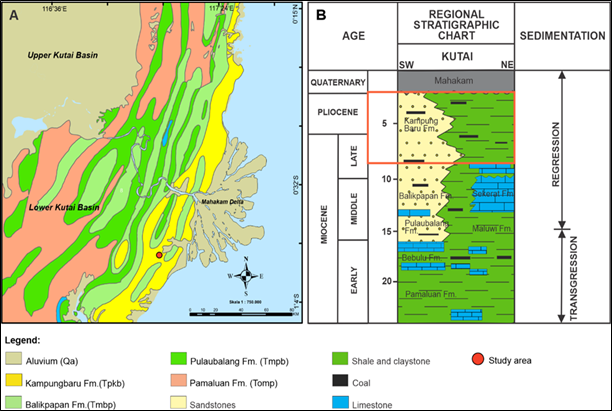
The study of paleoenvironmental influences on sedimentary organic matter has become a critical field of research, particularly in understanding the depositional conditions that control the accumulation and preservation of organic matter. In present study, Upper Miocene-Pliocene Kampungbaru Formation of the Lower Kutai Basin, Indonesia was evaluated by utilizing geochemical proxies to interpret the role of paleoclimate, paleosalinity, and paleoredox conditions on the enrichment of sedimentary organic matter. The rock unit is mostly comprised of shale, coaly shale and coal. The sediments of the Kampungbaru Formation were mostly deposited in a freshwater to brackish depositional environment, likely representing swampy or deltaic settings with transitions between weakly anoxic to oxic environments. A fluctuation between humid and arid climates with higher total organic carbon (TOC) values associated with humid conditions that enhanced the organic matter preservation. The geochemical results indicate that the analyzed samples have a TOC content between 1.50 wt.% to 43.68 wt.%, indicating a good to excellent organic matter content. Organic matter in the Kampungbaru Formation is composed of type III (gas-prone) and type II-III (mixed oil and gas prone) kerogen, with HI values ranging from 91 to 269 mg HC/g TOC. The pyrolysis Tmax of the Kampungbaru Formation range from 301 to 427 °C which indicate that sediments are thermally immature, bordering on the limit of 435ºC. The closure of the Indonesian Seaway during the Miocene-Pliocene restricted marine water exchange between the Indian and Pacific Oceans. This tectonic event likely reduced marine influence in the Lower Kutai Basin promoting freshwater-dominated depositional settings such as swamps and deltas.
Downloads
References
Afifah, P. D., and Setiawan, B., 2019. Middle Miocene Black Shale of Airbenakat Formation in Berau Areas, Jambi: are they potential source rock?. Journal of Geoscience, Engineering, Environment, and Technology, 4(2), 128.
Algeo, T.J., Liu, J., 2020. A re-assessment of elemental proxies for paleoredox analysis. Chem. Geol. 540, 119549.
Allen, J. R. L., 1970. Sediments of the modern Niger Delta, in J. P. Morgan (ed.), Deltaic Sedimentation: Modern and Ancient, Soc. Econ. Paleontologists and Mineralogists Spec. Pub. U.S.A, 15, 138–151.
Arthur, M.A., Sageman, B.B., 1994. Marine black shales: depositional mechanisms and environments of ancient deposits. Annu. Rev. Earth Planet Sci. 22 (1), 499–551.
Campbell, F.A., Williams, G.D., 1965. Chemical composition of shales of Mannville group (lower Cretaceous) of central Alberta, Canada. American Association of Petroleum Geologists Bulletin 49, 81-87.
Canfield, D. E., 1994. Factors Influencing Organic Carbon Preservation in marine Sediments. Chem. Geology 114, 315–329.
Cloke, I.R., Moss, S.J., Craig, J., 1997. The influence of basement reactivation on the extensional in inversional history of the Kutei Basin, East Kalimantan, SE Asia. Geological Society of London, 154, 157–161.
Demaison, G, J., Moore, G.T., 1980. Anoxic environments and oil source bed genesis. Organic Geochemistry 2, 9–31.
Dill, H., Teshner, M., Wehner, H., 1988. Petrography, inorganic and organic geochemistry of lower Permian Carboniferous fan sequences (Brandsschiefer Series) FRG constrains to their palaeogeography and assessment of their source rock potential. Chemical Geology 67, 307- 325
Ding, X., Liu, G., Zha, M., Huang, Z., Gao, C., Lu, X., 2015. Relationship between Total Organic Carbon Content and Sedimentation Rate in Ancient Lacustrine Sediments, a Case Study of Erlian basin, Northern China. J. Geochemical Exploration 149, 22–29.
Durand, B., Oudin, J.L., 1979. Example of hydrocarbon migration in deltaic-type series; the Mahakam delta, Kalimantan, Indonesia: 10th World Petroleum Cong. (Bucharest, Romania).
Duval, B.C., Cassaigneau, C., Choppin de Janvry, G., 1998. Impact of the petroleum system approach to exploration and appraisal efficiency in the Mahakam Delta. In Proceedings of the 26th Annual Convention , Jakarta, Indonesia, 18-20 May 1998; Indonesian Petroleum Association: Jakarta, Indonesia, 1998.
Dypvik, H., Harris, N.B., 2001. Geochemical facies analysis of fine-grained siliciclastic using Th/U, Zr/Rb and (Zr + Rb)/Sr ratios. Chem. Geol. 181, 131–146.
Emerson, S., Hedges, J.I., 1988. Processes controlling the organic carbon content of open ocean sediments. Paleoceanography 3(5), 621–634.
Espitalie, J., Deroo, G., Marquis, F., 1985. La Pyrolysis Rock-Eval Etses Applications. Oil and Gas Science and Technology (OGST) 40, 755-784.
Hu, T., Pang, X., Jiang, S., Wang, Q., Xu, T., Lu, K., Huang, C., Chen, Y., Zheng, X., 2018. Impact of paleosalinity, dilution, redox, and paleoproductivity on organic matter enrichment in a saline lacustrine rift basin: A case study of paleogene organic-rich shale in dongpu depression, bohai bay basin, eastern China. Energy Fuels 32, 5045–5061.
Jamaluddin, Wagreich, M., Gier, S., Schöpfer, K., Battu, D.P., 2023. Sedimentary Environments and Paleoclimate Control of the Middle Miocene Balikpapan Group, Lower Kutai Basin (Indonesia): Implications for Evaluation of the Hydrocarbon Potential. Minerals 13, 1259.
Jamaluddin, Schöpfer K., Wagreich, M., Maria, Gier, S., Fathy, D., 2024a. Effect of Depositional Environment and Climate on Organic Matter Enrichment in Sediments of the Upper Miocene — Pliocene Kampungbaru Formation, Lower Kutai Basin, Indonesia. Geosciences 14(6), 164.
Jamaluddin, Wagreich, M., Schöpfer, K., Sachsenhofer, R.F., Maria, Rahmawati, D., 2024b. Hydrocarbon potential and depositional environment of the Middle Miocene Balikpapan Formation, lower Kutai Basin, Indonesia: Sedimentology, calcareous nannofossil, organic geochemistry, and organic petrography integrated approach, International Journal of Coal Geology 293, 104591.
Jones, B., Manning, D.A.C., 1994. Comparison of geochemical indices used for the interpretation of palaeoredox conditions in ancient mudstones. Chem. Geol. 111 (1-4),
Kidder, D. L., Erwin, D. H., Erwin, D., Xa, H., 2001. Secular Distribution of Biogenic Silica through the Phanerozoic: Comparison of Silica-Replaced Fossils and Bedded Cherts at the Series Level. J. Geology 109, 509–522.
Lerman, A., 1978. Lakes: Chemistry, Geology, Physics; Springer: New York, NY, USA, pp. 237–289.
Li, D., Li, R., Zhu, Z., Wu, X., Liu, F., Zhao, B.; Cheng, J., Wang, B., 2018. Elemental characteristics and paleoenvironment reconstruction: a case study of the Triassic lacustrine Zhangjiatan oil shale, southern Ordos Basin, China. Acta Geochimica, 37 (1), 134–150.
Marks, E.B.. Sujatmiko, S.L., Dhanutirto, H., Ismoyowati, T., Sidik, B., 1982. Cenozoic Stratigraphic Nomenclature in East Kutai Basin, Kalimantan. In Proceedings of the 11th Annual Convention Proceedings, Jakarta, Indonesia, June 1982; Indonesian Petroleum Association: Jakarta, Indonesia.
McClay, K. R., Dooley, T., Ferguson, A., Poblet, J., 2000. Tectonic evolution of the Sanga Sanga block, Mahakam delta, Kalimantan, Indonesia. Am. Assoc. Petrol. Geol. Bull. 84, 765-786.
Moss, S.J., Chambers, J.L.C., Cloke, J.R., Satria, D., Ali, J., 1997. New observations on the sedimentary and tectonic evolution of the Tertiary Kutei Basin, East Kalimantan, Geological Society of London 1997, 126, 395–416.
Moss, S.J., Chambers, J.L.C., 1999. Tertiary facies architecture in the Kutai Basin, Kalimantan, Indonesia. Journal of Asian Earth Sciences 17, 157-181.
Murphy, A.E., Sageman, B.B., Hollander., 2000. Black shale deposition and faunal overturn in the Devonian Appalachian Basin: Clastic starvation, seasonal water-column mixing, and efficient biolimiting nutrient recycling. Paleoceanogr. Paleoclimatol. 15 (3), 280e291.
Paterson, D.W., Bachtiar, A., Bates, J.A., Moon, J.A.. Surdam, R.C., 1997. Petroleum system of the Kutei Basin, Kalimantan, In-donesia. In Proceedings of the International Conference on Petroleum Systems of SE Asia and Australasia, Jakarta, Indonesia, 21–23 May 1997 ; Indonesian Petroleum Association: Jakarta, Indonesia, 1997.
Peel, M.C., Finlayson, B.L., McMahon, T.A., 2007. Updated world map of the Köppen-Geiger climate classification. Hydrol. Earth Syst. Sci. 11, 1633–1644.
Permana, A.K., Sendjadja, Y. A., Panggabean, H., Fauxely, L., 2018. Depositional Environment and Source Rocks Potential of the Miocene Organic-Rich Sediments, Balikpapan Formation, East Kutai Sub-Basin, Kalimantan. J. Geology and Mineral Resources , 9(3), 171-186.
Permana, A.K., Kusworo, A., Wahyudiono, J., Sendjaja, Y.A., Panggabean, H., Fauziely, L., 2022. Chemostratigraphy and Paleoenvironment of the Miocene Organic Rich Sediments in the East Kutai Sub-Basin, Indonesia. Jurnal Geologi dan Sumberdaya Mineral 23(1):1-15.
Peters, K.E., 1986. Guidelines for evaluating petroleum source rock using programmed pyrolysis. Am. Assoc. Petrol. Geol. Bull. 70, 318–329.
Peters, K., Cassa, M., 1994. Applied source rock geochemistry. In: Magoon LB, Dow WG (eds) The petroleum system from source to trap, AAPG memoir 60, 93–117.
Rakocinski, M., Zaton, M., Marynowski, L., Przemysław, G., 2018. Redox conditions, productivity, and volcanic input during deposition of uppermost Jurassic and Lower Cretaceous organic-rich siltstones in Spitsbergen, Norway. Cretac. Res. 89, 126–147.
Rimmer, S.M., 2004. Geochemical paleoredox indicators in Devonian-Mississippian black shales, Central Appalachian Basin (USA). Chem. Geol. 206 (3e4), 373e391.
Roy, D. K., Roser, B. P., 2013. Climatic Control on the Composition of Carboniferous-Permian Gondwana Sediments, Khalaspir basin, Bangladesh. Gondwana Res 23, 1163–1171.
Sageman, B.B., Lyons, T.W., Joo, Y.J., 2014. Geochemistry of fine-grained, organic carbon-rich facies. In: Holland, H.D., Turekian, K.K. (Eds.), Treatise on Geochemistry 9, second ed. Elsevier, Oxford, pp. 141–179.
Sarki Yandoka, B.M., Abdullah, W. H., Abubakar, M.B., Hakimi, M.H., Adegoke, A.K., 2015. Geochemical characterisation of Early Cretaceous lacustrine sediments of Bima Formation, Yola Sub-basin, Northern Benue Trough, NE Nigeria: organic matter input, preservation, paleoenvironment and paleoclimatic conditions. Marine and Petroleum Geology 61, 82-94.
Satyana, A.H., Nugroho, D., Surontoko, I., 1999. Tectonic Controls on The Hydrocarbon Habitats of The Barito, Kutai and Tarakan basin, East Kalimantan, Indonesia: major dissimilarities in adjoining basins, J. of Asian Earth Sci. 17, 99-120.
Setyawan, R., Subroto, E. A., Sapiie, B., Condronegoro, R., & Syam, B., 2020. Geochemical and Geomechanical Study on Gumai and Talangakar Formation to Determine Potential of Shale Gas in Jambi Sub-Basin, South Sumatra Basin. Journal of Geoscience, Engineering, Environment, and Technology 5, 94–102.
Sykes, R., Snowdon, L.R., 2002. Guidelines for Assessing the Petroleum Potential of Coaly Source Rocks Using Rock-Eval Pyrolysis. Organic Geochemistry 33, 1441-1455.
Tissot, B.P., Welte, D.H., 1984. Petroleum Formation and Occurrence, 2nd ed.; Springer: Berlin/Heidelberg, Germany.
Wei, W., Algeo, T. J., 2020. Elemental proxies for paleosalinity analysis of ancient shales and mudrocks. Geochim. Cosmochim Acta 287, 341–366.
Winantris, W., Hamdani, H., Harlia, E., 2017 Paleoenvironment of Tanjung Formation Barito Basin–Central Kalimantan based on palynological data. J Geosci. Eng. Environ. Tech. 2:110–116
Xu, Q., Liu, B., Ma, Y., Song, X., Wang, Y., Chen, Z., 2017. Geological and geochemical characterization of lacustrine shale: a case study of the Jurassic Da’anzhai member shale in the central Sichuan Basin, southwest
China. J. Nat. Gas Sci. Eng. 47, 124e139.
Yin, J.T., Yu, Y.X., Jiang, C.F., Liu, J., Zhao, Q.P., Shi, P., 2017. Relationship between element geochemical characteristic and organic matter enrichment in Zhangjiatan Shale of Yanchang Formation, Ordos Basin. J. China Coal Soc. 42, 1544–1556.
Zhen, Z., Li, W., Xu, L., Wang, C., Zhao, L., 2020. Characteristics of palaeosalinity and palaeoredox records in sediment from Dali Lake: Climate change in North China from 0 to 2100 cal BP. Quaternary Geochronology 60, 101104.
Zou, C., Mao, L., Tan, Z., Zhou, L., Liu, L., 2021. Geochemistry of major and trace elements in sediments from the Lubei Plain, China: Constraints for paleoclimate, paleosalinity, and paleoredox environment. Journal of Asian Earth Sciences X, 6, 100071.
Zuo, X., Li, C., Zhang, J., Ma, G., Chen, P., 2020. Geochemical characteristics and depositional environment of the Shahejie for-mation in the Binnan Oilfield, China. J. Geophys. Eng. 17 (3), 539–551.
Downloads
Published
Issue
Section
License
Copyright (c) 2025 Journal of Geoscience, Engineering, Environment, and Technology

This work is licensed under a Creative Commons Attribution-ShareAlike 4.0 International License.
Copyright @2019. This is an open-access article distributed under the terms of the Creative Commons Attribution-ShareAlike 4.0 International License which permits unrestricted use, distribution, and reproduction in any medium. Copyrights of all materials published in JGEET are freely available without charge to users or / institution. Users are allowed to read, download, copy, distribute, search, or link to full-text articles in this journal without asking by giving appropriate credit, provide a link to the license, and indicate if changes were made. All of the remix, transform, or build upon the material must distribute the contributions under the same license as the original.


